Actualités
• Actualités | News | Neuigkeiten | Nuovo •
• Mise à jour | Updated | Aktualiziert | Aggiornamento | 15-VII-2026 •
• (die mercurii• idibus iuliis• anno Domini D• bis millesimo vicesimo sexto) •
•
•
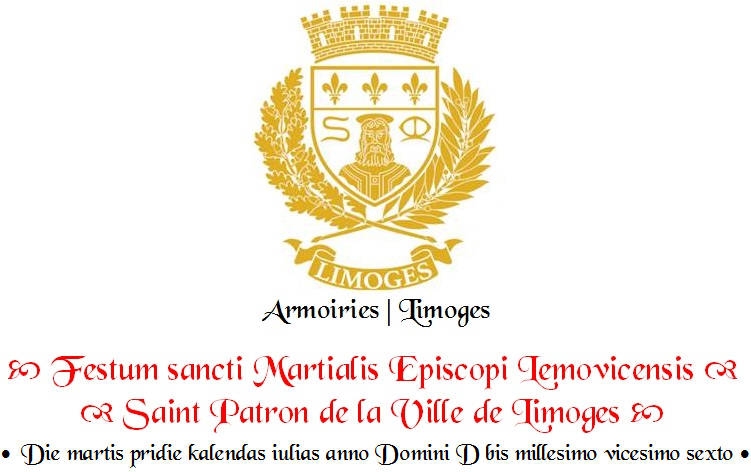
• https://www.heiligenlexikon.de//BiographienM/Martialis.html •
•
• https://www.limousin-medieval.com/ •
• https://frcitadelle.fr/blogs/blason-et-armoiries/le-blason-de-limoges-histoire-et-signification •
• https://portail.biblissima.fr/ark:/43093/cdata5b9a6479df162f04d4d2d8823893c9b3a3c3e205 •
•
• Illo-Humphrey.PhD-HDR-CNU-18.Article.Mélanges-James N. Grier.Rédaction-Finale-(n°19).30-VI-2026 •
• Illo Humphrey.Article.Festschrift-James N. Grier.Table-matières.Index-Planches.Résumés.30-VI-2026 •
•

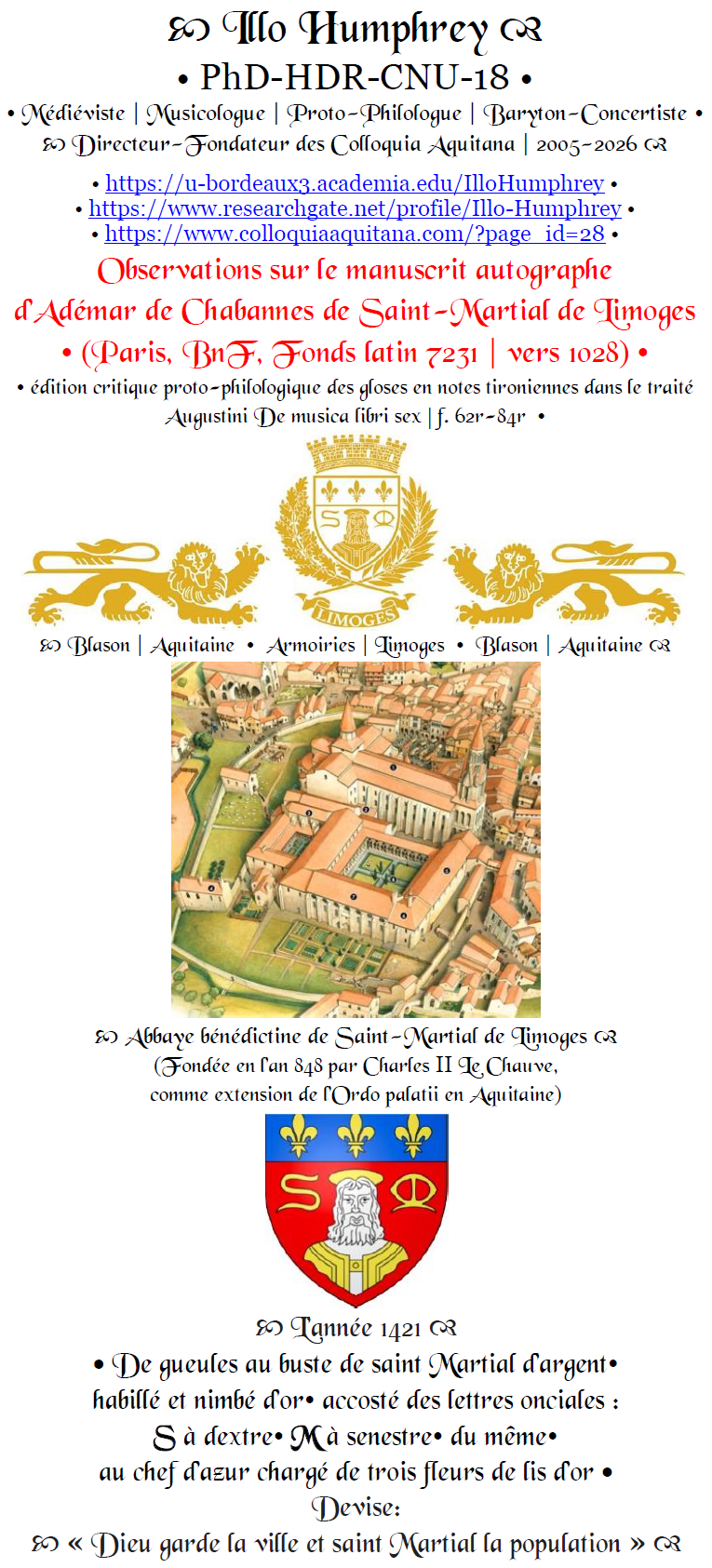
Blason | Aquitaine • Armoiries | Limoges • Blason | Aquitaine
• © Illo Humphrey | PhD-HDR-CNU-18 | Médiéviste-Musicologue-Proto-Philologue | 30-VI-2026 •
•
• Français | Résumé de synthèse •
• Observations sur le manuscrit autographe
d’Adémar de Chabannes de Saint-Martial de Limoges : Paris, BnF, Fonds latin 7231 •
• (Avec le concours précieux de Dr. Martin Hellmann, médiéviste : https://www.martinellus.de/) •
• L’Intitulé : « Observations sur le manuscrit autographe d’Adémar de Chabannes [*Chabannes, (Angoulême), vers 988-†Jérusalem, 1034] de Saint-Martial de Limoges, Paris, Bibliothèque nationale de France (Site Richelieu), Fonds latin 7231 (anciennes cotes : 1446 | 5442 | MCCCXXVIII | XIe s. : https://archivesetmanuscrits.bnf.fr/ark:/12148/cc66421x | https://gallica.bnf.fr/ark:/12148/btv1b9068428w), contenant une copie du traité Augustini De musica libri VI (f. 62r-84r), avec gloses et annotations interlinéaires et marginales en notes tironiennes aux feuillets 62r-66v (Augustini De musica : Livres I et II), et à la fin du traité au feuillet 84r (Augustini De musica : Livre VI) » •
• Nota bene (1) : Paris, BnF Fonds latin 7231 constitue le Manuscrit « H » dans l’édition critique du Augustini De musica libri sex de Martin Jacobsson, Stockholm (Almquist & Wiksell International), 2002 / Berlin (W. De Gruyter), 2017, p. 11 et 21 : https://dokumen.pub/augustinus-de-musica-3110469650-9783110469653.html •
• Résumé de synthèse : L’objectif de cette recherche est : (1) de donner une vue d’ensemble de l’évolution de la gouvernance carolingienne et postcarolingienne dans le contexte de la Tradition du savoir européenne gréco-romaine, et dans le cadre de la réforme carolingienne promulguée dans le Capitularium [XXII] de Charlemagne en 789, intitulée « Admonitio generalis », cf. Article 72 – « Sacerdotibus », mettant en évidence l’impact du style de gouvernance carolingien, soigneusement mise on pratique dans le vaste réseau de monastères et cathédrales de l’Ordo palatii en Neustria, sur la « Schola abbatialis » de l’abbaye bénédictine de Saint-Martial de Limoges entre le IXe et XIIe siècle, (2) de procéder à une édition critique des annotations en notes tironiennes conservées dans les gloses du traité Augustini De musica libri VI du manuscrit Paris, BnF, Fonds latin 7231, f. 62r-66v, 84r, (3) et, enfin, de léguer un instrument de travail précis aux futurs spécialistes et chercheurs passionnés de l’histoire de l’abbaye bénédictine de Saint-Martial de Limoges •
• Nota bene (2) : Cette étude se divise en 9 parties distinctes : (0) Prologue • (1) Capitulum I – Bilans des recherches • (2) Capitulum II – Le manuscrit Paris, BnF, Fonds latin 7231 dans le cadre de la tradition des « quattuor matheseos disciplinarum » • (3) Capitulum III – Augustini De musica libri sex • (4) Capitulum IV – Édition des gloses en notes tironiennes • (5) Capitulum V – Glossaire critique de sténographie latine (notes tironiennes) • (6) Capitulum VI – Épilogue - Observations et Conclusion • Capitulum VII – (7) Bibliographie sélective – Manuscrits | Éditions | Travaux | Archives sonores • (8) Appendice – Ad mesnam Philosophiae •
© Illo Humphrey, Mediéviste | Musicologue | Proto-Philologue | Baryton-Concertiste | PhD-HDR-CNU-18 | 30-VI-2026
• Directeur-Fondateur des Colloquia Aquitana •
• https://u-bordeaux3.academia.edu/IlloHumphrey/Papers •
• Scripsi et subscripsi •
• Die lunae• kalendis iuniis• anno Domini D •
• Numerus Aureus 13• Epactæ XI• Indictio 4• bis millesimo vicesimo sexto •
• Lundi, les calendes de juin – c’est-à-dire, le 1 juin •
• l’an de Grâce D, Nombre d’Or 13, Epacte XI, Indiction 4, 2026 •
•
• English Abstract •
Coat of arms | Aquitania • Coat of arms | Limoges • Coat of arms | Aquitania
• © Illo Humphrey | PhD-HDR-CNU-18 | Mediævalist | Musicologist | Proto-Philologist | 30-VI-2026 •
• Observations on the autograph Manuscrpit
by Adémar de Chabannes de Saint-Martial de Limoges •
(Paris, Bibliothèque nationale de France, Fonds latin 7231 | 11th c.)
• (With the Collaboration of Dr. Martin Hellmann, Mediaevalist : https://www.martinellus.de/) •
• Title: « Observations on the autograph manuscript of Ademar of Chabannes [*Chabannes, (Angoulême), around 988-†Jerusalem, 1034], Paris, Bibliothèque nationale de France (Site Richelieu), Fonds latin 7231 (origin: Saint-Martial of Limoges, 11th c.; cf. https://archivesetmanuscrits.bnf.fr/ark:/12148/cc66421x | https://gallica.bnf.fr/ark:/12148/btv1b9068428w), containing a copy of the treatise Augustini De musica libri sex (folios 62r-84r), with interlinear and marginal glosses in Latin Stenography (“tironian notes”) conserved on folios 62r-66v (Books I and II), and at the very end of the treatise on folio 84r (Book VI) •
• Nota bene (1) : Paris, BnF, Fonds latin 7231 is Manuscript « H » in the critical edition of the Augustini De musica libri sex by Martin Jacobsson, Stockholm (Almquist & Wiksell International, 2002 / Berlin (De Gruyter), 2017, p. 11 et 21 : https://dokumen.pub/augustinus-de-musica-3110469650-9783110469653.html •
• Abstract: The main objective of this research is, firstly, to provide an overall view of the development of the Carolingian and post-Carolingian civilization within the context of the Greco-Roman Tradition of Knowledge in Europe, then, to underline the impact of the Carolingian reform of the year 789 – that is to say, Charlemagne’s Capitularium [XXII] « Admonitio generalis », Article 72 – « Sacerdotibus », carefully put into practice in the vast network of monasteries and cathedrals of the Ordo palatii in Neustria, on the creation and the development of the “Schola abbatialis” of Benedictine monastery of Saint-Martial of Limoges as of 848, the year of its foundation by the future Emperor Charles II “The Bald” (*823-†877) •
• Nota bene (2) : This study is divided into 9 distinct sections: (0) Prolog • (1) Capitulum I – Research Inventory on Saint-Martial of Limoges • (2) Capitulum II – The Manuscript Paris, BnF, Fonds latin 7231 within the Framework of the « quattuor matheseos disciplinarum » • (3) Capitulum III – Augustini De musica libri sex • (4) Capitulum IV – Critical edition of the Glosses in tironian notes • (5) Capitulum V – Critical Glossary of Latin Stenography • (6) Capitulum VI – Epilog – Observations and Conclusion • (7) Capitulum VII – Selected Bibliography: Manuscripts | Editions | Studies | Audio-visual Archives • (8) Appendix – Ad mesnam Philosophiae •
• © Illo Humphrey, Mediævalist-Musicologist-Proto-Philologist-Concert-Baritone | PhD-HDR-CNU-18 | 30-VI-2026 •
• Director-Founder of the Colloquia Aquitana •
• https://u-bordeaux3.academia.edu/IlloHumphrey/Papers •
• Scripsi et subscripsi •
• Die lunae• kalendis iuniis• anno Domini D •
• Numerus Aureus 13• Epactæ XI• Indictio 4• bis millesimo vicesimo sexto •
• Monday, the Calends of June– that is to say, le 1st of June•
• Year of the Lord D, Golden Number 13, Epact XI, Indiction 4, 2026 •
•
• Deutsche Zusammenfassung •
Wappen | Aquitanien • Wappen | Limoges • Wappen | Aquitanien
• © Illo Humphrey | PhD-HDR-CNU-18 | Mediävist | Musikwissenschaftler | Proto-Philologe | 30-VI-2026 •
• Beobachtungen über die Autograph-Handschrift von Ademar von Chabannes •
(Paris, Bibliothèque nationale de France, Fonds latin 7231 | 11. Jhdt.)
• (In Zusammenarbeit mit Dr. Martin Hellmann, Mediävist : https://www.martinellus.de/) •
• Titel : « Beobachtungen über die Autograph-Handschrift von Ademar von Chabannes, [*Chabannes, (Angoulême), um 988-†Jerusalem, 1034] Paris, Bibliothèque nationale de France (Site Richelieu), Fonds latin 7231 (Ursprung: Saint-Martial von Limoges, 11. Jhdt.; cf. https://archivesetmanuscrits.bnf.fr/ark:/12148/cc66421x | https://gallica.bnf.fr/ark:/12148/btv1b9068428w), die eine Kopie des Traktats Augustini De musica libri sex (f. 62r-84r) enthält, und dessen Text im Buch I u. II (f. 62r-66v) und im Buch VI (f. 84r) von Interlinear- und Randglossen in lateinischer Stenographie („tironischen Noten”) annotiert ist •
• Nota bene (1) : Paris, BnF, Fonds latin 7231 ist die Handschrift « H » in der kritischen Ausgabe des Traktats Augustini De musica libri sex von Martin Jacobsson, Stockholm (Almquist & Wiksell International, 2002 / Berlin (De Gruyter), 2017, S. 11 und 21 : https://dokumen.pub/augustinus-de-musica-3110469650-9783110469653.html •
• Zusammenfassung : Das Hauptziel dieser Forschung ist zuerst einen klaren Überblick der Entwicklung der karolingischen Zivilisation im Zusammenhang mit der griechisch-romanischen Wissenstradition in Europa zu geben, dann die Auswirkung der karolingischen Reform von 789 – d. h. das Capitularium [XXII] von Karolus Magnus, bzw.: « Admonitio generalis », Artikel 72 – « Sacerdotibus », durch die sorgfältigen Umsetzung im sehr ausgedehnten Netzwerk der Abteien, Klöstern u. Kathedralen des Ordo palatii in Neustria, auf die “Schola abbatialis” der Benediktinerabtei Sankt-Martial von Limoges ab 848, Jahr ihrer Begründung von Karl des Kahlen, zu messen •
• Nota bene (2) : Anschließend, dieser Aufsatz wird in 9 verschieden Teilen organisiert, bzw.: (0) Prolog • (1) Capitulum I – Forschungsbilanz über Sankt-Martial von Limoges • (2) Capitulum II – Die Handschrift Paris, BnF, Fonds latin 7231 im Rahmen der « quattuor matheseos disciplinarum » • (3) Capitulum III – Augustini De musica libri sex • (4) Capitulum IV – Kritische Ausgabe der Glossen in tironischen Noten • (5) Capitulum V – Kritisches Glossar lateinischer Stenographie • (6) Capitulum VI – Epilog – Beobachtungen u. Schlussvolgerung • (7) Capitulum VII – Auswahlbibliographie – Handschriften | Kritische Ausgaben | Aufsätze | Audiovisuelle Archive • (8) Anhang – Ad mensam Philosophiae •
© Illo Humphrey, Medievist-Musikwissenschaftler-Proto-Philologe-Konzert-Bariton | PhD-HDR-CNU-18 | 30-VI-2026
• Leiter u. Begründer der Colloquia Aquitana •
• https://u-bordeaux3.academia.edu/IlloHumphrey/Colloquia%20Aquitana •
• Scripsi et subscripsi •
• Die lunae• kalendis iuniis• anno Domini D •
• Numerus Aureus 13• Epactæ XI• Indictio 4• bis millesimo vicesimo sexto •
• Montag, den Kalenden des Juni – d. h., den 1. Juni •
• Jahre des Herrn D, Goldene Zahl 13, Epakte XI, Indiktion 4, 2026 •
•
•
• Colloquia-Aquitana-XII-2-3-VIII-2025.Église-St-Pierre-de-Monbos.Fr-24240.Inscriptions.19-III-2025 •
• Colloquia-Aquitana-XII.2-3-VIII-2025.Exposition.Aliénor-d’-Aquitaine.Monbos-France.28-VII-2025 •
• Bibliographie-sélective.Colloquia-Aquitana XII.2-3-VIII-2025.Academia.edu.24-VIII-2025 •
• Prospectus.Colloquia-Aquitana-XII.2-3-VIII-2025.Eglise-St-Pierre-ès-liens-Monbos-France.3-VIII-2025 •
• Programme.Colloquia-Aquitana-XII-2025.Eglise-St-Pierre-ès-liens-Monbos-Fr.Academia.edu.26-VIII-2025 •
•
Nota bene :
• Les Colloquia Aquitana XII-2025 sont dédiés à la mémoire de
• Monsieur Francis Large •
(*1929-†2022)
et de
• Madame Marie-Louise Scheuber, née Boin •
(*1937-†2015),
tous deux enfants du pays,
tous deux ayant joué un rôle-clé dans la protection et la sauvegarde
du patrimoine culturel matériel et immatériel en Dordogne,
et en particulier celui du canton de Sigoulès-et-Flaugeac et du pays d’Eymet,
tous deux cofondateurs de l’Association des Amis de l’église Saint-Pierre-ès-liens de Monbos •
•
• Appel à contribution | Call for Papers | Aufruf für Beiträge •
(Date limite : 1er juin 2025 | Deadline: 1st of June, 2025 | Termin: 1. Juni 2025)
___________________________
• Français •
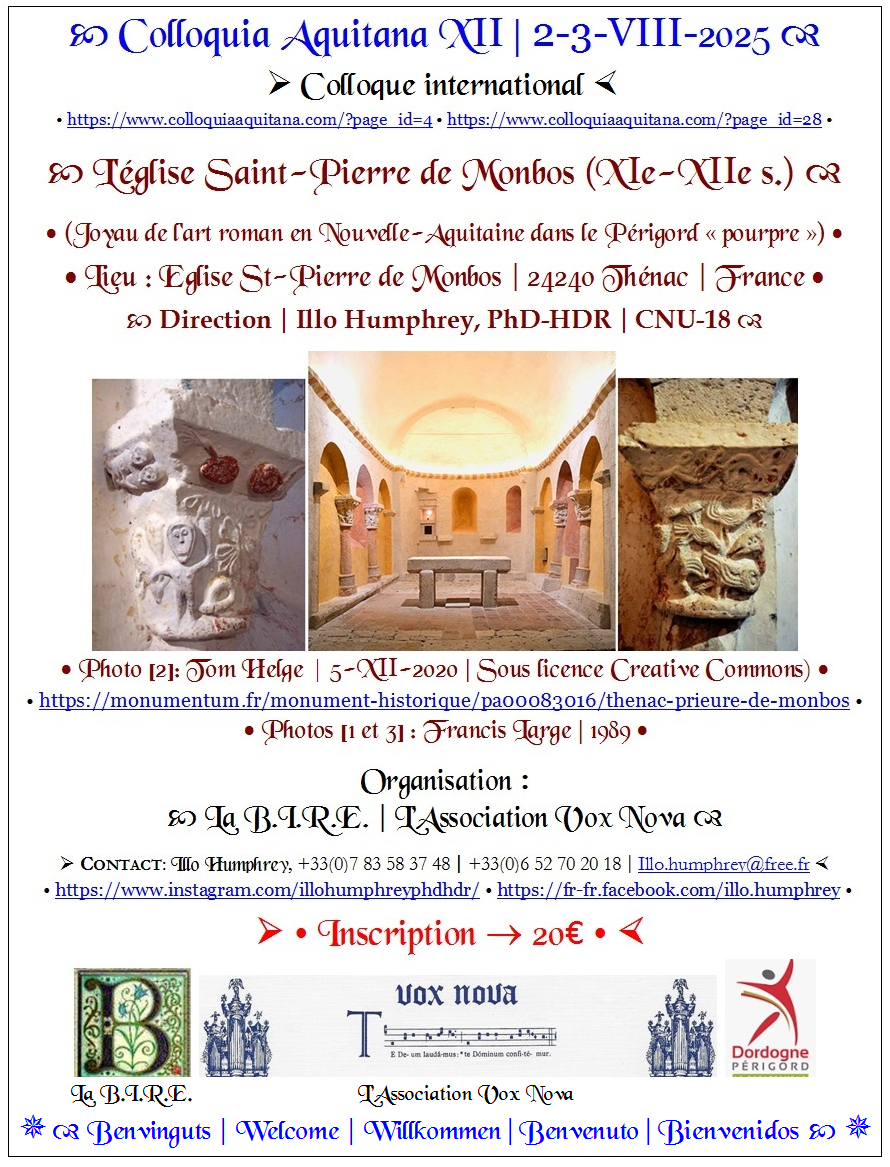
• À propos du Colloque : Ce colloque international constitue la 12e édition des Colloquia Aquitana, implantés en Nouvelle-Aquitaine depuis 2005 (https://www.colloquiaaquitana.com/?page_id=28). L’événement aura lieu les samedi 2 et dimanche 3 août 2025 en l’église Saint-Pierre-ès-liens de Monbos (architecture romane du XIe-XIIe s.), organisé conjointement par l’Association Vox Nova et l’Association La B.I.R.E. (Bibliothèque Interdisciplinaire de Recherche Européenne), présidées par Illo Humphrey, PhD-HDR, médiéviste-musicologue: CNU-Section 18 (illo.humphrey@free.fr / illohumphrey01@gmail.com), et ce sous l’égide de la commune de Monbos, avec le soutien du Conseil départemental de la Dordogne, et en partenariat avec les Archives départementales de la Dordogne •
• II s’agit d’un colloque international, intitulé Colloquia Aquitana XII-2025 | St-Pierre-ès-liens de Monbos (XIe-XIIe s.) : Joyau de l’architecture romane en Nouvelle-Aquitaine dans le Périgord « pourpre », organisé dans un beau cadre bucolique les 2 et 3 août 2025 dans l’église même de Monbos. Le village de Monbos se situe dans l’extrême sud du département de la Dordogne-Périgord dans le canton de Sigoulès-et-Flaugeac, à 16 kilomètres au sud de Bergerac et à 10 kilomètres au nord d’Eymet •
• L’objectif des Colloquia Aquitana XII-2025 est et de mettre de nouveau en relief, dans le contexte géographique de l’ancien diocèse de Sarlat, ce joyau de l’art roman qu’est l’église Saint-Pierre de Monbos, puis de réunir des intervenants et spécialistes régionaux et internationaux •
• Les thèmes transdisciplinaires sont comme suit : archivistique, héraldique, architecture, sculpture, musique, musicologie (monodie et polyphonie aquitaines), paléographie musicale, l’abbaye Saint-Martial de Limoges, organologie [facture d'instruments de musique], liturgie, spiritualité monastique, littérature et poésie occitanes, histoire de l’art, histoire politique et religieuse, culture régionale, toponymie, topographie, géographie, agriculture, etc., en rapport avec la région •
• Nota bene (1) : Le colloque sera agrémenté par des concerts de spécialistes de musique médiévale, des tables-rondes, des ateliers, etc. •
• Nota bene (2) : Comme dans les précédents Colloquia Aquitana depuis 2005, nous soulignons en particulier l’importance des valeurs culturelles fondamentales, qui sont définies dans les deux Conventions de l’UNESCO du 17-X-2003 et du 20-X-2005 (https://ich.unesco.org/doc/src/01852-FR.pdf • https://www.unesco.org/creativity/fr/2005-convention) – c‘est-à-dire, la protection et la sauvegarde du Patrimoine culturel matériel et immatériel de l’humanité dans toute sa diversité •
• Nota bene (3) : En marge du colloque, il y aura l’exposition : « Aliénor d’Aquitaine [*1122-†1204], reine des lettres occitanes », prêtée pour l’occasion par les Archives départementales de la Dordogne •
• Nota bene (4) : Les Colloquia Aquitana XII-2025 sont couverts par le contrat d’assurance GMF : U114534.001E •
•
• English •
• À propos du Colloquia Aquitana XII-2025: Continuing our commitment to the protection and the safeguard of the tangible and intangible cultural heritage of humanity, and its cultural diversity, in France and in Europe, we shall explore this year in particular the extraordinary little gem of Romanesque architecture: Église Saint-Pierre-ès-liens de Monbos (11th-12th c. | Classified as French Historical Monument in 1947: PA00083016). Monbos (Fr-24240) is a quaint and peaceful Aquitanian village situated in the southern extremity of the Dordogne-Périgord Region in France, in the district of Sigoulès-et-Flaugeac, approximately 16 kilometres south of Bergerac, and 10 kilometres north of Eymet.
• International Colloquium: The Colloquia Aquitana XII-2025 | St-Pierre de Monbos (XIe-XIIe s.) : Joyau de l’architecture romane en Nouvelle-Aquitaine dans le Périgord « pourpre » [St-Pierre of Monbos: Romanesque architectural "Gem" in New-Aquitania’s “purple” Périgord region”], is an international colloquium, which will take place on the 2nd & 3rd of August 2025, in the church of Monbos.
• Transdisciplinary Themes: In addition to the study of the Monbos Romanesque Church, we shall also explore other transdisciplinary themes, such as: archivistics, heraldry, art history (Romanesque sculpture), music, musicology (Aquitanian Monody and Polyphoniy), musical Palaeography, the Abbey Saint-Martial of Limoges, organology [the Art of making musical Instruments], liturgy, monastic spirituality, literature et Occitanian poetry, political and religious history, regional culture, toponymy, topography, geography, agriculture, etc., within the context of the Dordogne-Périgord Region. The Colloquia Aquitana XII-2025 proposes as well: mediaeval music concerts, round-table discussions, workshops, etc., with the special feature of the exhibition: « Aliénor d’Aquitaine [*1122-†1204], reine des lettres occitanes », made available by the Archives Départementales de la Dordogne •
• Nota bene (1): As in the previous Colloquia Aquitana, we maintain our focus on the importance of the fundamental values defined by the two UNESCO Conventions of 17-X-2003 and of 20-X-2005 (https://ich.unesco.org/doc/src/01852-EN.pdf • https://www.unesco.org/creativity/en/2005-convention) – that is to say, the protection and the safeguard of the tangible and intangible cultural heritage of humanity, in all its cultural diversity •
• Nota bene (2): The Colloquia Aquitana XII-2025 are organised with the support du Conseil départemental de la Dordogne, and in collaboration with the Archives départementales de la Dordogne •
• Nota bene (3): During the enitre colloquium, will be featured the exhibition « Aliénor d’Aquitaine [*1122-†1204], reine des lettres occitanes », made available by the Archives départementales de la Dordogne •
• Nota bene (4): The Colloquia Aquitana XII-2025 are covered by the Insurance Policy: GMF N° U114534.001E •
•
• Deutsch •
• Über die Colloquia Aquitana XII-2025: Fortsetzung unseres Engagements für den Schutz u. für die Sicherung des materiellen u. immateriellen Kulturerbes der Menschheit und für die kulturelle Diversität u. Vielfalt in Frankeich u. in Europa, wir erforschen dieses Jahr insbesonders das kleine „Juwel“ von romanischer Architektur, bzw.: Église Saint-Pierre-ès-liens de Monbos (11.-12. Jht | unter Denkmalschutz seit 1947: PA00083016). Das kleine Dorf von Monbos (Fr-24240) liegt im Extrem-Sud der Dordogne-Périgord-Region, ungefähr 16 Kilometer südlich von Bergerac, und etwas 10 Kilometer nordlich von Eymet •
• Internationales Kolloquium: Die « Colloquia Aquitana XII-2025 | St-Pierre de Monbos (XIe-XIIe s.) : Joyau de l’architecture romane en Nouvelle-Aquitaine dans le Périgord « pourpre » [St-Pierre von Monbos: Kleines „Juwel“ romanischer Architektur in Neu-Aquitanians Périgord pourpre”], ist eine internationale Begenung, die am 2. u. 3. August 2025 in der Kirche Saint-Pierre von Monbos stattfinden wird •
• Multidiziplinäre Themen: Neben dem Studium der romanischen Kirche von Monbos, kommen auch mehrere multidiziplinäre Themen, bzw.: Archivwissenschaft, Heraldik | Wappenkunde, romanische Architektur u. Kunstgeschichte (romanische Bildhauerei), Musik, Musikwissenschaft (aquitanische Monodie u. Polyphonie), musikalische Paläographie, die Abtei Sankt-Martial von Limoges, Organologie [Musikinstrumentenkunde], Liturgie, Klosterreform u. monastische Spiritualität, okzitanische Literatur u. Sprache, politische u. religiöse Geschichte, Regionalgeschichte, Toponymie, Topographie, Geographie, Landwirtschaft, etc., u. zw. im Rahmen der Region Dordogne-Périgord. Die Colloquia Aquitana XII-2025 bietet auch: Konzerte von mittelalterliche Musik, Rundgespräche, Werkstäte, etc. an, mit, als Bonus, einer Sonderausstellung: « Aliénor d’Aquitaine [*1122-†1204], reine des lettres occitanes », ausgeliehen von den Archives départementales de la Dordogne.
• Nota bene (1): Wie bei den vorhergehenden Colloquia Aquitana, wir halten unseren Schwerpunkt auf die grundsätzliche Werte der Kultur, die von den zwei UNESCO-Übereinkommen vom 17-X-2003 u. vom 20-X-2005 (https://ich.unesco.org/doc/src/00009-DE-Germany-PDF.pdf • https://ich.unesco.org/doc/src/00009-DE-Luxembourg-PDF.pdf) definiert wurden – d. h., der Schutz u. die Sicherung des materiellen u. immateriellen Kulturerbes der Menschheit und für die kulturelle Diversität, Vielfal u. Vielfältigkeit •
• Nota bene (2): Die Colloquia Aquitana XII-2025 werden mit der Unterstützung vom Conseil départemental de la Dordogne, und in Zusammenarbeit mit den Archives départementales de la Dordogne, organiziert •
• Nota bene (3): Während des Kolloqiums wird die Sonderausstellung « Aliénor d’Aquitaine [*1122-†1204], reine des lettres occitanes » präsentiert werden, ausgeliehen von den Archives départementales de la Dordogne.
• Nota bene (4): Alle Teilnehmer der Colloquia Aquitana XII-2025 sind vom Versichergungsvertrag GMF N° U114534.001E abgedeckt •
•
• © Illo Humphrey | Médiéviste-Musicologue | PhD-HDR | CNU-18 | scripsi et subscripsi •
• Die martis• septimo kalendas septembres• anno Domini E• bis millesimo vicesimo quinto •
• Mardi, 7e jour avant les calendes de septembre – c’est-à-dire, le 26 août, l’année de Grâce E, 2025 •
• Tuesday, 7th day before the Calends of September – that is to say, the 26th of August, Year of the Lord E, 2025 •
• Dienstag, 7 Tage vor den Kalenden des September– d. h., den 26. August, Jahr des Herrn E, 2025 •
•
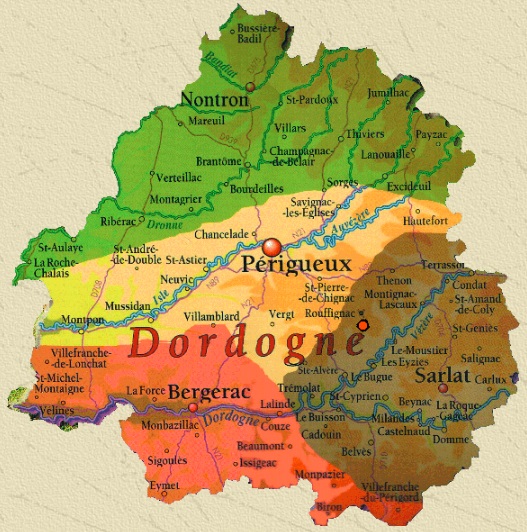
Les 4 Périgords : « Vert » | « Blanc » | « Noir » | « Pourpre »
Chef-lieu (Préfecture) : Périgueux | F-24000
•
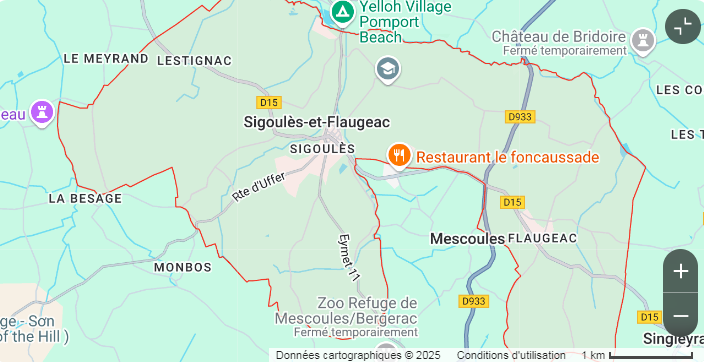
Monbos | Canton de Sigoulès-et-Flaugeac | 2025
Arrondissement (Sous-préfecture) : Bergerac | F-24100
• • •
•
• Château de Monteton | 47120 Monteton | +33(0) 7 57 77 24 40 •
• chateaudemonteton@gmail.com •
•
• Colloquia-Aquitana-XI-15-16-VII-2024.Château-de-Monteton.Fr-47120.Annonce.15-III-2024 •
• Colloquia-Aquitana-XI-15-16-VII-2024.Château-de-Monteton.Fr-47120.Affiche.4-XII-2023 •
• Bulletin-d’Inscription.Colloquia-Aquitana-XI-15-16-VII-2024.F-47120-Monteton.4-XII-2023 •
• Registration-Form.Colloquia-Aquitana-XI-15-16-VII-2024.F-47120-Monteton.15-III-2024 •
• Einschreibungsformular.Colloquia-Aquitana-XI-15.-16.-VII-2024.F-47120-Monteton.4-XII-2023 •
• Programme.Colloquia-Aquitana-XI-15-16-VII-2024.Château-de-Monteton.Fr-47120.7-VII-2024 •
• Bibliographie-sélective.Colloquia-Aquitana-XI-15-16-VII-2024.Monteton.Fr-47120.17-VII-2024 •
• Colloquia-Aquitana-XI.15-16-VII-2024.Exposition.Périgord-terre-des-troubadours.5-VIII-2024 •
• Concert.Iégor-Reznikoff-Dominique-Leconte.Colloquia-Aquitana-XI-2024.Monteton.16-VII-2024.18-h •
•
• Colloquia Aquitana XI : 15 | 16 | juillet | 2024 | Château de Monteton | 47120 France •
• Château de Monteton | +33(0) 7 57 77 24 40 | chateaudemonteton@gmail.com•
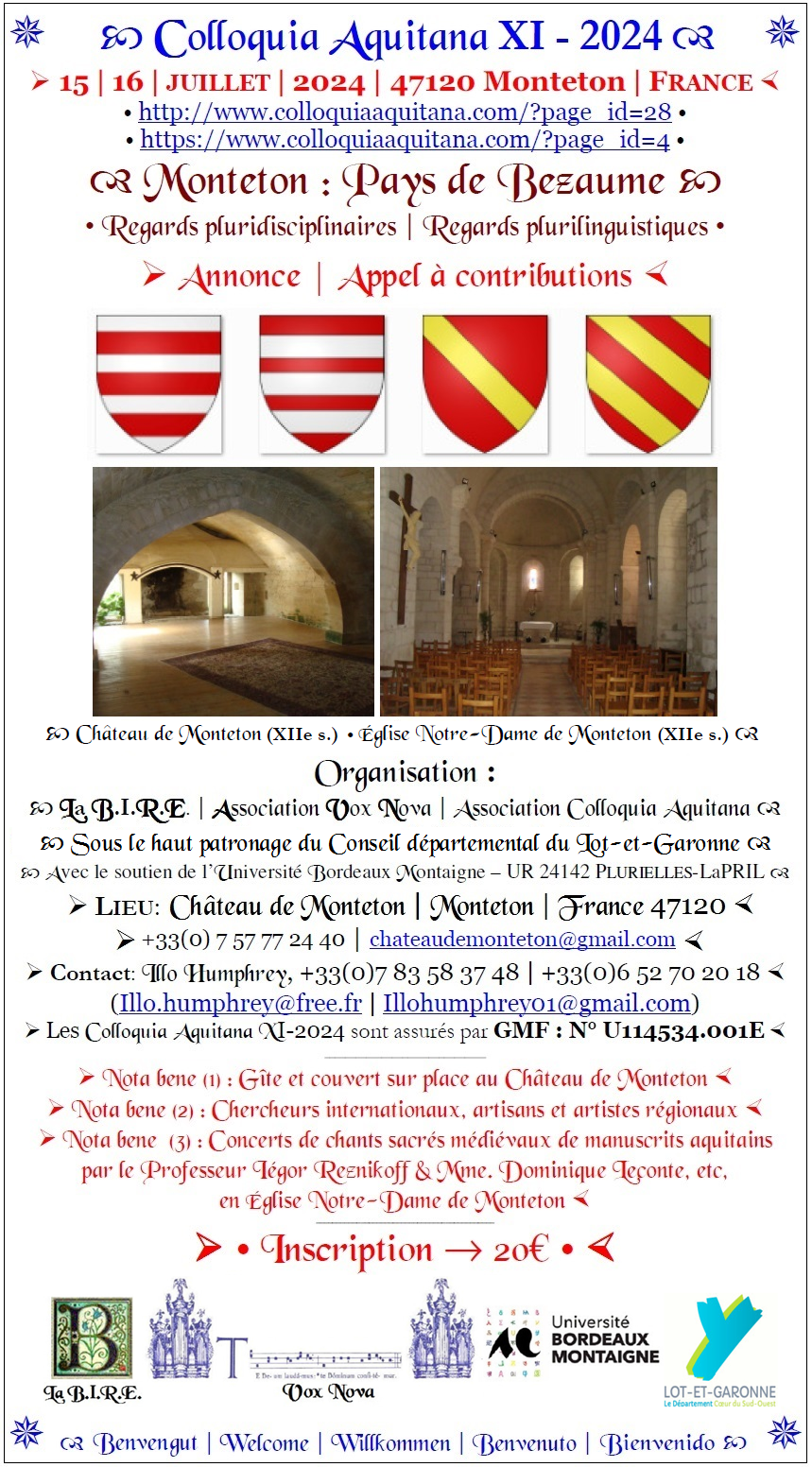
• Français : Poursuivant notre engagement dans la protection et la sauvegarde du Patrimoine culturel matériel et immatériel et dans celles de la diversité culturelle en France et en Europe, nous explorons cette année en particulier celles de Monteton et le Pays de Bezaume (pagus Beselmensis | pagus Bicelmensis | en langue vernaculaire: Bezaume, Bezalme, Vesalme, Vesaume, etc.), telles le Château de Monteton du XIIe s., l’église romane Notre-Dame de Monteton du XIIe s., l’histoire de la famille Digeon de Monteton et, peu après l’an 1685, sa branche allemande Digeon von Monteton, ainsi que l’archivistique, langue-littérature-poésie occitanes, la musique des Troubadours, la culture, etc., et ce selon les critères définis par les deux conventions de l’UNESCO du 17-X-2003 et du 20-X-2005, et nous organisons ici notre 11e rencontre des Colloquia Aquitana •
• II s’agit d’un colloque international, intitulé, Colloquia Aquitana XI-2024 | Monteton : Pays de Bezaume | Regards pluridisciplinaires | Regards plurilinguistiques, organisé les 15 et 16 juillet 2024, et accueilli sous le haut patronage de la Ville de Monteton et le Château de Monteton. Nota bene: Les Colloquia Aquitana XI-2024 sont organisés avec le soutien soutenu de l’Université Bordeaux Montaigne UR 24142 Plurielles – Laboratoire LaPRIL • Die lunae • idibus iuliis • anno Domini intercalario GF• bis millesimo vicesimo quarto• | 15-VII-2024 •
• Colloquia Aquitana XI: 15th | 16th | July | 2024 | Château de Monteton | 47120 France •
• Château de Monteton | +33(0) 7 57 77 24 40 | chateaudemonteton@gmail.com •
• English: Continuing our commitment to the protection and the safeguard of the tangible and intangible cultural heritage of humanity, and its cultural diversity, in France and in Europe, we shall explore in particular the cultural heritage of the charming Village of Monteton and the Bezaume Region (pagus Beselmensis | pagus Bicelmensis | en langue vernacular: Bezaume, Bezalme, Vesalme, Vesaume, etc.), with its 12th-c. Château of Monteton, its 12th-c. Romanesque Church Notre-Dame of Monteton, the history of the family Digeon de Monteton and, shortly after the year 1685, its German branch Digeon von Monteton, as well as: Archivistics, Occitan language-literature-poetry, Music and Poetry of Troubadours, Culture, etc., and this, according to the criteria defined by the two UNESCO conventions of the 17-X-2003 and of 20-X-2005, and we announce here the 11th Colloquia Aquitana •
• This international colloquium, entitled, Colloquia Aquitana XI-2024 | Monteton: Pays de Bezaume | Regards pluridisciplinaires | Regards plurilinguistiques, will take place on the 15th and 16th of July 2024, in the lovely mediæval village of Monteton. Nota bene: The Colloquia Aquitana XI-2024 are organised with the support of the Université Bordeaux Montaigne UR 24142 Plurielles – Research Laboratory LaPRIL • Die lunae • idibus iuliis • anno Domini GF• bis millesimo vicesimo quarto• | 15-VII-2024 •
• Colloquia Aquitana XI: 15. | 16. | Juli | 2024 | Château de Monteton | 47120 France •
• Château de Monteton | +33(0) 7 57 77 24 40 | chateaudemonteton@gmail.com •
• Deutsch: Fortsetzung unseres Engagements für den Schutz u. für die Sicherung des materiellen u. immateriellen Kulturerbes der Menschheit und für die kulturelle Diversität u. Vielfalt in Frankeich u. in Europa, wir erforschen insbesonders das Dorf von Monteton und das Land von Bezaume (pagus Beselmensis | pagus Bicelmensis | in gemeinsamer Umganssprache: Bezaume, Bezalme, Vesalme, Vesaume, usw.), sein Schloss aus dem 12. Jhdt., seine romanische Kirche Notre-Dame von Monteton aus dem 12. Jhdt., die Geschichte der franzözischen Familie Digeon de Monteton und, kurz nach dem Jahre 1685, deren deutschen Zweig, bzw.: Digeon von Monteton, sowie: Archivistics, Archivwissenschaft, Okzitanische Sprache u. Literatur, Musik der Troubadoure [Trobadore], Kultur, usw., und zwar, nach den Kriterien der zwei UNESCO-Konventionen vom 17.-10.-2003 u. vom 20.10.-2005, und wir organisieren die 11. Begegnung der Colloquia Aquitana •
• Die Colloquia Aquitana XI-2024 | Monteton: Pays de Bezaume | Regards pluridisciplinaires | Regards plurilinguistiques, sind ein internationales Kolloquium, das am 15. u. 16. Juli 2024 in dem schönen mittelalterlichen Ort von Monteton statt findet. Nota bene: Die Colloquia Aquitana XI-2024 sind organisiert mit Unterstützung von der Université Bordeaux Montaigne UR 24142 Plurielles – Forschungslabor LaPRIL • Die lunae • idibus iuliis • anno Domini intercalario GF• bis millesimo vicesimo quarto• | 15-VII-2024 •
• • •
•
• Vidéoconférence | FreeConference.com •
• Nota bene : 21-juillet-2023 | Inscriptions : 9h | Ouverture : 10h | Table ronde : 14h •
• FreeConference.com | Colloquia-Aquitana.com | illohumphrey01@gmail.com •
Connexion | Link | Verbindung:
• https://hello.freeconference.com/conf/call/8424982 •
•
• Compte-rendu.Colloquia-Aquitana-X.Histoire-du-Périgord.Eymet-France.21-22-VII-2023 •
• Programme.Colloquia-Aquitana-X-2023.Histoire-du-Périgord.Eymet.21-22-VII-2023.19-VII-2023 •
• Bibliographie-sélective.Colloquia-Aquitana-X-2023.24500-Eymet-Fr.29-VII-2023 •
• Programme-Concert.Iégor-Reznikoff.Dominique-Leconte.Colloquia-Aquitana-X-2023.Eymet.29-VII-2023 •
• Invitation.Colloquia-Aquitana-X-21-22-VII-2023.Le-Périgord.Eymet.24500.France.19-VII-2023 •
• Annonce.Colloquia-Aquitana-X-2023.21-22-VII.Le-Périgord.Eymet.24500.France.19-VII-2023-a •
• Affiche.Colloquia-Aquitana-X-21-22-VII-2023.Le-Périgord.Eymet-24500.Fr.19-VII-2023.r°-v° •
• Bulletin d’Inscription.Colloquia-Aquitana-X-2023.Eymet-en-Périgord.21-22-VII-2023 •
•
• Colloquia Aquitana X – 2023 | 21 | 22 | juillet | 2023 | 24500 Eymet | France •
• Résumé •
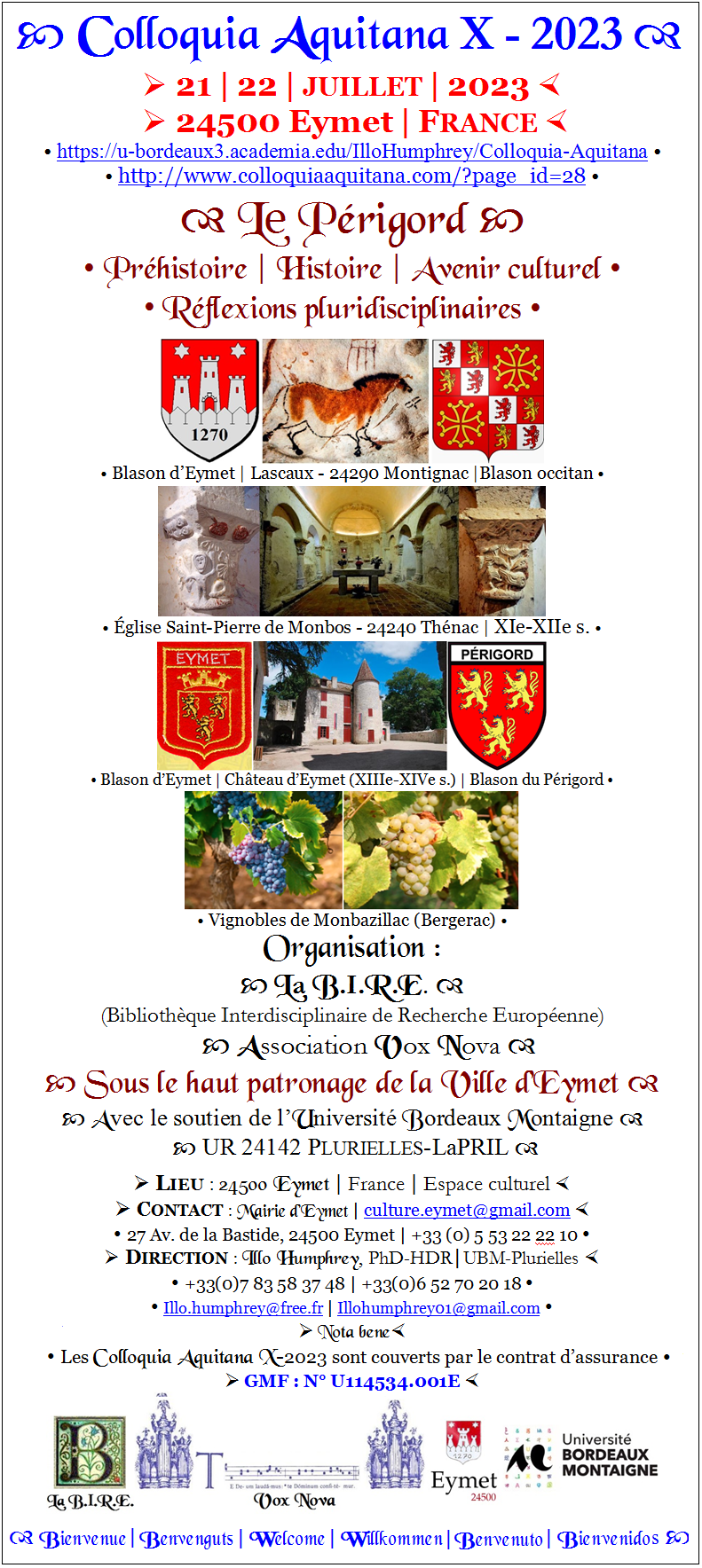
• Poursuivant notre engagement dans la protection et la sauvegarde du Patrimoine culturel matériel et immatériel et dans celles de la diversité culturelle en France et en Europe, et en particulier celles du Périgord, telles les Grottes de Lascaux et celles des Eyzies-de-Tayac-Sireuil, VESUNNA (Site-Musée archéologique gallo-romain de Périgueux), la Cathédrale Saint-Front de Périgueux (XIIe-XIXe s.), la Ville-Abbaye de Sarlat-la-Canéda (IXe s.), l’Abbaye cistercienne Notre-Dame de la Nativité de Cadouin-Le Buisson (1115), l’Église Saint-Pierre de Monbos (XIe-XIIe s. | 24240 Thénac), et la Chapelle prieurale Saint-Thomas de Tresséroux (XIIe s. | 24400 Les Lèches), les Châteaux, tels Beynac (XIIe s.), Commarque (XIIe s.), Château d’Eymet (XIIIe-XIVe s.), Château de Bannes (XIVe s.), etc., l’archivistique, langue-littérature-poésie occitanes, la musique des Troubadours, l’industrie, la culture, etc., et ce selon les critères définis par les deux conventions de l’UNESCO du 17-X-2003 et du 20-X-2005, nous organisons ici notre 10e rencontre des Colloquia Aquitana •
• II s’agit d’un colloque international, intitulé, Le Périgord : Préhistoire | Histoire | Avenir culturel | Réflexions pluridisciplinaires, organisé les 21 et 22 juillet 2023, et accueilli sous le haut patronage de la Ville d’Eymet, fondée le 28 juin 1270 par Alphonse de Poitiers (*Poissy [Fr., 78300 Yvelines], 11-XI-1220-†Sienne, [Italie, Toscane, 53100], 1271) et son épouse Jeanne de Toulouse (*Toulouse [Fr., 31000 Haute-Garonne], 1220-†Sienne, [Italie, Toscane, 53100], 1271). Nota bene: Les Colloquia Aquitana X-2023 sont organisés avec le soutien soutenu de l’Université Bordeaux Montaigne UR 24142 Plurielles – Laboratoire LaPRIL •
• © Illo Humphrey, PhD-HDR | Directeur-Fondateur des Colloquia Aquitana •
• Chercheur Associé : Université Bordeaux Montaigne-UR 24142 Plurielles – Laboratoire LaPRIL •
• https://plurielles.u-bordeaux-montaigne.fr/membres/illo-humphrey •
• Die veneris• decimo sexto kalendas iulias• anno Domini A• bis millesimo vicesimo tertio •
• Vendredi, le 16e jour avant les calendes de juillet – c’est-à-dire, le 16 juin, l’an de Grâce A, 2023 •
•
• Colloquia Aquitana X – 2023 | 21 | 22 | July | 2023 | 24500 Eymet | France •
• Abstract•
• English •
• Continuing our commitment to the protection and the safeguard of the tangible and intangible cultural heritage of humanity, and its cultural diversity, in France and in Europe, and, in particular the cultural heritage of the Périgord Region, such as: the prehistoric caves of Lascaux | the prehistoric caves of Les Eyzies-de-Tayac-Sireuil, VESUNNA (Gallo-Roman archeological site of Périgueux), the Cathedral of Saint-Front in Périgueux (12th-19th c.), the Abbey and city of Sarlat-la-Canéda (9th c.), the Cistercian Abbey Notre-Dame of the Nativity in Cadouin-Le Buisson (1115), Saint-Peter’s Church of Monbos (11th-12th c. | 24240 Thénac), Saint-Thomas Chapel of Tresséroux (12th c. | 24400 Les Lèches), the Castles of Beynac (12th c.), Commarque (12th c.), Eymet (13th-14th c.), Bannes (14th c.), etc., as well as the study of Archivistics and Heraldry, the Occitan language-literature-poetry, the Music and Poetry of Troubadours, Industry, Culture, etc., and this, according to the criteria defined by the two UNESCO conventions of the 17-X-2003 and of 20-X-2005, we announce here the Colloquia Aquitana X-2023 •
• This international colloquium, Colloquia Aquitana X-2023, entitled, Le Périgord: Préhistoire | Histoire | Avenir culturel | Réflexions pluridisciplinaires, will take place on the 21st and 22nd of July 2023, in the lovely mediæval town of Eymet, founded the 28th of June, 1270, by Alphonse of Poitiers (*Poissy, 11-XI-1220-†Sienna, 1271) and his wife Jeanne de Toulouse (*Toulouse, 1220-†Sienne, 1271). Nota bene: The Colloquia Aquitana X-2023 are organised with the support of the Université Bordeaux Montaigne UR 24142 Plurielles – Research Laboratory LaPRIL •
• © Illo Humphrey, PhD-HDR | Director-Founder of the Colloquia Aquitana •
• Research Associate | University Bordeaux Montaigne: Research Team 24142 Plurielles-Laboratory LaPRIL •
• https://plurielles.u-bordeaux-montaigne.fr/membres/illo-humphrey •
• Die veneris• decimo sexto kalendas iulias• anno Domini A• bis millesimo vicesimo tertio •
• Friday, the 16th day before the Calends of July – that is to say, the 16th of June, Year of the Lord A, 2023 •
•
• Colloquia Aquitana X – 2023 | 21. | 22. | Juli | 2023 | 24500 Eymet | France •
• Zusammenfassung •
• Deutsch •
• Fortsetzung unseres Engagements für den Schutz u. für die Sicherung des materiellen u. immateriellen Kulturerbes der Menschheit und für die kulturelle Diversität u. Vielfalt in Frankeich u. in Europa, aber insbesonders im Périgord, bzw.: die Höhle von Lascaux u. von Eyzies-de-Tayac-Sireuil, VESUNNA (Gallo-romanisches Museum von Périgueux), die Kathedrale von Saint-Front in Périgueux (12.-19. Jhdt.), die Abtei-Stadt von Sarlat-la-Canéda (9. Jhdt.), Zistersienserkloster u. Abteikirche Notre-Dame-de-la-Nativité von Cadouin-Le Buisson (1115), Sankt-Peters Kirche von Monbos (11.-12. Jhdt. | 24240 Thénac), Sankt-Thomas Kapelle von Tresséroux (12. Jhdt. | 24400 Les Lèches), Schlösser von Beynac (12. Jhdt.), Commarque (12. Jhdt.), Eymet (13.-14. Jhdt.), Bannes (14. Jhdt.), etc., Archivwissenschaft, Okzitanische Sprache u. Literatur, Musik der Troubadoure [Trobadore], Industrie, Kultur, etc., und zwar, nach den Kriterien der zwei UNESCO-Konventionen vom 17.-10.-2003 u. vom 20.10.-2005, wir organisieren die 10. Begegnung der Colloquia Aquitana •
• Die Colloquia Aquitana X-2023: Le Périgord. Préhistoire | Histoire | Avenir culturel | Réflexions pluridisciplinaires sind ein internationales Kolloquium, das am 21. u. 22. Juli 2023 in der schönen mittelalterlichen Bastidenstadt Eymet statt findet, Stadt, die am 28. Juni 1270 von Alfons von Poitiers (*Poissy, 11-XI-1220-†Sienna, 1271) und seiner Frau Jeanne von Toulouse (*Toulouse, 1220-†Sienne, 1271) gegründet wurde. Nota bene: Die Colloquia Aquitana X-2023 sind organisiert mit Unterstützung von der Université Bordeaux Montaigne UR 24142 Plurielles – Forschungslabor LaPRIL •
• © Illo Humphrey, PhD-HDR | Lieter u. Begründer der Colloquia Aquitana •
• Forscher an der Universität Bordeaux Montaigne-Forschungseinheit 24142 Plurielles – Labor LaPRIL •
• https://plurielles.u-bordeaux-montaigne.fr/membres/illo-humphrey •
• Die veneris• decimo sexto kalendas iulias• anno Domini A• bis millesimo vicesimo tertio •
• Freitag, 16. Tag vor den Kalenden des Juli – d. h., den 16. Juni, im Jahre des Herrn A, 2023 •
•
• Colloquia Aquitana X – 2023 | 21. | 22. | Juli | 2023 | 24500 Eymet | France •
• Thèmes principaux | Thèmes annexes •
• (1) Alphonse de Poitiers (*1220-†1271), frère de Louis IX, fonde la Ville d’Eymet le 28 juin 1270 • • (2) Archéologie / Site archéologique de Barbas (24100 Creysse [Bergerac]) – Pléistocène moyen [Ionien] (781000 – 126000 années avant 11700 BC) | etc. • • (3) Architecture : Église Saint-Pierre de Monbos (XIe-XIIe s. | 24240 Thénac) | etc. • • (4) Architecture : Chapelle prieurale de Tresséroux (XIIe s. | 24440 Les Lèches) | etc. • • (5) Architecture : Les Villes-Bastides (« villes nouvelles » | « villes closes » | « villes bâties de pierres ») | etc. • • (6) Archivistique-Diplomatique traditionnelles (collecte-récolement – gestion – évaluation – classement – etc.) | Sigillographie | Numismatique | etc. • • (7) Archivistique-Diplomatique numériques/digitales (collecte-récolement-gestion-évaluation-classement – etc.) • • (8) Arts plastiques et visuels | etc. • • (9) Démographie • • (10) Économie | Industrie | Élevage : bovin, ovin, avicole | etc. • • (11) Éducation (« …Humanitas eruditio institutioque in bonas artes… » [« …Humanités, érudition et les fondements du canon des 7 bons arts libéraux… »] : Aulus Gellius Noctes atticae XIII, 17) • • (12) Héraldique temporelle | Héraldique ecclésiastique | Héraldique « Emblématique » • • (13) La Ville d’Eymet (lieu stratégique aux XIIIe et XIVe s., tantôt anglais, tantôt français) • • (14) Généalogie • • (15) Histoire des institutions • • (16) Léon Dessalles (*1803-†1878) : Histoire du Périgord. Des origines au XIIIe siècle | 1883-1885/2019 • • (17) Linguistique : les « Dialectes » et « Parlers » occitans en Périgord • • (18) Littérature : Prose et Poésie • • (19) Musique | Organologie | Périgord, terres des Troubadours : https://archives.dordogne.fr/a/491/perigord-terre-des-troubadours/ | etc. • • (20) Peiregord | Terra occitana | Félibrige (Lou Felibrige | Lo Felibritge) « Félibres mainteneurs » (Felibres mantenèire) • • (21) « Les quatre Périgord » : « Noir » | « Blanc » | « Vert » | « Pourpre » • • (22) Sigillographie | Sphragistique (Sceaux | Queues de sceaux: étude-description-interprétation historiques) • • (23) Topographie : Agriculture | Botanique | Cuisine | Eaux et Forêts | Flore et Faune | Viticulture | etc. • • (24) UNESCO : Protection et sauvegarde du patrimoine matériel et immatériel (Convention- l’UNESCO, Paris, 17-X-2003 : http://www.unesco.org/culture/ich/fr/convention) • • (25) UNESCO : La sauvegarde de l’unité de la culture dans toute sa diversité (Convention-UNESCO, Paris, 20-X-2005 : http://unesdoc.unesco.org/images/0022/002253/225383F.pdf) •
•
• Colloquia Aquitana X – 2023 | 21 | 22 | juillet | 2023 | 24500 Eymet | France •
• Le Périgord. Préhistoire | Histoire | Avenir culturel | Réflexions pluridisciplinaires •
• Bibliographie sélective •
• Nota bene : This « Bibliographie-sélective » on the History of the Périgord Region in France, which accompanies the Colloquia Aquitana X-2023 : « Le Périgord. Préhistoire | Histoire | Avenir culturel | Réflexions pluridisciplinaires », is designed to open up a few windows of research and reflexion for pre-historians, specialists in archeoacoustics, historians, archivists, librarians, art historians, proto-musicologists, musicologists, linguists, proto-philologists, philologists, cultural ecologists, specialists on the protection and safeguard of the tangible and intangible cultural heritage of humanity, according to the criteria of the two UNESCO Conventions (Paris: 17-X-2003 | 20-X-2005) •
• (1) Boëda (Éric), Gonzalez (Jesus), Ibañez (Juan-Jose), Ortega-Cordellat (Maria-Iluminada), Rios (Joseva), Sellami (Farid), « Creysse – Barbas » [Site archéologique pléistocène moyen (Ionien) | 781000 à 126000 années avant 11700 BC], ADLFI. Archéologie de la France – Informations [En ligne], Aquitaine, 1-III- 2008 : https://journals.openedition.org/paleo/183 | http://journals.openedition.org/adlfi/2619 •
• (2) Cabrero-Ravel (Laurence), Cabanot (Jean), (Pon) Georges, « Une abbaye au cœur de la Gascogne, Saint-Sever (988-1791) », dans Comité d’études sur l’histoire et l’art de la Gascogne (CEHAG), 102 av. Francis Planté, 40100 Dax, 2014. Bulletin Monumental, 2016, 174 (4), p. 515-516 : https://hal.science/hal-02183167/ •
• (3) Capdeville (J.-P.), [Histoire de la Ville d’Eymet] ® Carte géologique de la France à 1/50 000 – Eymet, Éditions du BRGM | Service géologique national, Orléans, 1991 •
• (4) Cocula-Vaillières (Anne-Marie), Histoire du Périgord, Quintin Fr-22800 (Gisserot), 2019 •
• (5) Cocula-Vaillières (Anne-Marie), (éd.), Histoire de Bergerac, avec la collaboration de : M. Genty, J.-Cl. Ignace, L. Laborie, Y. Laborie, B. Lachaise, S. Maury (sous la direction de Michel Combet), Périgueux (Fanlac), 2017, 440 pages •
• (6) Dessalles (Léon) (1803-1878), Histoire du Périgord, préambule de Pierre-Lucien Bertrand, Le Bugue (Pierre-Lucien Bertrand | éditeur), 1980, 1006 pages (3 tomes en 1) •
• (7) Dessalles (Léon) (1803-1878), Histoire du Périgord. Des origines au XIIIe siècle | Tome I | Nouvelle éd. entièrement recomposée | 1 vol. (323 p.) | Initialement paru chez R. Delage et D. Joucla, Périgueux, 1883-1885 | Cressé F-17160 (Éditions des Régionalismes) | 2019 •
• (8) Dessalles (Léon) (1803-1878), Histoire du Périgord | 3 volumes (XXI-394, 461, 158 p.) | Éditeur scientifique : G. Escande (1847-1928) | Périgueux (R. Delage et D. Joucla) | 1883-1885 | 3 documents numérisés : T. 1 (2018) | Tome 2 (2012/2020) | Tome 3, 2017 •
• (9) Douais (Célestin), IV. « Charte de Louis XI en faveur de Cadouin (avril 1482) », dans Annales du Midi : revue archéologique, historique et philologique de la France méridionale, année 1896, Volume 8, n° 30, p. 205-228 •
• (10) Dufourcq (Albert), « Jean-M. Maubourguet. Le Périgord méridional des origines à l’an 1370. Étude d’histoire politique et religieuse et le cartulaire de l’abbaye de Cadouin, précédé de notes sur l’histoire économique du Périgord méridional à l’époque féodale », dans Revue d’histoire de l’Église de France, tome 12, n°57, 1926. pp. 467-472 • https://www.persee.fr/doc/rhef_0300-9505_1926_num_12_57_2410_t1_0467_0000_1 •
• (11) Falmagne (Th.), Stones (A.), Cazaux-Kowalski (C.), Zaluska (Y.), Les manuscrits de l’abbaye de Cadouin, Archives départementales de la Dordogne, Périgueux, 2015, 320 pages •
• (12) Fournioux (Bernard), [Chapelle prieurale Saint-Thomas de Tresséroux | 24400 Les Lèches] ® « Le prieuré de Tresséroux dans la commune de Les Lèches », dans Bulletin de la Société historique et archéologique du Périgord, t. CXVIII, n° 3, 1991, p. 497-501 : https://french-baroudeur.com/prieure-de-tresseroux/ •
• (13) Garrigou-Grandchamp (Pierre) : [Histoire de la Ville d’Eymet] : « L’architecture domestique des bastides périgourdines aux XIIIe et XIVe siècles », dans Congrès archéologique de France. 156e session. Monuments en Périgord. 1999, p. 47-71, Société française d’archéologie, Paris, 1999 • Demeures médiévales, cœur de la cité, Paris, R.E.M.P.ART. et Desclée de Brouwer, 1992 • La ville de Cluny et ses maisons (XIe – XVe s.), avec M. Jones, G. Meiron-Jones, J.-D. Salvèque, Paris (Picard), 1997 • Maisons de Charlieu, XIIIe – XIVe s., avec Daniel Pouly, Jean-Denis Salvèque, Charlieu, 1998 • Pierre Garrigou-Grandchamp, L’hôtel du Grand Commandement à Tours – Histoire et vie d’un monument militaire. Saint-Maixent-l’École (Point d’impression de l’Armée de terre), 2002 • Saumur, l’École de cavalerie. Une cité du cheval militaire, Monum, P. Garrigou-Grandchamp (dir.), Paris (Éditions du Patrimoine), 2005 • L’École militaire à Paris : l’art de la guerre, Flammarion, Paris, 2015 • L’église Saint-Pierre d’Auvillar : Histoire et archéologie d’un monument majeur de la Lomagne, Canens, 31310 France (Editions In extenso / Art et Culture), 2022, 105 pages •
• (14) Gérard (Vicomte Gaston de) (Membre de la Société historique du Périgord), Les Chroniques de Jean Tarde, Chanoine théologal et Vicaire Général de Sarlat : Contenant l’histoire religieuse et politique de la ville et du diocèse de Sarlat, depuis les origines jusqu’aux premières années du XVIIe siècle [édition originale], avec une introduction de Gabriel Tarde | Membre de la Société historique du Périgord, 432 pages, Paris (H. Oudin / Alphonse Picard), 1887, p. 89 (note 3) : « Aymet ou Eymet, chef-lieu de canton, arrondissement de Bergerac, ancien diocèse et sénéchaussée de Sarlat. Bastide frontière entre le Périgord et l’Agenais, fondée sur la rive gauche du Drot (sic) [auj. Le Dropt], vers le milieu du XIIIe siècle, par les officiers du comte Alphonse de Poitiers [frère du roi Louis IX, dit « Saint Louis », *Poissy, France, 78300 Yvelines, 11-XI-1220-†Sienne, Italie, Toscane, 53100, 1271]. (B. N. Manuscrit Fonds Oihémart, volumes CV et CVI.) Les titres primordiaux n’existent plus. – Les privilèges accordés par le comte de Poitiers en juin 1270 [28 juin] sont rappelés dans les lettres confirmatives du roi Philippe le Bel [*Fontainebleau, printemps 1268 - †Fontainebleau, 19 novembre 1314], du mois de novembre 1295. (B.N. Fonds Doat, tomes LXXIV et CCLVI ; – [Alcide] Curie-Seimbres, « Essais sur les [villes Fondées dans le Sud-Ouest de la France Aux XIIIe et XIVe siècles sous le nom générique des] Bastides », [dans Bibliothèque numérique de l'Ecole nationale des chartes, Paris (Edouard Privat), 1880-1881[http://bibnum.enc.sorbonne.fr/tires-a-part/045908524], page 200 ; – [Edgar] Boutaric, Saint Louis et Alphonse de Poitiers, [Paris (Plon), (1870) : [https://gallica.bnf.fr/ark:/12148/bpt6k5768525c.texteImage], p. 512 » : https://gallica.bnf.fr/ark:/12148/bpt6k5822013q.texteImage | https://gallica.bnf.fr/ark:/12148/bpt6k5822013q/f153.item.texteImage •
• Nota bene : My most sincere thanks to Manuel Lorenzo of the Archives départementales de la Dordogne for having indicated to me the historical chronicles of the Dordogne-Périgord region by Gaston de Gérard: Les Chroniques de Jean Tarde…, published in Paris by the publishing house H. Oudin / Alphonse Picard, in 1887 •
• (15) Glory (André), Delluc (Brigitte), Delluc (Gilles), Les recherches à Lascaux (1952-1963), (Éditions du CNRS | via OpenEdition), paru le 27 janvier 2022 : https://www.decitre.fr/livres/les-recherches-a-lascaux-1952-1963-9782271066114.html#resume •
• (16) Germond (Lucie), Boëda (Eric), Soriano(Sylvain), « Barbas I (Creysse, Dordogne) : Une séquence archéologique à bifaces du Pléistocène moyen », dans XVIIIe Congrès de l’UISPP, session XIV-4. À l’ombre du biface. Complexité des systèmes techniques au Pléistocène moyen en Europe, Juin 2018, Paris, France : https://hal.science/hal-02331575 •
• (17) Humphrey (Illo), Colloquia Aquitana I – 2005. Études médiévales, patrimoine matériel et immatériel, (tenus à Duras F-47120, les 5 et 6-VIII-2005), Paris (éditions Le Manuscrit-Université), 2006, 265 pages ; cf. chapitre 5 – Florence Vachia, « Les églises médiévales du canton de Sigoulès », p. 153-211 : https://u-bordeaux3.academia.edu/IlloHumphrey/Books •
• (18) Landes (Richard), Paupert (Catherine), Naissance d’Apôtre. La Vie de Saint Martial de Limoges. Un apocryphe de l’an Mil, Turnhout (Brepols), 104 pages, 1991. Compte rendu : Françoise Lautman, Archives de sciences sociales des religions, n° 78, 1992, p. 238-239 : https://www.persee.fr/doc/assr_0335-5985_1992_num_78_1_1532_t1_0238_0000_2 •
• (19) Lassaque (Aurélia), En quête d’un visage, Paris (Doucey), 2017 • Pour que chantent les salamandres, Paris (Doucey), 2013 • Cinquena Sason, Pechabou Fr-31320 (Letras d’oc), 2006 •
• (20) Le Vot (Gérard) (https://www.editionsminerve.com/catalogue/9782869311688/) :
• Vocabulaire de la musique médiévale, Minerve, Paris, 1993, 2001, 255 pages • L’Œuvre lyrique de Blondel de Nesle. Mélodies. Avec Avner Bahat, éd. Champion, Paris, 1996, 222 pages • Troubadours and Trouvères Songs, An Anthology of Poems and Melodies, avec Margaret Switten et Sam N. Rosenberg, Garland, New-York, 1998, 378 pages – Poétique du rock, oralité, voix et tumultes, Paris (Minerve), 2017, 203 pages • Les Troubadours, les chansons et leur musique (XIIe – XIIIe siècles), Minerve, Paris, 2019, 393 pages • Chansons d’amour des troubadours. Une anthologie texte et musique, Minerve, Paris, 2022, 263 pages •
• (21) Maubourguet (J.-M.), Le Périgord méridional des origines à l’an 1370, étude d’histoire politique et religieuse, (Thèse de doctorat présentée à la Faculté des Lettres de Bordeaux), Cahors (Imprimerie A. Coueslant), 1926, p. 95 •
• (22) Maubourguet (J.-M.) (éd.), Le cartulaire de l’abbaye de Cadouin, précédé de notes sur l’histoire économique du Périgord méridional à l’époque féodale, (Thèse de doctorat présentée à la Faculté des Lettres de Bordeaux), Cahors (Imprimerie A. Coueslant), 1926, LIV-112 p, voir p. 73-74 : n° CXXXIX ; cf. Paris, BnF, Fonds latin 9196 (Le cartulaire de l’abbaye de Cadouin), à partir du f. 477 ; la charte qui nous intéresse est une donation en l’an 1135 de l’église de Monbos à l’abbaye de Cadouin par Boson, comte de Grignols : https://archivesetmanuscrits.bnf.fr/ark:/12148/cc772829 • https://gallica.bnf.fr/ark:/12148/btv1b10032621t/f239.item •
• (23) Maubourguet (J.-M.), Sarlat et le Périgord méridional. Histoire politique et religieuse, Tome II : 1370-1453 | Tome III : 1453-1547, Paris, (Le Livre Libre), 1930, in-8°, 160 pages / Cressé F-17160 (Éditions des Régionalismes), 2021 ; cf. Albert Dufourcq, « Jean Maubourguet. Sarlat et le Périgord méridional », dans Revue d’histoire de l’Église de France, tome 16, n° 72, 1930. pp. 396-397 : www.persee.fr/doc/rhef_0300-9505_1930_num_16_72_2550_t1_0396_0000_1 | https://shop.vivlio.com/product/9782824056333_9782824056333_2/le-perigord-meridional-tomes-2-3-1370-1547 •
• (24) Pépin (Guilhem), Les emblèmes historiques de l’Aquitaine, www.historiweb.fr | Pdf | 2016 •
• (25) Reznikoff (Iégor), “On the Sound Related to Painted Caves and Rocks”, dans Sounds Like Theory. XII Nordic Theoretical Archaeology Group Meeting, Oulu, 25–28 avril, 2012, J. Ikäheimo et al. (éds), cf. Monographs of the Archaeological Society of Finland 2, Helsinki 2014, p.101–109 : https://paris10.academia.edu/IegorReznikoff •
• (26) Reznikoff (Iégor), « The Hal Saflieni Hypogeum: A link between Palaeolithic painted caves and Romanesque chapels? », dans Archaeoacoustics: The Archaeology of Sound, 2014 Conference in Malta, L. C. Eneix (éd.), OTS Foundation (Florida, USA), 2014, p. 45-50: https://paris10.academia.edu/IegorReznikoff •
• (27) Reznikoff (Iégor), « La dimension sonore des grottes paléolithiques et des rochers à peintures », dans L’art pléistocène dans le monde / Pleistocene art of the world / Arte pleistoceno en el mundo, CLOTTES J. (dir.), 2012, Actes du Congrès IFRAO, Tarascon-sur-Ariège, sept. 2010 – Symposium « Art pléistocène en Europe », p. cd-45 – cd-56 : https://paris10.academia.edu/IegorReznikoff •
• (28) Reznikoff (Iégor), « L’existence de signes sonores et leurs significations dans les grottes paléolithiques », dans L’art pléistocène dans le monde / Pleistocene art of the world / Arte pleistoceno en el mundo, J. Clottes (dir.), 2012, Actes du Congrès IFRAO, Tarascon-sur-Ariège, septembre 2010 – Symposium « Signes, symboles, mythes et idéologie… », p. cd-1741-cd-1747 : https://paris10.academia.edu/IegorReznikoff •
• (29) Reznikoff (Iégor), « L’existence de signes sonores et leurs significations dans les grottes paléolithiques », dans L’art pléistocène dans le monde / Pleistocene art of the world / Arte pleistoceno en el mundo, J. Clottes (dir.), 2012, Actes du Congrès IFRAO, Tarascon-sur-Ariège, septembre 2010 – Symposium « Signes, symboles, mythes et idéologie… », p. cd-1741-cd-1747 : https://paris10.academia.edu/IegorReznikoff •
• (30) Reznikoff (Iégor), « On the Sound Related to Painted Caves and Rocks », dans Sounds Like Theory. XII Nordic Theoretical Archaeology Group Meeting , Oulu, 25–28 avril, 2012, J. Ikäheimo et al. (éds), cf. Monographs of the Archaeological Society of Finland 2, Helsinki 2014, p.101–109 / Symposium on Musical Signification, Berlin ([Mouton] Walter de Gruyter, GmbH), 1995, p. 541-557 : https://www.academia.edu/98101347/On_the_sound_dimension_of_prehistoric_painted_caves_and_rocks •
• (31) Reznikoff (Iégor), Dauvois (Michel), « La dimension sonore des grottes ornées », Bulletin de la Société préhistorique française, vol. 85, n° 8, 1988, p. 238-246 •
• (32) SHAP (Société historique et archéologique du Périgord), Livre du Jubilé de Lascaux (1940-1990), Bulletin de la SHAP- Supplément, t. CXVII [117] / n° 3, publié à l’occasion des 50 ans de la découverte de Lascaux en 1940 par les 4 adolescents : Marcel Ravidat (17 ans), Jacques Marsal (15 ans), Georges Agniel (16 ans), Simon Coencas (15 ans), Périgueux, 1990, 155 p., ill. : https://archeologie.culture.gouv.fr/lascaux/fr/les-quatre-inventeurs •
• (33) Tanet (Chantal) et Hordé (Tristan), Dictionnaire des noms de lieux du Périgord, Périgueux (Fanlac), 1994, 447 pages ; cf. Mulon Marianne, « Chantal Tanet, Tristan Hordé, Dictionnaire des noms de lieux du Périgord, 1994 », dans Nouvelle revue d’onomastique, n°23-24, 1994, p. 278 : www.persee.fr/doc/onoma_0755-7752_1994_num_23_1_1204_t1_0278_0000_1 •
• (34) Vachia (Florence), « Les églises médiévales du canton de Sigoulès (Dordogne) », dans Colloquia Aquitana I-2005. Études médiévales, patrimoine matériel et immatériel, éd. Illo Humphrey, Paris (Les Éditions du Manuscrit), 2006, p. 153-211 : https://u-bordeaux3.academia.edu/IlloHumphrey/Books •
• © Illo Humphrey | PhD-HDR | Directeur-Fondateur des Colloquia Aquitana | Chercheur associé à l’Université Bordeaux Montaigne – UR 24142 Plurielles-LaPRIL | CNU-Section 18 (Musicologie) | Die dominico• decimo octavo kalendas augustas• anno Domini A• bis millesimo vicesimo tertio• (Dimanche | 29-VII-2023) •
• Bibliographie sélective supplémentaire •
• Charles Higounet (*13 janvier 1911 à Toulouse - †8 avril 1988 à Bordeaux) | historien médiéviste français spécialiste de géohistoire. Cf. L’Histoire de Bordeaux (sous la direction de Charles Higounet | 1963, 8 volumes) •
• https://fr.wikipedia.org/wiki/Bastide_(ville)#Pour_approfondir •
• https://fr.wikipedia.org/wiki/Charles_Higounet •
• Bibliographie sur les Bastides (c’est-à-dire, des villes fortifiées | ca. 1222-1373)
(https://fr.wikipedia.org/wiki/Bastide_(ville)#Pour_approfondir) :
• Higounet (Charles), « Les anciennes bastides du Sud-Ouest de la France », L’Information Historique, 1946, p. 28-35 •
• Higounet (Charles), Bastides et frontières : Le Moyen Âge, t. LIV, 1948 •
• Higounet (Charles), « La frange orientale des bastides », Annales du Midi, Toulouse, Privat, t. LXI, 1948-1949, p. 359-367 •
• Higounet (Charles), Villeneuves et bastides désertées, villages désertés et histoire économique (XI-XIIIe siècle), dans Les hommes et la terre-IX- École pratique des Hautes Études, Paris, S.E.V.P.E.N., 1965, p. 253-265.
• Higounet (Charles), « Nouvelle approche sur les bastides du Sud-ouest aquitain », Revue Urbanisme, Paris, 1967, no 101, p. 32-35 •
• Higounet (Charles), « Les villeneuves du Piémont et les bastides de Gascogne (xiie et xive siècles) », Comptes rendus de l’Acad. des Inscriptions et Belles Lettres, Paris, 1970, p. 130-139 •
• Higounet (Charles), Paysages et Villages neufs du Moyen Âge, recueil d’articles, Bordeaux, 1975, 492 pages •
• Higounet (Charles), « Les bastides en question », Revue Urbanisme, Paris, no 173-174, Paris, 1979, p. 6-10 •
• Higounet (Charles), La place dans les bastides médiévales, Plazas et sociabilité en Europe et Amérique latine, Publications de la Case de Velasquez, sér. Recherches en Sciences Sociales, Paris, fasc. VI, 1982, p. 119 •
• Higounet (Charles), Villes, sociétés et économies médiévales / Recueil d’articles de Charles Higounet, Talence, Institut d’histoire, Université de Bordeaux III, Fédération historique du Sud-Ouest, 1992, 600 p. : illustrations, couverture : illustrations en couleur, 28 cm + addendum •
•
• Die sabbato• quarto kalendas augustas• anno Domini A• bis millesimo vicesimo tertio •
• Samedi, le 4e jour avant les calendes d’août – c’est-à-dire, le 29 juillet, l’an de Grâce A, 2023 •
• Illo Humphrey, PhD-HDR | CNU : Section 18 | Musicologie •
• Médiéviste-Musicologue | Université Bordeaux Montaigne | UR 24142 Plurielles-LaPRIL •
• scripsi et subscripsi •

•
•
Bienvenue
•
Benvenguts | Welcome | Willkommen | Benvenuto | Bienvenidos
•
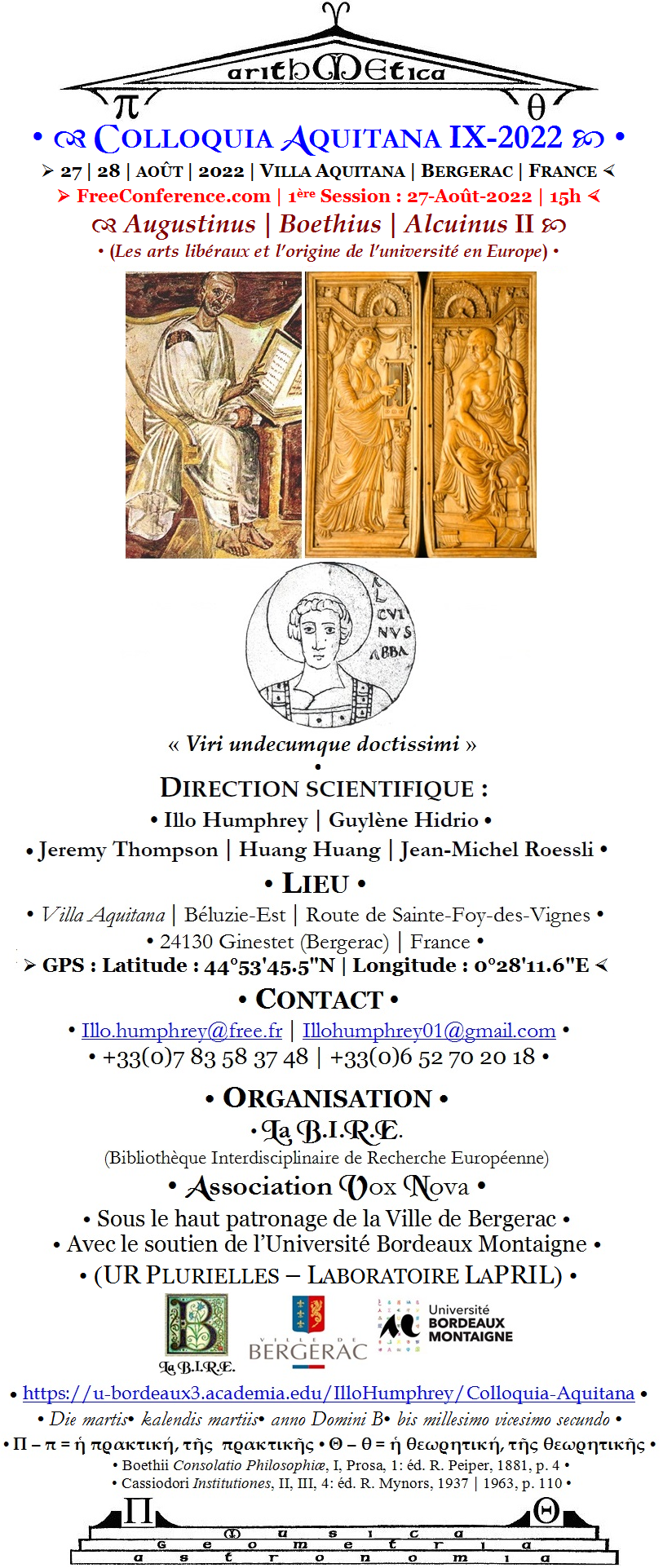
• Colloquia-Aquitana-IX-2022.Augustinus-Boethius-Alcuinus-II.Bibliographie-sélective.22-X-2023 •
• Colloquia-Aquitana-IX-2022.Augustinus-Boethius-Alcuinus-II.Table-Ronde.27-28-VIII-2022 •
• Annonce.Colloquia-Aquitana-IX.27-28-Août-2022.Augustinus-Boethius-Alcuinus-II.21-VIII-2022 •
• Affiche.Colloquia-Aquitana-IX-2022.Augustinus-Boethius-Alcuinus-II.r°-v°.27-VIII-2022 •
• Invitation.Colloquia-Aquitana-IX-27-28-août-2022.Augustunis-Boethius-Alcuinus-II.21-VIII-2022 •
•
Ø Vidéoconférence | FreeConference.com | 1ère Session : 27-Août-2022 | 15h ×
• FreeConference.com | Colloquia-Aquitana.com | illohumphrey01@gmail.com •
Connexion | Link | Verbindung:
• https://hello.freeconference.com/conf/call/8424982 •
•
Rubriques
•
• (1) À propos des Colloquia Aquitana IX – 2022 •
• (2) À propos du trio d’images sur l’affiche •
• (3) Thèmes principaux | Thèmes annexes •
• (4) Bibliographie sélective •
•
(1) À propos des Colloquia Aquitana IX – 2022
•
« Priscae recentiorisque auctoritatis viros et feminas eximios
ad mensam Philosophiae recte consederunt Augustinus Boethius Alcuinusque inter omnes•
Docendi discendi et bibendi substantiam septem matheseon disciplinarum•
παιδεία humanitatem eruditionem institutionemque in bonas artes• »
• (© Illo Humphrey | Carmen philosophicum XII) •
• Die martis• idibus septembribus• anno Domini B• bis millesimo vicesimo secundo •
• (13-IX-2022) •
•
• Colloquia Aquitana IX – 2022: Les Colloquia Aquitana IX – 2022, intitulés « Augustinus | Boethius | Alcuinus II: Les arts libéraux et l’Origine de l’Université en Europe », auront lieu les 27 | 28 | août 2022 dans le sud-ouest de la France à Bergerac, dans le département de la Dordogne-Périgord. La rencontre est organisée par La B.I.R.E. (Bibliothèque Interdisciplinaire de Recherche Européenne), et par l’Association Vox Nova sous le haut patronage de la Ville de Bergerac et avec le soutien de l’Université Bordeaux Montaigne: Unité de Recherche 24142 Plurielles-Laboratoire LaPRIL | 33607 Pessac.
• Direction: Les Colloquia Aquitana IX – 2022 sont organisés sous la direction de: Illo Humphrey, Médiéviste | Musicologue | Proto-Philologue (Université Bordeaux Montaigne: UR 24142 Plurielles – Laboratoire LaPRIL), Guylène Hidrio, Médiéviste | Historienne d’art (Université Lille 3: IRHiS-GRIM-CNRS), Jeremy Thompson, Médiéviste | Historien | Latiniste (Friedrich-Alexander Universität Erlangen-Nürnberg) | Huang Huang, Musicologue | Médiéviste (University of Western Ontario) | Jean-Michel Roessli, Professeur de l’Histoire du Christianisme (Université Concordia, Montréal, Canada).
• Objectif: L’objectif des Colloquia Aquitana IX – 2022 est d’approfondir le thème des Colloquia Aquitana VIII-2021, toujours à travers le puissant trio : Aurelius Augustinus | Anicius Manlius [Torquatus] Severinus Boethius | Alcuinus Euboricensis, l’histoire fascinante de l’évolution du système d’éducation en Europe entre le Ve et le XIVe s. Une partie du colloque sera consacré, comme il se doit, au célèbre Capitularium XXII de Charlemagne, promulgué en 789, l’Admontio generalis (§1-82 | cf. §72, Sacerdotibus: cf. https://www.colloquiaaquitana.com/?page_id=754 | Bibliographie I), et à l’influence qu’a exercé cette législation, rédigée semble-t-il par Alcuin, d’abord sur l’Ordo palatii (réseau royal carolingien de monastères, cathédrales, avec leurs scriptoria, leurs banques de savoir – c’est-à-dire, leurs bibliothèques, et leurs écoles respectives, en territoire de Neustria), puis, à partir du 25 décembre, l’an 800, sur l’éducation et la culture générale de l’empire carolingien et sur l’Europe dans son ensemble.
• En effet, l’Admonitio generalis joua un rôle déterminant sur les origines des Scholae palatinae à Urbs aquensis, urbs regalis / Aquisgrana (Aix-la-Chapelle), et à Urbs laudunensis (Laon), ainsi que sur celles des écoles monastiques (« scholae monatsicae » | « claustrales »), et des écoles cathédrales (« scholae canonicae | « externae » | « écoles canoniales ») précarolingiennes, carolingiennes et postcarolingiennes, notamment: à York (Euboricum / Ecclesia et Schola Euboricensis) | Aix-la-Chapelle (Aquisgrana / Urbs aquensis, urbs regalis / Sancti Cornelii ad Indam / Kornelimünster) | Saint-Amand-en-Pévèle (Monasterium Elnonense) | Saint-Pierre de Corbie (Corbeia / Monasterium Sancti Petri Corbeiensis) | Saint-Riquier (Centula / Monasterium Centulense / Monasterium Sancti Richarii) | Saint-Bertin de Sithiu – Saint-Omer (Sithium / Audomaropolis / Monasterium Sithiense seu Sancti Bertini apud Audomaropolim Artesiae) | Saint-Corneille-et-Saint-Cyprien de Compiègne (Compendium / Monasterium Sancti Cornelii [et Sancti Cypriani] Comendiensis) | Notre-Dame de Chelles (Cala / Calensis Ecclesia Parisiacae urbis) | Saint-Denis-en-France (Monasterium Sancti Dionysii) | Saint-Germain-des-Prés (Sancti Germani de Prate) | Saint-Benoît-sur-Loire / Fleury-sur-Loire (Floriacum / Monasterium Sancti Benedicti Floriacensis) | Saint-Pierre-et-Saint-Paul de Ferrières-en-Gâtinais (Monasterium Sancti Petri [et Sancti Pauli] Ferrariensis) | Saint-Germain d’Auxerre (Autissiodorum / Autesiodurum / Monasterium Sancti Germani Autissiodorensis) | Saint-Martin de Tours (Civitas Turonorum / Monasterium Sancti Martini Turonensis) | Sainte-Marie et Saint-Jean de Laon (Alaudanum / Lugdunum Clavatum / Monasterium [Beatae Mariae et] Sacnti Iohannis Laudunensis) | Saint-Rémi de Reims (Durocortorum / Civitas Remorum / Monasterium Sancti Remigii Remensis) | Saint-Pierre d’Hautvillers (Monasterium Sancti Petri Altivillaris) | Metz (Monasterium Sancti Arnulfi Metensis) | Reichenau (Augia insula), en Allemagne sur le Lac de Constance | Fulda | Lorsch (Laureshamense Monasterium / Laurissa / etc.) | Corvey (Monasterium Corbeiae novae) | Sankt Gallen (Monasterium Sancti Galli / Monasterium Sangallensis) | Chartres (Civitas Carnotum / Ecclesia et Schola Carnotensis) | etc., ainsi que sur les maîtres du Xe s. (Notker le Bègue | Hrotsvita von Gandersheim | Abbon de Fleury | Gerbert d’Aurillac | etc.), et du XIe s. (Guido d’Arezzo | Fulbert de Chartres | Anselmo d’Aosta [de Cantorbéry] | etc.).
• À partir du XIIe s., avec l’expansion des villes et la « révolution des écoles urbaines » (N-D de Paris | Saint-Victor de Paris | Sainte-Geneviève de Paris), on observe, grâce au précieux témoignage de Guibert de Nogent (*1053-†1125), le début d’une véritable explosion de savoir pluridisciplinaire propagé par les maîtres, tels que: Abélard | Hugues de Saint-Victor | Bernard de Chartres | Guillaume de Conches | Thierry de Chartres | Gilbert de la Porrée (Gilbert de Poitiers) | Jean de Salisbury | Herrad von Landsberg | Graziano da Chiusi | Pierre Lombard | Hildegarde von Bingen | Gherardo da Cremona | Pierre le Chantre | etc. Puis, à ces maîtres, s’ajoutent Alhazen (Abū ʿAlī al-Ḥasan ibn al-Ḥasan ibn al-Haytham أبو علي، الحسن بن الحسن بن الهيثم, *Bassora, Iraq, c. 965 – †Le Caire, Égypte, vers 1040) | Avicenne (ابن سينا: AbūʿAlī al-ḤusaynʿAlī Ibn Sīnā, *Boukhara, 980-†Hamadan, 1037) | Ibn Butlân (ابن بطلان), médecin irakien nestorien (*1001-†Bagdad, 1066), auteur du traité Taqwīm eṣ-ṣiḥḥa تقويم الصحة « La préservation de la santé » ou « Tables de santé » Tacuinum sanitatis | Averroès (ابن رشد Abu’l-Walid Muhammad ibn Rushd, *Cordoue, 1126-†Marrakech, Maroc, 1198) | Moïse Maïmonide (HaRav Moshe ben Maimoun dit « Le Rambam », *Cordoue, 1138-†Fostat [Le Caire], 1204) | Adelardus Bathensis, OSB (Adélard de Bath, *Bath, UK, ca. 1075-1080 – †Bath, ca. 1152-1160), traductions: Εὐκλείδης Γέλας, τὰ Στοιχεῖα | Robert Grossetête, *Stow, vers 1175-†Lincoln, 1253) | Albrecht von Bollstädt, OP (Albertus Magnus: *1200-†1280) | Roger Bacon (« Doctor mirabilis », *Ilchester, 1214-†Oxford, 1294) | Tommaso d’Aquino, OP: *Roccasecca, ca.1225-†Fossanova,1274 | Rabbi Levi ben Gershom (Gersonide dit « Ralbag », *Bagnols-sur-Cèze, 1288-†Perpignan, 1344), médecin, philosophe, théologien, exégète, mathématicien, astronome occitan, inventeur du Baculus Jacobi (Bâton de Jacob) | etc., qui, à tour de rôle, contribuèrent substantiellement à l’éclosion des Studia generalia, et à l’épanouissement de l’Uniuersitas magistrorum atque scholarium uel discipulorum [discipularumque], entre le XIe et XIVe s. •
• Universitas Bononiensis: La toute première université européenne fut fondée en 1088 à Bologna, Italie, portant le nom d’Alma Mater Studiorum – Universitas Bononiensis (« Mère nourricière des études » – « Communauté [des étudiants] de Bologna). Dans ce contexte, sera explorée l’origine du phénomène des communautés des « Nationes » à l’Alma Mater Studiorum de Bologna au XIIe siècle (cf. N. Gorochov, « Genèse et organisation des nations universitaires…»), puis sera explorée l’organisation du curriculum des 4 Facultates primitives: Facultas artium (la Faculté des Arts – c’est-à-dire du canon des sept arts libéraux: Quadruvium [sic] – ars arithmetica• ars musica• ars geometrica• ars astronomica• et Trivium – ars grammatica• ars dialectica• ars rhetorica•), Facultas theologiae (Faculté de Théologie), Facultas decreti | Facultas decretorum | Facultas iurisprudentiae (Faculté du Décret | de la Jurisprudence [Droit canonique]), Facultas medicinae (Faculté de Médecine) • Nota bene: Malgré l’interdiction par le Codex iuris canonici d’admettre les femmes à étudier à l’université, rappelons que l’Alma Mater Studiorum – Universitas Bononiensis, dès le début du XIIIe siècle semble-t-il, admettait l’immatriculation des femmes, à l’exemple de la brillante étudiante Bettisia Gozzadini (*1209-†1261), qui y obtint son doctorat en droit en 1236 et y devint professeure de droit vers 1239 •
• Patrimoine culturel: Les Colloquia Aquitana IX-2022 souhaitent aussi mettre l’accent à la fois sur l’ancienneté et la modernité du canon des sept arts libéraux (ἡ ἐγκύκλιος παιδεία | αἱ ἐλευθέριοι τέχναι | artes liberales | studia liberalia | paideia | humanitas | eruditio institutioque in bonas artes), dans la perspective de l’origine multiculturelle de ce vieux concept, rappelant, à ce propos, que la raison d’être des arts libéraux est en fait d’assurer la protection et sauvegarde du patrimoine matériel et immatériel de l’humanité, clé de voûte de l’UNESCO ; protection concernant non seulement la diversité dans le contexte de l’« unité culturelle européenne », mais aussi le bien-être de toutes les cultures, de tous les peuples, et le bien-être de toute la flora et microflora, de toute la fauna et microfauna de la nature dans son ensemble •
• Ad mensam Philosophiae: Enfin, les organisateurs et participants des Colloquia Aquitana IX-2022 se réjouissent par avance du privilège de s’asseoir, le temps de 2 journées d’été, à la table de Φιλοσοϕία et de partager l’harmonie et la substance des sept arts libéraux en compagnie de ce puissant trio: Aurelius Augustinus | Anicius Manlius [Torquatus] Serverinus Boethius | Alcuinus Euboricensis • IH | ih | Die mercurii• kalendis martiis• anno Domini B• bis millesimo vicesimo secundo | scripsi et subscripsi •
•
• « Parmi les hommes et les femmes éminents d’autorité ancienne et plus récente
prirent place de bon droit Augustin• Boèce et Alcuin à la table de Φιλοσοϕία•
Enseignant• apprenant et buvant la substance des sept sciences et disciplines renaissantes•
en l’occurrence• humanitas• eruditio• les fondements des arts libéraux et παιδεία• » •
• (© Illo Humphrey | Carmen philosophicum XII) •
• Die martis• kidibus septembribus• anno Domini B• bis millesimo vicesimo secundo •
• (13-IX-2022) •
•
Colloquia Aquitana VIII – 2021 et Colloquia Aquitana IX – 2022
•
Nota bene :
Voir, infra, les Rubriques :
• (2) À propos du trio d’images sur l’affiche •
• (3) Thèmes principaux | Thèmes annexes •
• (4) Bibliographie sélective •
•
•
Bienvenue | Benvenguts | Welcome | Willkommen | Benvenuto
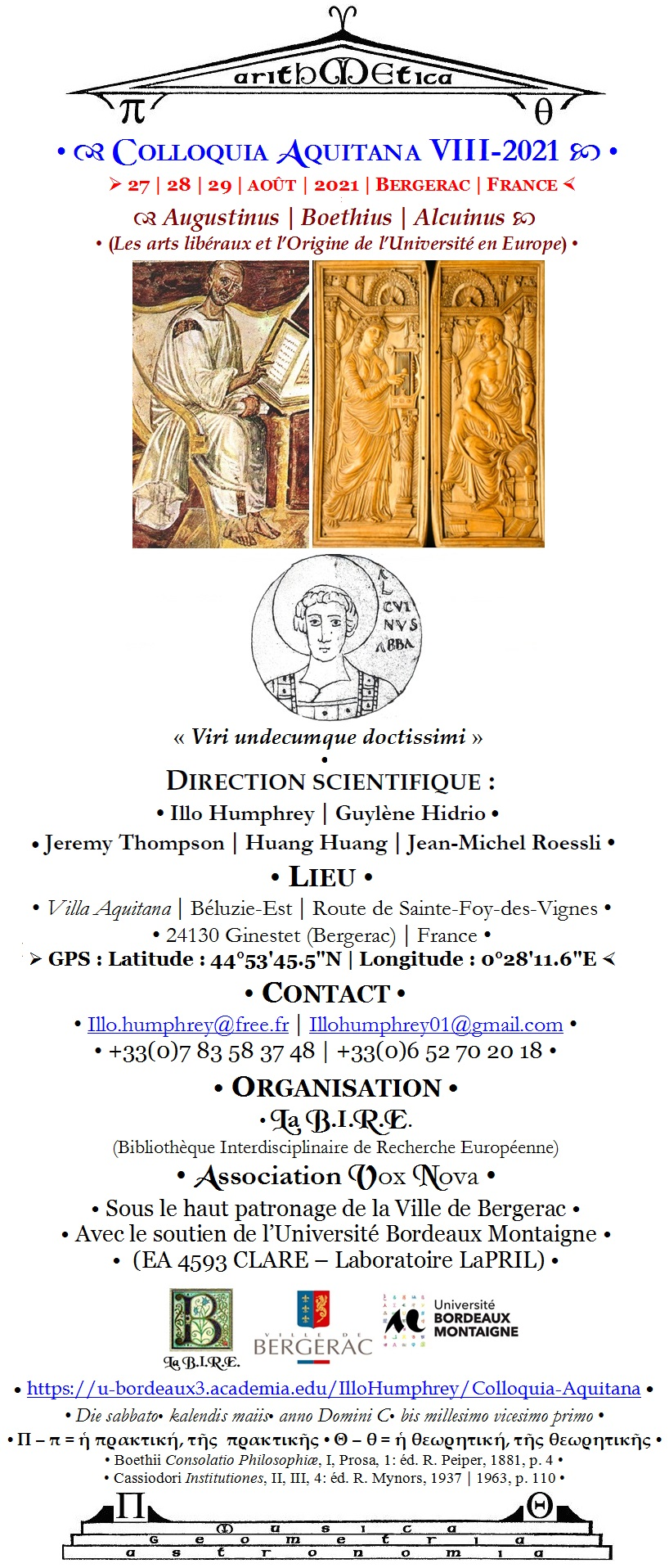
• Colloquia-Aquitana-VIII.27-28-29-VIII-2021.Augustinus-Boethius-Alcuinus.Annonce.18-VII-2021 •
• (https://u-bordeaux3.academia.edu/IlloHumphrey/Colloquia-Aquitana) •
• Colloquia-Aquitana-VIII.27-28-29-VIII-2021.Augustinus-Boethius-Alcuinus.Inscription.18-VII-2021 •
• (https://u-bordeaux3.academia.edu/IlloHumphrey/Colloquia-Aquitana) •
• Colloquia-Aquitana-VIII.27-28-29-VIII-2021.Augustunis-Boethius-Alcuinus.Affiche.4-X-2021 •
• https://clare.u-bordeaux-montaigne.fr/301 •
• DOI: 10.13140/RG.2.2.21598.77124 •
•
Programme
• Colloquia-Aquitana-VIII.27-28-29-VIII-2021.Augustinus-Boethius-Alcuinus.Programme.17-X-2021 •
Vidéoconférence | Sessions 1 | 2 | 3 : 27-28-29-VIII-2021 | 15h
(FreeConference.com | Colloquia-Aquitana.com | illohumphrey01@gmail.com)
Connexion | Link | Verbindung:
• hello.freeconference.com/conf/call/8424982 •
•
Rubriques
•
• (1) À propos des Colloquia Aquitana VIII – 2021 •
• (2) À propos du trio d’images sur l’affiche •
• (3) Thèmes principaux | Thèmes annexes •
• (4) Bibliographie sélective •
•
À propos des Colloquia Aquitana VIII – 2021
•
« Priscae recentiorisque auctoritatis viros et feminas eximios
ad mensam Philosophiae recte consederunt Augustinus Boethius Alcuinusque inter omnes•
Docendi discendi et bibendi substantiam septem matheseon disciplinarum•
παιδεία humanitatem eruditionem institutionemque in bonas artes• »
• (© Illo Humphrey | Carmen philosophicum XII) •
• Die sabbato• kalendis maiis• anno Domini C• bis millesimo vicesimo primo •
• (1-V-2021) •
•
• Colloquia Aquitana VIII – 2021: Les Colloquia Aquitana VIII – 2021, intitulés « Augustinus | Boethius | Alcuinus | Les arts libéraux et l’Origine de l’Université en Europe », auront lieu les 27 | 28 | 29 août 2021 dans le sud-ouest de la France à Bergerac, dans le département de la Dordogne-Périgord. La rencontre est organisée par La B.I.R.E. (Bibliothèque Interdisciplinaire de Recherche Européenne), et par l’Association Vox Nova sous le haut patronage de la Ville de Bergerac et avec le soutien de l’Université Bordeaux Montaigne: EA 4593 CLARE-Laboratoire LaPRIL-TELEM •
• Direction: Les Colloquia Aquitana VIII – 2021 sont organisés sous la direction de: Illo Humphrey, Médiéviste | Musicologue | Proto-Philologue (Université Bordeaux Montaigne : EA 4593 CLARE-Laboratoire LaPRIL), Guylène Hidrio, Médiéviste | Historienne d’art (Université Lille 3: IRHiS-GRIM-CNRS), Jeremy Thompson, Médiéviste | Historien | Latiniste (Friedrich-Alexander Universität Erlangen-Nürnberg) | Huang Huang, Musicologue | Médiéviste (University of Western Ontario) | Jean-Michel Roessli, Professeur d’histoire du christianisme (Université Concordia, Montréal, Canada) •
• Objectif: L’objectif des Colloquia Aquitana VIII – 2021 est d’explorer, à travers ce puissant trio: Aurelius Augustinus | Anicius Manlius [Torquatus] Severinus Boethius | Alcuinus Euboricensis, l’histoire fascinante de l’évolution du système d’éducation en Europe entre le Ve et le XIVe s. Une partie du colloque sera consacré, comme il se doit, au célèbre Capitularium XXII de Charlemagne, promulgué en 789, intitulé Admontio generalis (§1-82 | cf. §72, Sacerdotibus: cf. https://www.colloquiaaquitana.com/?page_id=754 | Bibliography I), et à l’influence qu’a exercé cette législation, rédigée semble-t-il par Alcuin, d’abord sur l’Ordo palatii (réseau royal carolingien de monastères, cathédrales, avec leurs scriptoria, leurs banques de savoir - c’est-à-dire, leurs bibliothèques, et leurs écoles respectives, en territoire de Neustria), puis, à partir du 25 décembre, l’an 800, sur l’éducation et la culture générale de l’empire carolingien dans son ensemble. En effet, l’Admonitio generalis joua un rôle déterminant sur les origines des Scholae palatinae à Urbs aquensis, urbs regalis / Aquisgrana (Aix-la-Chapelle), et à Urbs laudunensis (Laon), ainsi que sur celles des écoles monastiques (« scholae monatsicae » | « claustrales »), et des écoles cathédrales (« scholae canonicae | « externae » | « écoles canoniales ») précarolingiennes, carolingiennes et postcarolingiennes, notamment: à York (Euboricum / Ecclesia et Schola Euboricensis) | Aix-la-Chapelle (Aquisgrana / Urbs aquensis, urbs regalis / Sancti Cornelii ad Indam / Kornelimünster) | Saint-Amand-en-Pévèle (Monasterium Elnonense) | Saint-Pierre de Corbie (Corbeia / Monasterium Sancti Petri Corbeiensis) | Saint-Riquier (Centula / Monasterium Centulense / Monasterium Sancti Richarii) | Saint-Bertin de Sithiu – Saint-Omer (Sithium / Audomaropolis / Monasterium Sithiense seu Sancti Bertini apud Audomaropolim Artesiae) | Saint-Corneille-et-Saint-Cyprien de Compiègne (Compendium / Monasterium Sancti Cornelii [et Sancti Cypriani] Comendiensis) | Notre-Dame de Chelles (Cala / Calensis Ecclesia Parisiacae urbis) | Saint-Denis-en-France (Monasterium Sancti Dionysii) | Saint-Germain-des-Prés (Sancti Germani de Prate) | Saint-Benoît-sur-Loire / Fleury-sur-Loire (Floriacum / Monasterium Sancti Benedicti Floriacensis) | Saint-Pierre-et-Saint-Paul de Ferrières-en-Gâtinais (Monasterium Sancti Petri [et Sancti Pauli] Ferrariensis) | Saint-Germain d’Auxerre (Autissiodorum / Autesiodurum / Monasterium Sancti Germani Autissiodorensis) | Saint-Martin de Tours (Civitas Turonorum / Monasterium Sancti Martini Turonensis) | Sainte-Marie et Saint-Jean de Laon (Alaudanum / Lugdunum Clavatum / Monasterium [Beatae Mariae et] Sacnti Iohannis Laudunensis) | Saint-Rémi de Reims (Durocortorum / Civitas Remorum / Monasterium Sancti Remigii Remensis) | Saint-Pierre d’Hautvillers (Monasterium Sancti Petri Altivillaris) | Metz (Monasterium Sancti Arnulfi Metensis) | Reichenau (Augia insula), en Allemagne sur le Lac de Constance | Fulda | Lorsch (Laureshamense Monasterium / Laurissa / etc.) | Corvey (Monasterium Corbeiae novae) | Sankt Gallen (Monasterium Sancti Galli / Monasterium Sangallensis) | Chartres (Civitas Carnotum / Ecclesia et Schola Carnotensis) | etc., ainsi que sur les maîtres du Xe s. (Notker le Bègue | Hrotsvita von Gandersheim | Abbon de Fleury | Gerbert d’Aurillac | etc.), et du XIe s. (Guido d’Arezzo | Fulbert de Chartres | Anselmo d’Aosta [de Cantorbéry] | etc.).
• À partir du XIIe s., avec l’expansion des villes et la « révolution des écoles urbaines » (N-D de Paris | Saint-Victor de Paris | Sainte-Geneviève de Paris), on observe, grâce au précieux témoignage de Guibert de Nogent (*1053-†1125), le début d’une véritable explosion de savoir pluridisciplinaire propagé par les maîtres, tels que : Abélard | Hugues de Saint-Victor | Bernard de Chartres | Guillaume de Conches | Thierry de Chartres | Gilbert de la Porrée (Gilbert de Poitiers) | Jean de Salisbury | Herrad von Landsberg | Graziano da Chiusi | Pierre Lombard | Hildegarde von Bingen | Gherardo da Cremona | Pierre le Chantre | etc. Puis, à ces maîtres, s’ajoutent Alhazen (Abū ʿAlī al-Ḥasan ibn al-Ḥasan ibn al-Haytham أبو علي، الحسن بن الحسن بن الهيثم, *Bassora, Iraq, c. 965 – †Le Caire, Égypte, vers 1040) | Avicenne (ابن سينا : AbūʿAlī al-ḤusaynʿAlī Ibn Sīnā, *Boukhara, 980-†Hamadan, 1037) | Ibn Butlân (ابن بطلان), médecin irakien nestorien (*1001-†Bagdad, 1066), auteur du traité Taqwīm eṣ-ṣiḥḥa تقويم الصحة « La préservation de la santé » ou « Tables de santé »: Tacuinum sanitatis | Averroès (ابن رشد Abu’l-Walid Muhammad ibn Rushd, *Cordoue, 1126-†Marrakech, Maroc, 1198) | Moïse Maïmonide (HaRav Moshe ben Maimoun dit « Le Rambam », *Cordoue, 1138-†Fostat [Le Caire], 1204) | Robert Grossetête (Robert Grosseteste / Robert de Lincoln, *Stow [Suffolk], vers 1175-†Lincoln, 1253) | Albrecht von Bollstädt, OP (Albertus Magnus: *1200-†1280) | Roger Bacon (Doctor mirabilis, *Ilchester [Somerest], 1214-†Oxford, 1294) | Tommaso d’Aquino, OP: *Roccasecca, ca.1225-†Fossanova,1274 | Rabbi Levi ben Gershom (Gersonide dit « Ralbag », *Bagnols-sur-Cèze, 1288-†Perpignan, 1344), médecin, philosophe, théologien, exégète, mathématicien, astronome occitan, inventeur du Baculus Jacobi (Bâton de Jacob) | etc., qui ont tous, à tour de rôle, contribué substantiellement à l’éclosion des Studia generalia aux XIe et XIIe s., et, aux XIIIe et XIVe s., à l’épanouissement de l’Uniuersitas magistrorum atque scholarium uel discipulorum [discipularumque] •
• Universitas Bononiensis: La toute première université européenne fut fondée en 1088 à Bologna, Italie, portant le nom d’Alma Mater Studiorum – Universitas Bononiensis: c’est-à-dire « Mère nourricière des études » – « Communauté [des étudiants] de Bologna. Dans ce contexte, sera explorée l’origine du phénomène des communautés des « Nationes » à l’Alma Mater Studiorum de Bologna au XIIe siècle (cf. infra, Bibliographie: Nathalie Gorochov, « Genèse et organisation des nations universitaires en Europe aux XIIe et XIIIe siècles »), puis sera explorée l’organisation du curriculum des 4 Facultates primitives : Facultas artium (Faculté des Arts – c’est-à-dire du canon des sept arts libéraux: Quadruvium [sic] – ars arithmetica• ars musica• ars geometrica• ars astronomica• et Trivium – ars grammatica• ars dialectica• ars rhetorica•), Facultas theologiae (Faculté de Théologie), Facultas decreti | Facultas decretorum | Facultas iurisprudentiae (Faculté du Décret | de la Jurisprudence [Droit canonique]), Facultas medicinae (Faculté de Médecine) • Nota bene: Malgré l’interdiction par le Codex iuris canonici d’admettre les femmes à étudier à l’université, rappelons que l’Alma Mater Studiorum – Universitas Bononiensis, dès le début du XIIIe siècle semble-t-il, admettait l’immatriculation des femmes, à l’exemple de la brillante étudiante Bettisia Gozzadini (*1209-†1261), qui y obtint son doctorat en droit en 1236 et y devint professeure de droit vers 1239 •
• Patrimoine culturel: Les Colloquia Aquitana VIII – 2021 souhaitent aussi mettre l’accent à la fois sur l’ancienneté et la modernité du canon des sept arts libéraux (ἡ ἐγκύκλιος παιδεία | αἱ ἐλευθέριοι τέχναι | artes liberales | studia liberalia | paideia | humanitas | eruditio institutioque in bonas artes), dans la perspective de l’origine multiculturelle de ce vieux concept, rappelant, à ce propos, que la raison d’être des arts libéraux est en fait d’assurer la protection et la sauvegarde du patrimoine matériel et immatériel de l’humanité, clé de voûte de l’UNESCO. Cette protection concerne non seulement la diversité dans le contexte de l’« unité culturelle européenne », mais aussi le bien-être de toutes les cultures, de tous les peuples, ainsi que le bien-être de toute la flora et microflora, de toute la fauna et microfauna de la nature dans son ensemble •
• Ad mensam Philosophiae: Enfin, les organisateurs et participants des Colloquia Aquitana VIII– 2021 se réjouissent par avance du privilège de s’asseoir, le temps de 3 journées d’été, à la table de Φιλοσοϕία et de partager l’harmonie et la substance des sept arts libéraux en compagnie de ce puissant trio: Aurelius Augustinus | Anicius Manlius [Torquatus] Serverinus Boethius | Alcuinus Euboricensis. © IH | ih | die iovis• idibus iuliis• anno Domini C• bis millesimo vicesimo primo | scripsi et subscripsi •
•
• « Parmi les hommes et les femmes éminents d’autorité ancienne et plus récente
prirent place de bon droit Augustin• Boèce et Alcuin à la table de Φιλοσοϕία•
Enseignant• apprenant et buvant la substance des sept sciences et disciplines•
en l’occurrence• humanitas• eruditio• les fondements des arts libéraux et παιδεία• » •
• (© Illo Humphrey | Poème philosophique XII) •
• Die sabbato• kalendis maiis• anno Domini C• bis millesimo vicesimo primo •
• (1-V-2021) •
•
Colloquia Aquitana VIII – 2021 et Colloquia Aquitana IX – 2022
•
(2) À propos du trio d’images sur l’affiche
•
• (1) Aurelius Augustinus (*Thagaste [Souk Ahras, Algérie] 354-†Hippo Regius [Annaba, Algérie] 430) •
• Affresco | VI secolo | Basilica del Laterano | Roma | cf. Fabrizio Bisconti, “L’affresco del S. Agostino”, dans Mélanges de l’École française de Rome | Antiquité, Tome 116, n°1, 2004, p. 51-78: https://doi.org/10.3406/mefr.2004.10754 • https://www.persee.fr/doc/mefr_0223-5102_2004_num_116_1_10754 •
• (2) Anicius Manlius [Torquatus] Serverinus Boethius (*Rome, ca. 480-†Pavie, ca. 524) | Monza | Museo del Duomo | Officina tardo-romana | Dittico del poeta e della musa | VI s. dc | cf.: Fabio Troncarelli, “La consolazione del dolore. Nuove ipotesi sul Dittico del poeta et della musa”, dans Arte medievale, IV serie, anno 1, 2010-2011, p. 9-29: https://www.academia.edu/6704509/La_consolazione_del_dolore_Nuove_ipotesi_sul_Dittico_del_Poeta_e_della_Musa • Fabio Troncarelli, “Forbidden Memory: The Death of Boethius and the Conspiracy of Silence”, dans Medieval Studies 73 (Pontifical Institute of Medieval Studies) 2011, p. 183-205 • cf. https://unitus.academia.edu/TroncarelliFabio •
• (3) Alcuinus Euboricensis (*Yorkshire, ca. 730-†Tours, 804) | dessin d’après Bamberg Staatsbibliothek | Misc. Class. Bibl. I | IXe s., f. 5v | origine: Marmoutier [Maius Monasterium] (37100 Tours | Département: Indre-et-Loire), France: https://www.gnm.de/objekte/alkuin-bibel-fol-5v/ | voir, infra, Bibliographie: Bragg (Melvyn) • cf. Melvyn Bragg, Podcast | In Our Time: S22/19 Alcuin | Production-BBC: Simon Tillotson | 30-I-2020) | Invités: Mary Garrison (University of York) | Joanna Story (University of Leicester) | Andrew Orchard (University of Oxford): https://www.youtube.com/watch?v=YPi83hAC_EM • Illo Humphrey, Boethius. His Influence on the European Unity of Culture: from Alcuin of York (†804) to Thierry of Chartres (†1154), 237 pages, Nordhausen, Germany (Bautz), 2010 | 2e édition 2012, chapitre 1: “Boethius and Alcuin of York”, p. 49-59: https://u-bordeaux3.academia.edu/IlloHumphrey/Books • https://www.researchgate.net/profile/Illo_Humphrey/publications •
•
Colloquia Aquitana VIII – 2021 et Colloquia Aquitana IX – 2022
•
(3) Thèmes principaux | Thèmes annexes
• Main Topics | Sub-Topics • Hauptthemen | Unterthemen • Temi principali | Sottotemi •
•
• Augustinus (*Thagaste [Souk Ahras, Algérie] 354-†Hippo Regius [Annaba, Algérie] 430) • • Boethius (*Rome, ca. 480-†Pavie, ca. 524) • • Alcuinus (*Yorkshire, ca. 730-†Tours, 804) •
• Dynastie carolingienne : Pépin le Bref – Charlemagne – Louis le Pieux – Charles le Chauve | « Ordo palatii » en Neustria | Politique culturelle | Les maîtres d’école | L’essor de la dynastie ottonienne en Allemagne ® Xe et XIe siècles | etc. •
• « Renovatio » | « Correctio » | « Renaissance carolingienne » | cf. : Jean-Jacques Ampère (*12-VIII-1800 – †27-III-1864) • Erna Patzelt (*Wien, 29-X-1894 – †Wien, 9-III-1987) • Bernhard Bischoff (*Altendorf, 20-XII-1906 – †19-IX-1991) • Pierre Riché (*Paris, 4-X-1921 – †Ivry-sur-Seine, 6-V-2019) • Michel Huglo (*Lille, France, 14-XII-1921 – †Washington, D.C., USA, 13-V-2012) • Rosamond McKitterick, (*Chesterfield, UK, 31-V-1949 – ) • Philippe Depreux (*Roubaix, 26-III-1967 – ) • etc. •
• Écoles et bibliothèques (précarolingiennes | carolingiennes | postcarolingiennes) •
• Écoles palatines | monastiques | cathédrales (« scholae canonicae | « externae » | « écoles canoniales ») •
• Admontio generalis (Capitularium XXII | 23-III-789 | §1 – 82, voir §72, Sacerdotibus): “…et ut scolae legentium puerorum fiant• psalmos• notas• cantus• compotum [sic]• grammaticam• per singula monasteria vel episcopia et libros catholicos bene emendate•…” •
• Promulgation: L’Admonitio generalis fut promulguée die lunae, decimo kalendas apriles, anno Domini A, septingentesimo octogesimo nono• (lundi, le 10e jour avant les calendes d’avril• [le 23 mars] • l’an de Grâce A• 789); Paris, BnF, Fonds latin 9654, Xe s., origine Metz [?], f. 9r:
• (https://archivesetmanuscrits.bnf.fr/ark:/12148/cc77644n) •
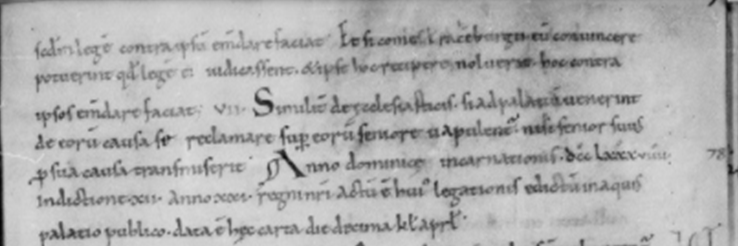
• Paris, Bibliothèque nationale de France (Site Richelieu), Fonds latin 9654, Xe s. | Metz [?], f. 9-recto •
• (https://gallica.bnf.fr/ark:/12148/btv1b10721350r/f15.item) •
ligne 5: «…pro sua causa transmiserit• Anno dominicæ [sic] incarnationis• dcc° LXXX°VIIII°•
ligne 6: indictione• XII• anno XXI• regni nostri actum est huius legationis edictum in aquis
ligne 7: palatio publico• data est hæc carta die decima kalendas apriles• »
• Nota bene: Émanant de Charlemagne, écrit, semble-t-il par Alcuin d’York, ce capitulaire fut adressé, principalement, à l’Ordo palatii - c’est-à-dire au réseau carolingien de monastères et de cathédrales, et leurs écoles respectives, en Neustria; à propos de la Neustria et l’Ordo palatii, voir infra, Bibliographie: Atsma (Hartmut) (éd.) | Heuclin (Jean) et Perin (Patrick) et Feffer (Laure-Charlotte) (éds.) • Cette législation de Charlemagne institua un vaste programme d’éducation pour tous les enfants du royaume carolingien, puis, à partir de la date octavo kalendas ianuarias• anno Domini bisextile BA• octingentesimo• (le 8e jour avant les calendes de janvier• c’est-à-dire le 25 décembre• l’an de Grâce bissextile BA• 800), pour tous les enfants de l’empire carolingien dans son ensemble. Nota bene: Ce fut Étienne Baluze (Stephanus Baluzius, le bibliothécaire de Jean-Baptiste Colbert, *1619-†1683), qui attribua le numéro XXII au Capitularium Admonitio generalis dans son édition des Capitularia regum Francorum de 1677 •
• Bibliographie sur Neustria et sur l’Ordo Palatii :
• Atsma (Hartmut), (éd.), La Neustrie. Les pays au nord de la Loire de 650 à 850, (Colloque historique international tenu à Rouen, France | 1985), Préface de Karl Ferdinand Werner, 2 volumes (XXXII-594 pages | VIII-544 pages), (Beihefte der Francia, 16 /1), Sigmaringen (Jan Thorbecke Verlag), 1989 | Illustrations | Cartes géographiques | Bibliographie | Index • Compte rendu : Stéphane Lebecq, « La Neustrie. Les pays au nord de la Loire de 650 à 850. Colloque historique international publié par Hartmut Atsma. Préface de Karl Ferdinand Werner », 1989, dans Revue du Nord, Tome 73, n° 293, octobre-décembre 1991. p. 765-766: www.persee.fr/doc/rnord_0035-2624_1991_num_73_293_4708_t1_0765_0000_1 •
• Heuclin (Jean), « Les abbés des monastères neustriens 650-850 », dans La Neustrie. Les pays au nord de la Loire de 650 à 850, (Colloque historique international tenu à Rouen, France | 1985), Hartmut Atsma (éd.), (Beihefte der Francia, 16/1), Sigmaringen (Thorbecke) 1989, ISBN 3-7995-7316-X, Tome I, p. 331, 334, 335, voir carte géographique, p. 337: ‘L’Ordo Palatii’ en Neustrie, p. 338: « Les Abbés du IXe s. », p. 339: « Les Abbés du VIIe s. », p. 340: « Les Abbés du VIIIe s. »): https://cour-de-france.fr/histoire-et-fonction/religion-spiritualite-et-esoterisme/etudes-modernes/article/les-abbes-des-monasteres-neustriens-650-850 •
• Périn (Patrick), Feffer (Laure-Charlotte), (éds.), La Neustrie. Les pays au nord de la Loire de Dagobert à Charles le Chauve (VIIe-IXe siècles), Exposition organisée par les Musées départementaux de la Seine-Maritime, Rouen (Musées départementaux de la Seine-Maritime), 1985 • Nota bene: Cette exposition fut le complément du Colloque historique international tenu à Rouen, France, en 1985: La Neustrie. Les pays au nord de la Loire de 650 à 850, organisé et publié en deux volumes par Hartmut Atsma aux éditions Thorbecke (Sigmaringen | Deutschland) en 1989 •
• Admonitio generalis | Philosophie fondamentale: La philosophie fondamentale du Capitularium XXII Admonitio generalis se base sur la fusion harmonieuse entre l’enseignement chrétien de l’Ancien et du Nouveau Testament biblique et la Tradition du savoir séculière, essentiellement méditerranéenne et gréco-romaine. Cette Tradition du savoir séculière gréco-romaine se résume par des concepts suivants: ἡ παιδεία: humanitas, et ἡ ἐγκύκλιος παιδεία: artes liberales – c’est-à-dire, le cycle d’études du canon des sept arts libéraux, divisés à partir du Ive-Ve siècle en deux parties distinctes: (a) le Quadruvium [sic]: ars arithmetica• ars musica• ars geometrica• ars astronomica• (b) le Trivium: ars grammatica• ars dialectica uel logica• ars rhetorica•
• On observe que le Capitularium XXII Admonitio generalis est en fait un vaste et ambitieux programme de réformes ecclésiastiques, monastiques, éducatives et culturelles réparti sur 82 articles et divisé en deux parties: réformes ecclésiastiques et monastiques (articles 1 à 59), et réformes de culture générale (articles 60 à 82), qui relèvent de l’éducation et de l’instruction de base pour l’ensemble des écoles du royaume carolingien, et, à partir du 25 décembre l’an 800, de l’empire carolingien dans son ensemble •
• Cette législation faisait partie intégrante de la « renovatio » ou la « correctio » carolingienne – c’est-à-dire la Renaissance carolingienne, dont l’origine remonte au père de Charlemagne, Pépin le Bref (Pippinus III, *714-†768) et à son proche conseiller Chrodegang évêque de Metz (vers *712-†766), et dont la mise en oeuvre de base a été réalisée par Charlemagne (†814) et par son proche conseiller Alcuin d’York (†804). Le but de cette législation était bipartite: (a) l’unification politique, religieuse, administrative et institutionnelle de l’empire carolingien, (b) la mise en place d’un programme d’études pour tous les établissements scolaires de l’empire •
• Aisni, le Capitularium XXII Admonitio generalis joua un rôle déterminant dans la réussite de la « renovatio » carolingienne, et, bien au-delà de la dynastie carolingienne, dans celle de la Renaissance ottonienne (Xe et XIe siècles), puis, par la suite aux XIe, XIIe et XIIIe, dans la creation et le développement de l’université primitive européenne, appelée, dans un premier temps Studium generale, essentiellement un phénomène urbain, puis, au cours du XIIIe siècle, l’Uniuersitas magistrorum atque scholarium uel discipluorum [discipularumque], et finalement, au XIVe siècle, Universitas tout court •
• Charlemagne | Saint Patron de l’Université de Paris: À la lumière de l’Admonitio generalis, héritage puissant de [Saint] Charlemagne, canonisé en 1165 par l’antipape Pascal III (Guido da Crema †1168) et fêté le 28 janvier, il n’est pas étonnant qu’il ait été choisi en 1661 comme Saint Patron de l’Université de Paris •
• Sources:
• Paris, BnF, Fonds latin 10758 (IXe s., Saint-Rémi de Reims), Capitularium « Admonitio generalis », p. 50, l. 15-19: http://gallica.bnf.fr/ark:/12148/btv1b8423828c/f62.image | http://archivesetmanuscrits.bnf.fr/ark:/12148/cc34715m •
• Paris, BnF, Fonds latin 4613 (Xe s., Leges Langobarorum, Italie du nord – La Lombardia [?]), Capitularium « Admonitio generalis », f. 73 / p. 147, f. 79v / p. 162, l. 1-4 « … aut scolegentium puerorum fiant uectes cantuit conpotum gramaticam, per singula monasteria vel episcopia et libros canonicos bene emendate… » [sic], dans ce manuscrit, il manque les Capitularia 9, 11, 26, 27: http://gallica.bnf.fr/ark:/12148/btv1b9066866b/f1.image | http://archivesetmanuscrits.bnf.fr/ark:/12148/cc634592 •
• Paris, BnF, Fonds latin 4628 A, f. 59 v (Xe s., Lex Salica, France): http://archivesetmanuscrits.bnf.fr/ark:/12148/cc634787 •
• https://capitularia.uni-koeln.de/?s=admonitio+generalis&submit= •
• https://capitularia.uni-koeln.de/capit/pre814/bk-nr-022/ •
• http://www.uni-leipzig.de/~jurarom/manuscr/Can&RomL/titles/10657.htm: Admonitio generalis | 44 manuscrits •
• Travaux et Éditions: Baluze (Étienne), (Stephanus Baluzius, *Tulle, France, 1630 - †Paris, 1718), Capitularia regum Francorum: additae sunt Marculfi monachi et aliorum formulae veteres et notae doctissimorum virorum, Paris, 1677, 2 Volumes in-folio, réimpression, 1780, Pierre Chiniac de la Bastide | Nota bene (Rappel): Ce fut Étienne Baluze, dans son édition des Capitularia regum Francorum de 1677, qui a attribué le numéro XXII au Capitularium « Admonitio generalis » • Boretius (Alfred E.) (éd.), Capitularia regum Francorum, Volume I, MGH, Legum sectio II, Hannoverae, 1883, p. 52-62 • Mordek (Hubert)†, Zechiel-Eckes (Klaus)†, Glatthaar (Michael) (éds.): Die Admonitio generalis Karls des Großen (Monumenta Germaniae Historica, Fontes iuris Germanici antiqui in usum scholarum separatim editi. Band 16), Hannover (Hahn), 2012, ISBN 978-3-7752-2201-3: https://pinpdf.com/monumenta-germaniae-historica-capitularia.html •
• Commentaires: Holtz (Louis), “Alcuin et la renaissance des arts libéraux”, dans Karl der Grosse und sein Nachwirken. 1200 Jahre Kultur und Wissenschaft in Europa, Butzer (P.), Kerner (M.), Oberschelp (W.), (éds.), [ouvrage collectif composé de 21 articles issus du Colloquium Carolus Magnus: 1200 Years of Civilisation and Science in Europe, tenu à Aix-la-Chapelle du 19 au 26 mars 1995], Vol. I, 1997, p. 45-60 • Humphrey (Illo), « Boethius and Alcuin of York », dans Boethius. His Influence on the European Unity of Culture: from Alcuin of York (†804) to Thierry of Chartres (†1154), Nordhausen, Germany (Traugott Bautz Verlag), 2010 | 2e édition 2012, ch. 1, p. 57-59: https://u-bordeaux3.academia.edu/IlloHumphrey/Books • Humphrey (Illo): Boethius and the Liberal Arts (Database | Meta-Database): https://www.colloquiaaquitana.com/?page_id=754 | Bibliograpy I: « Admonitio generalis« •
• De litteris colendis (Epistola de litteris colendis), émanant de Charlemagne, écrite, semble-t-il par Alcuin d’York, cette épître fut adressée à l’abbé Baugulfe de Fulda entre l’an 780 et l’an 800 [?] •
• Sources: (1) Oxford, Bodleian laudianus Misc. 125 (VIIIe s., vers 787[?] • (2) Bibliothèque municipale de Metz, manuscrit 226 (XIe s.), Catalogue des Manuscrits des Bibliothèques publiques, des Départements, publié sous les auspices du Ministère de l’Instruction publique, Tome V: Metz – Verdun – Charleville, Paris, 1879, p. 99, 6° Epistola Karoli imperatoris | Incipit: Karoli gratia Dei rex Francorum et Langobardorum ac partricius Romanorum, Bauogulfo abbati et omni congregationi… • (3) https://archive.org/details/catalogue05fran/page/n5/mode/2up?view=theater • https://capitularia.uni-koeln.de/?s=epistola+litteris+colendi&submit= • https://capitularia.uni-koeln.de/capit/pre814/bk-nr-029/ •
• Travaux et Éditions: Boretius (Alfred E.) (éd.), Capitularia regum Francorum, Vol. I, MGH, Legum sectio II (Vol. I), Hannoverae, 1883, p. 78-79 • Lehmann (Paul), « Fuldaer Studien. Neue Folge », Sitzungsberichte, Bayerische Akademie (Philologische-Historische Klasse, 1927 | Abhandlung 2), p. 8-9, une étude sur l’Epistola Caroli regis de litteris colendis dans Oxford, Bodleian laudianus Misc. 125 (VIIIe s., vers 787[?]) • Mordek (Hubert)†, Zechiel-Eckes (Klaus)†, Glatthaar (Michael) (éds.): Die Admonitio generalis Karls des Großen…: https://pinpdf.com/monumenta-germaniae-historica-capitularia.html • Wallach (Luitpold), « Charlemagne’s De litteris colendis and Alkuin », dans Alcuin and Charlemagne. Studies in Carolingian History and Literature, Wallach (Luitpold), Caplan (Harry), Hutton (James), Kirkwood (G. M.), Solmsen (Friedrich), (éds.), (Cornell Studies in Classical Philology | Volume 32), Cornell University Press, Ithaca NY 1959, chapitre XI, p. 198-226, p. 198-199, voir note 2 sur l’Epistola Caroli regis de litteris colendis dans Oxford, Bodleian laudianus Misc. 125 (VIIIe s., vers 787[?]): https://www.mgh-bibliothek.de/dokumente/0/086370.pdf • Wallach (Luitpold), Charlemagne and Alcuin: Diplomatic Studies in Carolingian Epistolography, (Traditio | Volume 9), 1953, p. 127-154 • Wallach (Luitpold), “Charlemagne’s De Litteris Colendis and Alcuin: A Diplomatic-Historical Study”, (Speculum | Volume 26, no. 2), 1951, p. 288–305 • Chartrier (Yves): « Documents pour servir à l’histoire de la théorie musicale. Charlemagne (*ca. 742-†814), Mandement sur l’instruction » (Tradcution française du De litteris colendis, avec notes et bibliographie des sources manuscrites et des travaux d’édition): https://www.musicologie.org/publirem/hmt/hmt_charlemagne.html •
• Commentaires: Chartrier (Yves): « Documents pour servir à l’histoire de la théorie musicale. Charlemagne (*ca. 742-†814), Mandement sur l’instruction » (Tradcution française du De litteris colendis, avec notes et bibliographie des sources manuscrites et des travaux d’édition): https://www.musicologie.org/publirem/hmt/hmt_charlemagne.html • Holtz (Louis), “Alcuin et la renaissance des arts libéraux”, dans Karl der Grosse und sein Nachwirken. 1200 Jahre Kultur und Wissenschaft in Europa, Butzer (P.), Kerner (M.), Oberschelp (W.), (éds.), [ouvrage collectif composé de 20 articles issus du Colloquium Carolus Magnus: 1200 Years of Civilisation and Science in Europe, tenu à Aix-la-Chapelle du 19 au 26 mars 1995], Vol. I, 1997, p. 45-60 • Humphrey (Illo), « Boethius and Alcuin of York », dans Boethius. His Influence on the European Unity of Culture: from Alcuin of York (†804) to Thierry of Chartres (†1154), ch. 1, p. 57-59: https://u-bordeaux3.academia.edu/IlloHumphrey/Books •
• Epistola generalis, émanant de Charlemagne, écrite, semble-t-il par Alcuin d’York entre l’an 786 et l’an 801, cette épître fut adressée surtout à l’Ordo palatii en Neustria, encourageant l’adoption de la révision du lectionnaire de l’Office des Vigiles par l’érudit Italien lombard Paulus Barnefridus, dit « Paulus Diaconus » | « Paulus Cassinensis » | « Paolo Diacono », moine bénédictin de Monte Cassino (*vers 720-† vers 799) », ainsi que la révision de la Bible par Alcuin d’York •
• Sources: https://capitularia.uni-koeln.de/capit/pre814/bk-nr-030/ •
• Travaux et Éditions: Boretius (Alfred E.) (éd.), Capitularia regum Francorum, Vol. I, MGH, Legum sectio II (Vol. I), Hannoverae, 1883, p. 80 • Mordek (Hubert)†, Zechiel-Eckes (Klaus)†, Glatthaar (Michael) (éds.): Die Admonitio generalis Karls des Großen…: https://pinpdf.com/monumenta-germaniae-historica-capitularia.html •
• Commentaires: Wallach (Luitpold), Charlemagne and Alcuin: Diplomatic Studies in Carolingian Epistolography, (Traditio | Volume 9), 1953, p. 127-154 • Holtz (Louis), “Alcuin et la renaissance des arts libéraux”, dans Karl der Grosse und sein Nachwirken. 1200 Jahre Kultur und Wissenschaft in Europa, Butzer (P.), Kerner (M.), Oberschelp (W.), (éds.), [ouvrage collectif composé de 20 articles issus du Colloquium Carolus Magnus: 1200 Years of Civilisation and Science in Europe, tenu à Aix-la-Chapelle du 19 au 26 mars 1995], Vol. I, 1997, p. 45-60, see p. 51 (note 19) et p. 53 (note 25) • Humphrey (Illo), « Boethius and Alcuin of York », dans Boethius. His Influence on the European Unity of Culture: from Alcuin of York (†804) to Thierry of Chartres (†1154), ch. 1, p. 57-59: https://u-bordeaux3.academia.edu/IlloHumphrey/Books •
• Nota bene: Parmi ces trios documents émanant de Charlemagne consacrés à la « Renovatio » | « Correctio » (c’est-à-dire à la « Renaissance carolingienne »), en l’occurrence: Admonitio geleralis | Epistola de litteris colendis | Epistola generalis, seule l’Epistola generalis mentionne explicitement que les « artes liberales, suivant notre [propre] exemple, doivent être apprises et maîtrisées à fond »: « …et ad pernoscenda studia liberalium artium nostro etiam quos possumus inuitamus exemplo »; cf. A. Boretius, Capitularia regum Francorum, p. 80 • Holtz (Louis), “Alcuin et la renaissance des arts libéraux”, dans Karl der Grosse und sein Nachwirken. 1200 Jahre Kultur und Wissenschaft in Europa, Butzer (P.), Kerner (M.), Oberschelp (W.), (éds.), [ouvrage collectif composé de 21 articles issus du Colloquium Carolus Magnus: 1200 Years of Civilisation and Science in Europe, tenu à Aix-la-Chapelle du 19 au 26 mars 1995], Vol. I, 1997, p. 45-60, see p. 53 (note 25) •
• Iconographie carolingienne | postcarolingienne : Philosophie et les arts libéraux représentés dans l’iconographie • • Traductions scientifiques: l’arabe vers le latin ® XIIe s. • Iacobus Veneticus Graecus (Jacques de Venise [le Grec] | †après 1147): « Logica nova »: traductions du grec vers le latin ® XIIe s. • Renaissance scolaire ® XIIe s. • • L’urbanisation: Les Collèges | Les Ordres réguliers | Les Ordres séculiers | Les Ordres mendiants ® XIIIe s. • • Alma Mater Studiorum – Universitas Bononiensis (l’Université de Bologna, fondée en 1088) • • Bettisia Gozzadini (*1209-†1261) : étudiante, puis professeure à l’Alma Mater Studiorum – Universitas Bononiensis • • Processo di Bologna (Processus de Bologne : 1998) | Magna Charta Universitatum (Bologne | 18-IX-1988) • • Convention de Lisbonne (1997) | EEES [Espace européen de l’enseignement supérieur] (2010) • • Studium generale ® XIe-XIIe s. / Universitas magistrorum atque scholarium uel discipulorum [discipularumque] ® XIIIe s. •
• Les 4 + 1 Nations : France | Picardie | Normandie | Angleterre | Alemannia [Suisse alémanique] •
• France (Région de France : Île de France, incluant Paris et ses 7 départements autour) •
• Picardie (Ancienne Région administrative, auj. incluse dans la Région Hauts-de-France au nord de l’Île de France) •
• Normandie (Région de France au nord-ouest de l’Île de France, donnant sur l’océan Atlantique) • • Angleterre • • Alemannia [Suisse alémanique] • • Les 4 Facultés primitives de l’Université médiévale ® XIIIe s. : • Facultas artium (la Faculté des Arts – c’est-à-dire du canon des sept arts libéraux) : • Quadruvium [sic] – ars arithmetica• ars musica• ars geometrica• ars astronomica• • Trivium – ars grammatica• ars dialectica• ars rhetorica) • • Facultas theologiae (la Faculté de Théologie) • • Facultas decreti | Facultas decretorum | Facultas iurisprudentiae (la Faculté du Décret | de la Jurisprudence [Droit canonique]) • • Facultas medicinae (la Faculté de Médecine) • • L’organisation des cours et séminaires | Studia generalia / Universitas magistrorum atque scholarium : Prælectio (Pre-Lecture) • Lectio (Lecture) • Disputatio (Discussion | Débat) • Prædicatio (Prédication | Exposé) • Determinatio (Rapport du maître | Examen / Contrôle des connaissances) • Quolibet / Quodlibet (Disputatio spontanée sur des sujets non préparés) • • Manuscrits (Sources) • Gloses (Notes tironiennes ® IXe s.) • • Paléographie – Codicologie (Pecia | Exemplaria ® XIIIe s.) • • Vocabulaire spécialisé • Lexique raisonné •
•
Colloquia Aquitana VIII – 2021 et Colloquia Aquitana IX – 2022
•
(4) Bibliographie sélective
• © Illo Humphrey | PhD-HDR | Université Bordeaux Montaigne | UR 24142 Plurielles – LaPRIL •
• Die martis• idibus septembribus• anno Domini B• bis millesimo vicesimo primo •
• 13-IX-2022 •
•
• Admontio generalis (Capitularium XXII | 23-III-789 | §1–82, voir §72, Sacerdotibus: “…et ut scolae legentium puerorum fiant• psalmos• notas• cantus• compotum [sic]• grammaticam• per singula monasteria vel episcopia et libros catholicos bene emendate•…” •
• Nota bene (1) | Traduction française : Admonitio generalis, Article 72 | « À l’intention des Prêtres: …et afin que les écoles deviennent [un endroit où] les enfants [apprennent] à lire les psaumes, [où ils apprennent à lire et à écrire] les notes [tironiennes - c’est-à-dire, la sténographie latine], [où ils apprennent les] chants ["grégoriens" de toute l’année liturgique], [où ils apprennent] le comput [ - c’est-à-dire, l’art de calculer les dates et les jours de fêtes importants du calendrier, et en particulier la fête de Pâques], [où ils apprennent] la grammaire [de base de tous les sept arts libéraux, c’est-à-dire le Quadruvium [sic]: ars arithmetica• ars musica• ars geometrica• ars astronomica• et le Trivium: ars grammatica• ars dialectica uel logica• ars rhetorica•], [et ce] dans [toutes les écoles monastiques et toutes les écoles cathédrales de l'Ordo Palatii], [utilisant les] livres catholiques [qui, pour les enfants, ont été] bien corrigés… » • (© IH | ih) •
• Nota bene (2) | English translation: Admonitio generalis, Article 72 | “To the attention of the Clergy: …and in order that the schools become [a place where] children [may] become [proficient in] reading, [in the reading and writing of tironian] Notes, [ - that is to say, Latin Stenography], [in the reading of the Book of] Psalms, [in the singing of the "Gregorian"] chants [of the entire liturgical year], [in the art of the] computus [or computation], [- that is to say, the art of calculating the important dates and feast days of the calendar, especially Easter], [in the learning of the basic] grammar [of the sevenfold canon of the liberal arts - that is to say, the Quadruvium [sic]: ars arithmetica• ars musica• ars geometrica• ars astronomica• and the Trivium: ars grammatica• ars dialectica uel logica• ars rhetorica•], [and this within the framework of] every single monastic and cathedral school [of the Ordo Palatii], [utilising the] catholic [text]books [which for the children have been] well-corrected…” • (© IH | ih) •
• Nota bene (3) | Deutsche Übersetzung: Admonitio generalis, Artikel 72 | Für die Prieste: …und damit die Kinder in den Schulen die Psalmen lesen lernen, [die tironischen] Noten, [bzw. die lateinische Kurzschrift, lesen u. schreiben lernen], die ["Gregorianischen"] Choräle [des ganzen liturgischen Jahres lernen und singen], den Computusz, [bzw. die Zeitrechnung der wichtigen Termine und religiösen Feste des Kalendars lernen und berechnen, und besonders das Osterfest], [bzw. die grundsätzliche] Grammatik [der Sieben Freien Künste, bzw., das Quadruvium [sic]: ars arithmetica• ars musica• ars geometrica• ars astronomica• und das Trivium: ars grammatica, ars dialectica uel logica, ars rhetoricaars grammatica• ars dialectica uel logica• ars rhetorica• lernen], [und zwar], in jeder Klosterschule und in jeder Domschule [Kathedralschule], des Ordo Palatii, [mit] katholischen Büchern, [die für die Kinder] wohl korrigiert wurden…“ • (© IH | ih) •
• Promulgation: L’Admonitio generalis fut promulguée die lunae• decimo kalendas apriles• anno Domini A• septingentesimo octogesimo nono• (lundi• le 10e jour avant les calendes d’avril• [le 23 mars] • l’an de Grâce A• 789); Paris, BnF, Fonds latin 9654, Xe s., Metz [?], f. 9-recto:
• (https://archivesetmanuscrits.bnf.fr/ark:/12148/cc77644n) •
• Paris, Bibliothèque nationale de France (Site Richelieu), Fonds latin 9654, Xe s. | Metz [?], f. 9-recto •
• (https://gallica.bnf.fr/ark:/12148/btv1b10721350r/f15.item) •
ligne 5: «…pro sua causa transmiserit• Anno dominicæ [sic] incarnationis• dcc° LXXX°VIIII°•
ligne 6: indictione• XII• anno XXI• regni nostri actum est huius legationis edictum in aquis
ligne 7: palatio publico• data est hæc carta die decima kalendas apriles• »
• Nota bene: Émanant de Charlemagne, écrit, semble-t-il par Alcuin d’York, ce capitulaire fut adressé, principalement, à l’Ordo palatii – c’est-à-dire au réseau carolingien de monastères et de cathédrales, et leurs écoles respectives, en Neustria; à propos de la Neustria et l’Ordo palatii, voir infra, Bibliographie: Atsma (Hartmut) (éd.) | Heuclin (Jean) et Perin (Patrick) et Feffer (Laure-Charlotte) (éds.) • Cette législation de Charlemagne institua un vaste programme d’éducation pour tous les enfants du royaume carolingien, puis, à partir de la date octavo kalendas ianuarias• anno Domini bisextile BA• octingentesimo• (le 8e jour avant les calendes de janvier• c’est-à-dire le 25 décembre• l’an de Grâce bissextile BA• 800), pour tous les enfants de l’empire carolingien dans son ensemble. Nota bene: Ce fut Étienne Baluze (Stephanus Baluzius, le bibliothécaire de Jean-Baptiste Colbert, *1619-†1683), qui attribua le numéro XXII au Capitularium Admonitio generalis dans son édition des Capitularia regum Francorum de 1677 •
• Bibliography on Neustria and on the Ordo Palatii :
• Atsma (Hartmut), (éd.), La Neustrie. Les pays au nord de la Loire de 650 à 850, (Colloque historique international tenu à Rouen, France | 1985), Préface de Karl Ferdinand Werner, 2 volumes (XXXII-594 pages | VIII-544 pages), (Beihefte der Francia, 16 /1), Sigmaringen (Jan Thorbecke Verlag), 1989 | Illustrations | Cartes géographiques | Bibliographie | Index • Compte rendu : Stéphane Lebecq, « La Neustrie. Les pays au nord de la Loire de 650 à 850. Colloque historique international publié par Hartmut Atsma. Préface de Karl Ferdinand Werner », 1989, dans Revue du Nord, Tome 73, n° 293, octobre-décembre 1991. p. 765-766: www.persee.fr/doc/rnord_0035-2624_1991_num_73_293_4708_t1_0765_0000_1 •
• Heuclin (Jean), « Les abbés des monastères neustriens 650-850 », dans La Neustrie. Les pays au nord de la Loire de 650 à 850, (Colloque historique international tenu à Rouen, France | 1985), Hartmut Atsma (éd.), (Beihefte der Francia, 16/1), Sigmaringen (Thorbecke) 1989, ISBN 3-7995-7316-X, Tome I, p. 331, 334, 335, voir carte géographique, p. 337: ‘L’Ordo Palatii’ en Neustrie, p. 338: « Les Abbés du IXe s. », p. 339: « Les Abbés du VIIe s. », p. 340: « Les Abbés du VIIIe s. »): https://cour-de-france.fr/histoire-et-fonction/religion-spiritualite-et-esoterisme/etudes-modernes/article/les-abbes-des-monasteres-neustriens-650-850 •
• Périn (Patrick), Feffer (Laure-Charlotte), (éds.), La Neustrie. Les pays au nord de la Loire de Dagobert à Charles le Chauve (VIIe-IXe siècles), Exposition organisée par les Musées départementaux de la Seine-Maritime, Rouen (Musées départementaux de la Seine-Maritime), 1985 • Nota bene: Cette exposition fut le complément du Colloque historique international tenu à Rouen, France, en 1985: La Neustrie. Les pays au nord de la Loire de 650 à 850, organisé et publié en deux volumes par Hartmut Atsma aux éditions Thorbecke (Sigmaringen | Deutschland) en 1989 •
• Admonitio generalis | Philosophie fondamentale: La philosophie fondamentale du Capitularium XXII Admonitio generalis se base sur la fusion harmonieuse entre l’enseignement chrétien de l’Ancien et du Nouveau Testament biblique et la Tradition du savoir séculière, essentiellement méditerranéenne et gréco-romaine. Cette Tradition du savoir séculière gréco-romaine se résume par des concepts suivants: ἡ παιδεία: humanitas, et ἡ ἐγκύκλιος παιδεία: artes liberales – c’est-à-dire, le cycle d’études du canon des sept arts libéraux, divisés à partir du Ive-Ve siècle en deux parties distinctes: (a) le Quadruvium [sic]: ars arithmetica• ars musica• ars geometrica• ars astronomica• (b) le Trivium: ars grammatica• ars dialectica uel logica• ars rhetorica•
• On observe que le Capitularium XXII Admonitio generalis est en fait un vaste et ambitieux programme de réformes ecclésiastiques, monastiques, éducatives et culturelles réparti sur 82 articles et divisé en deux parties: réformes ecclésiastiques et monastiques (articles 1 à 59), et réformes de culture générale (articles 60 à 82), qui relèvent de l’éducation et de l’instruction de base pour l’ensemble des écoles du royaume carolingien, et, à partir du 25 décembre l’an 800, de l’empire carolingien dans son ensemble •
• Cette législation faisait partie intégrante de la « renovatio » ou la « correctio » carolingienne – c’est-à-dire la Renaissance carolingienne, dont l’origine remonte au père de Charlemagne, Pépin le Bref (Pippinus III, *714-†768) et à son proche conseiller Chrodegang évêque de Metz (*vers 712-†766), et dont la mise en oeuvre de base a été réalisée par Charlemagne (†814) et par son proche conseiller Alcuin d’York (†804). Le but de cette législation était bipartite: (a) l’unification politique, religieuse, administrative et institutionnelle de l’empire carolingien, (b) la mise en place d’un programme d’études pour tous les établissements scolaires de l’empire •
• Aisni, le Capitularium XXII Admonitio generalis joua un rôle déterminant dans la réussite de la « renovatio » carolingienne, et, bien au-delà de la dynastie carolingienne, dans celle de la Renaissance ottonienne (Xe et XIe siècles), puis, par la suite aux XIe, XIIe et XIIIe, dans la creation et le développement de l’université primitive européenne, appelée, dans un premier temps Studium generale, essentiellement un phénomène urbain, puis, au cours du XIIIe siècle, l’Uniuersitas magistrorum atque scholarium uel discipluorum [discipularumque], et finalement, au XIVe siècle, Universitas tout court •
• Charlemagne | Saint Patron de l’Université de Paris: À la lumière de l’Admonitio generalis, héritage puissant de [Saint] Charlemagne, canonisé en 1165 par l’antipape Pascal III (Guido da Crema †1168) et fêté le 28 janvier, il n’est pas étonnant qu’il ait été choisi en 1661 comme Saint Patron de l’Université de Paris •
• Sources:
• Paris, BnF, Fonds latin 10758 (IXe s., Saint-Rémi de Reims), Capitularium « Admonitio generalis », p. 50, l. 15-19: http://gallica.bnf.fr/ark:/12148/btv1b8423828c/f62.image | http://archivesetmanuscrits.bnf.fr/ark:/12148/cc34715m •
• Paris, BnF, Fonds latin 4613 (Xe s., Leges Langobarorum, Italie du nord – La Lombardia [?]), Capitularium « Admonitio generalis », f. 73 / p. 147, f. 79v / p. 162, l. 1-4 « … aut scolegentium puerorum fiant uectes cantuit conpotum gramaticam, per singula monasteria vel episcopia et libros canonicos bene emendate… » [sic], dans ce manuscrit, il manque les Capitularia 9, 11, 26, 27: http://gallica.bnf.fr/ark:/12148/btv1b9066866b/f1.image | http://archivesetmanuscrits.bnf.fr/ark:/12148/cc634592 •
• Paris, BnF, Fonds latin 4628 A, f. 59 v (Xe s., Lex Salica, France): http://archivesetmanuscrits.bnf.fr/ark:/12148/cc634787 •
• https://capitularia.uni-koeln.de/?s=admonitio+generalis&submit= •
• https://capitularia.uni-koeln.de/capit/pre814/bk-nr-022/ •
• http://www.uni-leipzig.de/~jurarom/manuscr/Can&RomL/titles/10657.htm: Admonitio generalis | 44 manuscrits •
• Travaux et Éditions: Baluze (Étienne), (Stephanus Baluzius, *Tulle, France, 1630 - †Paris, 1718), Capitularia regum Francorum: additae sunt Marculfi monachi et aliorum formulae veteres et notae doctissimorum virorum, Paris, 1677, 2 Volumes in-folio, reprint, 1780, Pierre Chiniac de la Bastide | Nota bene (Rappel): It was Étienne Baluze, in his 1677 edition of the Capitularia regum Francorum, who catalogued the « Admonitio generalis » as Capitularium XXII • Boretius (Alfred E.) (éd.), Capitularia regum Francorum, Volume I, MGH, Legum sectio II, Hannoverae, 1883, p. 52-62 • Berschin (Walter), Biographie und Epochenstil im Lateinischen Mittelalter, Band 3: Karolingische Biographie 750–920 (Quellen und Untersuchungen zur Lateinischen Philologie des Mittelalters, Band 10), Stuttgart (Hiersemann) 1991, ISBN 3-7772-9102-1, S. 101–113, bes. S. 101 • McKitterick (Romamond), Charlemagne: the Formation of a European Identity. Cambridge, UK (Cambridge University Press), ISBN 978-0-521-88672-7, 2008 • Mordek (Hubert)†, Zechiel-Eckes (Klaus)†, Glatthaar (Michael) (éds.): Die Admonitio generalis Karls des Großen (Monumenta Germaniae Historica, Fontes iuris Germanici antiqui in usum scholarum separatim editi. Band 16), Hannover (Hahn), 2012, ISBN 978-3-7752-2201-3: https://pinpdf.com/monumenta-germaniae-historica-capitularia.html •
• Comptes rendus: Depreux (Philippe), Rezension zu : Mordek, Hubert†; Zechiel-Eckes, Klaus†; Glatthaar, Michael (Herausgeber): Die Admonitio generalis Karls des Großen | Hannover 2012. ISBN 978-3-7752-2201-3, dans: H-Soz-Kult, 25.09.2013, <www.hsozkult.de/publicationreview/id/reb-18984> • Ganz (David), Compte rendu, publié le 31-III-2014, de l’ouvrage : Die Admonitio generalis Karls des Großen…, Mordek (Hubert)†, Zechiel-Eckes (Klaus)†, Glatthaar (Michael) (Herausgeber), MGH, Fontes iuris Germanici antiqui in usum scholarum separatim editi | Band 16, 2012: https://onlinelibrary.wiley.com/doi/full/10.1111/emed.12054 •
• Commentaires: Holtz (Louis), “Alcuin et la renaissance des arts libéraux”, dans Karl der Grosse und sein Nachwirken. 1200 Jahre Kultur und Wissenschaft in Europa, Butzer (P.), Kerner (M.), Oberschelp (W.), (éds.), [ouvrage collectif composé de 20 articles issus du Colloquium Carolus Magnus: 1200 Years of Civilisation and Science in Europe, tenu à Aix-la-Chapelle du 19 au 26 mars 1995], Vol. I, 1997, p. 45-60 • Humphrey (Illo), « Boethius and Alcuin of York », dans Boethius. His Influence on the European Unity of Culture: from Alcuin of York (†804) to Thierry of Chartres (†1154), ch. 1, p. 57-59: https://u-bordeaux3.academia.edu/IlloHumphrey/Books • Humphrey (Illo), Boethius and the Liberal Arts (Database and Meta-Database): https://www.colloquiaaquitana.com/?page_id=754 | Bibliography I: « Admonitio generalis » •
• Explicit | Admonitio generalis •
• Alberi (Mary), « The “Mystery of the Incarnation” and Wisdom’s House (Prov. 9,1) in Alcuin’s Disputatio de vera philosophia », dans Journal of Theological Studies, New Series, 48, Nr. 2 (October), Oxford University Press, 1997, p. 505-516 •
• Alberi (Mary), « “The Better Paths of Wisdom”: Alcuin’s Monastic “True Philosophy” and the Worldly Court », dans Speculum, 76, Nr. 4 (October), University of Chicago Press, 2001, p. 896-910 •
• „Alcuinus abbas S. Martini Turonensis (Alkuin von Tours) | Leben – Vita“, Bayeriche Akademie der Wissenschaften – Geschichtsquellen des deutschen Mittelalters: https://www.geschichtsquellen.de/autor/274 •
• Alcuinus Euboricensis (Æalhwine, Alchvine, Albinus, Alcuinus dit “Flaccus”, Alcuin of York, *ca. 732 – †Tours, 804), « Versus de patribus regibus et sanctis euboricensis ecclesiae », Monumenta Germaniae Historica (MGH), Poetae latini aevi Carolini, Ernst Dümmler (éd.), t. I (Pars prior), Berlin (Weidmann), 1886, p. 201; cf. Godman (Peter), ed., Alcuin.The Bishops, Kings and Saints of York, Oxford Medieval Texts, Oxford (Claredon), 1982, p. 123-126 •
• Alcuinus Euboricensis (Æalhwine, Alchvine, Albinus, Alcuinus dit “Flaccus”, Alcuin of York, *ca. 732 – †Tours, 804), Epistola ad monachos Hibernienses CCLXXX [Lettre n° 280 adressée aux moines irlandais], MGH, Epistolae Karolini Aevi, Ernst Dümmler (éd.), t. II, Berlin (Weidmann), 1895 | 1974, p. 437, 27 •
• Alcuinus Euboricensis (Æalhwine, Alchvine, Albinus, Alcuinus dit “Flaccus”, Alcuin of York, *ca. 732 – †Tours, 804), De Grammatica [Disputatio de vera philosophia], Jacques-Paul Migne, (éd.), Patrologiae Cursus Completus, Series Latina (P. L.), t. 101, col. 852-854, et Dialogus de rhetorica et virtutibus; J.-P. Migne, (éd.), P. L., t. 101, col. 947 (§332, IV) •
• Alcuinus Euboricensis (Æalhwine, Alchvine, Albinus, Alcuinus dit “Flaccus”, Alcuin of York, *ca. 732 – †Tours, 804), Missa de sapientiae, J.-P. Migne, (éd.), Patrologiae Cursus Completus, Series Latina (P. L.), t. 101, col. 450-D – 451-B •
• Alcuinus Euboricensis (Æalhwine, Alchvine, Albinus, Alcuinus dit “Flaccus”, Alcuin of York, *ca. 732 – †Tours, 804), Alcuinus Ars Grammatica, die lateinische Schulgrammatik der karolingischen Renaissance, Wilhelm Schmitz, (éd.), Ratingen (P. J. Brehmen), 1908, 86 pages, cf. Chapter II, p. 19: « Die Dialogform der Ars » (J.-P. Migne, éd., P. L., t. 101, Dialogus: Saxo, Franco, Discipuli, Magister, col. 854-902), cf. ch.V, p. 53-67: « Bedeutsame Autoren als Quellen im Anfange der Ars: Boethius », p. 55 (note 1, 2), Donatus, Priscianus, p. 56-57 (J.-P. Migne, éd., P. L., t. 64, col. 297b-306b = Boethii Perì Hermenias) •
• Alcuinus Euboricensis (Æalhwine, Alchvine, Albinus, Alcuinus dit “Flaccus”, Alcuin of York, *ca. 730 – †Tours, 804 • cf. Illo Humphrey, « Boethius and Alcuin of York », dans Boethius. His Influence on the European Unity of Culture: from Alcuin of York (†804) to Thierry of Chartres (†1154), 237 pages, Nordhausen, Germany (Traugott Bautz Verlag), 2010 | 2e édition 2012, ISBN: 978-3-88309-603-2, ch. 1, p. 49-59: https://u-bordeaux3.academia.edu/IlloHumphrey/Books • https://www.researchgate.net/profile/Illo_Humphrey/publications •
• Allott (Stephen), Alcuin of York c. A.D. 732- 804: His Life and Letters, York | North Yorkshire (William Sessions Limited), 1974 •
• Ampère (Jean-Jacques), (*Lyon, 12-VIII-1800 – †Pau, 27-III-1864), Histoire littéraire de la France avant le XIIe siècle, Revue des Deux Mondes, période initiale, tome 5, 1836, p. 24-38 • https://fr.wikisource.org/wiki/Histoire_litt%C3%A9raire_de_la_France_avant_le_XIIe_si%C3%A8cle •
• Angotti (Claire), Brinzei (Monica), Teeuwen (Mariken), éds. Portraits de maîtres offerts à Olga Weijers, Fédération Internationale des Instituts d’Études Médiévales, Textes et Études du Moyen Âge 65 | Begijnhof 67 | 2300 Turnhout (Brepols) | 2013 | ISBN: 978-2-503-54801-2 | 521 pages: https://www.brepolsonline.net/action/showBook?doi=10.1484%2FM.TEMA-EB.5.112375& | http://www.brepols.net/Pages/ShowProduct.aspx?prod_id=IS-9782503548012-1 •
• Atsma (Hartmut), (éd.), La Neustrie. Les pays au nord de la Loire de 650 à 850, (Colloque historique international tenu à Rouen, France | 1985), Préface de Karl Ferdinand Werner, 2 volumes (XXXII-594 pages | VIII-544 pages), (Beihefte der Francia,16/1), Sigmaringen (Jan Thorbecke Verlag), 1989 | Illustrations | Cartes géographiques | Bibliographie | Index • Compte rendu : Stéphane Lebecq, « La Neustrie. Les pays au nord de la Loire de 650 à 850. Colloque historique international publié par Hartmut Atsma. Préface de Karl Ferdinand Werner », 1989, dans Revue du Nord, Tome 73, n° 293, octobre-décembre 1991. p. 765-766: www.persee.fr/doc/rnord_0035-2624_1991_num_73_293_4708_t1_0765_0000_1 •
• Augustinus (Aurelius) (*Thagaste [Souk Ahras, Algérie] 354 – †Hippo Regius [Annaba, Algérie] 430), De ordine, II,7: 24, II,8: 25, ed. Migne, P. L., 32 (1), col. 977-1019, Liber II, XII (§35), Liber XVI (§44) = artes liberales ; Carl Johann Perl, Augustinus: Die Ordnung (De Ordine), Paderborn (Ferdinand Schöningh), 1966 ; Jörg Trelenberg: Augustins Schrift De Ordine: Einfuhrung, Kommentar, Ergebnisse (Beitrage Zur Historischen Theologie), Tübingen (Mohr Siebeck), 2009 •
• Augustinus (Aurelius) (*Thagaste [Souk Ahras, Algérie] 354 – †Hippo Regius [Annaba, Algérie] 430) La musique. De musica libri sex, (Volume IV de Dialogues philosophiques), Texte de l’édition bénédictine, Introduction, traduction et notes par Guy Finaert et François-Joseph Thonnard, Paris (Desclée de Brouwer), 1947 •
• Augustinus (Aurelius) (*Thagaste [Souk Ahras, Algérie] 354 – †Hippo Regius [Annaba, Algérie] 430),. Contra Academicos [p.2], edidit et apparatu critico instruxit Therese Fuhrer, De beata vita [p. 86], edidit et apparatu critico instruxit, Simone Adam, De ordine [p. 116], edidit et apparatu critico instruxit Therese Fuhrer, (Bibliotheca Scriptorum Graecorum et Romanorum Teubneriana – BT 2022), Berlin | Boston (De Gruyter), Göttingen (Hubert & Co. GmbH & Co. KG), 2017, Préface: Th. Fuhrer, S. Adam [p. VII-LIII], Éditions critiques/Appendix/Index nominum: p. 1-188 •
• Augustinus (Aurelius) (*Thagaste [Souk Ahras, Algérie] 354 – †Hippo Regius [Annaba, Algérie] 430),, Œuvres de saint Augustin, Volume 4 – 2, Dialogues philosophiques. De ordine – L’ordre, (Institut d’Études augustiennes | Collection Bibliothèque augustinienne) Jean Doignon (éd.), [traduction française], Turnhout (Brepols), 1997 • Nota bene: Dixit Brepols – « L’ordre du monde…! Un sujet qui, cher à la pensée antique, a tenu en haleine, il y a seize siècles, pendant trois journées d’automne, le petit groupe d’étudiants avec lequel Augustin s’était « retiré » dans un domaine des environs de Milan. D’abord, au cours d’épisodes « retransmis en direct », le maître laisse parler les choses (un incident technique dans l’installation d’eau, un bruit de souris, un combat de coqs) et les hommes: l’un des jeunes est engoué de poésie. Monique, la « femme philosophe », témoigne du « royaume qui n’est pas de ce monde ». Dans un second temps, Augustin donne un « cours » sur la philosophie de l’ordre, formant les consciences à passer de la référence à l’autorité, à l’autonomie de la raison et, à cette fin, déroulant un programme d’études « libérales » (arts et sciences), qui conduit à la contemplation de Dieu. Témoin privilégié de l’expérience intellectuelle et spirituelle d’Augustin avant son acheminement au baptême, l’Ordre reflète aussi, avec une vie intense, l’effervescence culturelle d’une jeunesse universitaire à la fin de l’Antiquité. Le traité est livré dans une édition critique nouvelle du texte latin par Jean Doignon, accompagnée, outre l’introduction et la traduction, de notes complémentaires traitant des problèmes d’art et de pensée soulevés au fil des débats. » •
• Aulus Gellius (*125 – †ca. 185) Noctes atticae XIII, 17: « … sed « humanitatem » appellaverunt id propemodum• quod Graeci paideian vocant• nos erudtio institutioque in bonas artes dicimus• » | (« …mais le terme « humanitas » recovrait à peu près le concept que les grecs appelaient paideia• ce que nous appelons [de nos jours] l’acquisition de l’érudition et l’instruction fondamentale dans les bons arts libéraux• »): cf. http://www.thelatinlibrary.com/gellius/gellius13.shtml •
• Bataillon (Louis J.), Guyot (Bertrand G.), Rouse (Richard H.), (éds.), La production du livre universitaire au Moyen Age, Exemplar et pecia, Actes du symposium tenu au Collège San Bonaventura de Grottaferrata en mai 1983, Paris (CNRS), 1988, in-octavo, 336 pages, 19 planches) • Comptes rendus: (1) Pascale Bourgain, « La production du livre universitaire au Moyen Age, Exemplar et pecia, Actes du symposium tenu au Collège San Bonaventura de Grottaferrata en mai 1983 (Textes réunis par Louis J. Bataillon, Bertrand G. Guyot, Richard H. Rouse ; Paris : C.N.R.S., 1988 ; in-8°, 336 pages, 19 planches) », dans Bibliothèque de l’école des chartes, 1990, tome 148, livraison 1. pages 227-229 | www.persee.fr/doc/bec_0373-6237_1990_num_148_1_450575_t1_0227_0000_003 • (2) Jean-François Gilmont, « La production du livre universitaire au moyen âge : Exemplar et pecia. Actes du symposium tenu au Collegio San Bonaventura de Grottaferrata en mai 1983. Textes réunis par Louis J. Bataillon, Bertrand G. Guyot, Richard H. Rouse. 1988 », dans Revue théologique de Louvain, 22ᵉ année, fasc. 4, 1991. p. 556 | www.persee.fr/doc/thlou_0080-2654_1991_num_22_4_2531_t1_0556_0000_1 •
• Becquet (Dom Jean), « Les bibliothèques de chanoines réguliers (Prémontrés, Victorins, etc.) », dans Histoire des bibliothèques françaises – Les bibliothèques médiévales du VIe siècle à 1530, Vernet (André), (sous la direction de), Tome 1, Paris, (Promodis – Éditions du Cercle de la Librairie), 1989, cf. encadré, p. 83-91 •
• Benseddik (Nacéra) (نَصِيرة بِن صِدّيق), « A la recherche de Thagaste, patrie de saint Augustin », Actes du Colloque International Augustin : Africanité et universalité, Alger-Annaba, avril 2001, Afer sum, Fribourg, 2003, p. 413-436 •
• Benseddik (Nacéra) (نَصِيرة بِن صِدّيق), Thagaste Souk Ahras: Patrie de saint Augustin, (Juste Dire Patrimoine), Alger (Éditions Inas), 2005 •
• Benseddik (Nacéra) (نَصِيرة بِن صِدّيق), « Thagaste (Souk-Ahras, Algérie). Glanes archéologiques », dans L’Afrique chrétienne, Connaissance des Pères de l’Eglise, n°106, juin 2007, p. 14-26 •
• Benseddik (Nacéra) (نَصِيرة بِن صِدّيق), Thagaste Souk Ahras: Patria di Sant’Agostino, avec la collaboration de Soraya Benseddik, Ortacesus, Sardegna (Sandhi), 2010 •
• Berg (Dieter), Bettelorden und Stadt. Bettelorden und städtisches Leben im Mittelalter und in der Neuzeit, (Saxonia Franciscana), Werl (Dietrich-Coelde-Verlag), 1992 •
• Bernhard (Michael), « Rezeption der Institutio Musica des Boethius im frühen Mittelalter », dans Boèce ou la chaîne des savoirs, Alain Galonnier, (éd.) Louvain – Paris (Peeters), 2003, p. 601-612 •
• Bernhard (Michael), Bower (Calvin M.), (éds.), Glossa maior in institutionem muisicam Boethii, Volume 1 – 1993 (Editionsband I) | Volume 2 – 1994 (Editionsband II) | Volume 3 – 1996 (Editionsband III) | Volume 4 – 2011 (Kommentar- und Registerband | Bibliographie: p. [215]-221 | Notes bibliographiques | Index), (Veröffentlichungen der Musikhistorischen Kommission / Bayerische Akademie der Wissenschaften), München (Verlag der Bayerischen Akademie der Wissenschaften): https://katalog.slub-dresden.de/en/id/0-167600168/ •
• Berschin (Walter), Biographie und Epochenstil im lateinischen Mittelalter. Band 3: Karolingische Biographie: 750–920 nach Christi Geburt, (Quellen und Untersuchungen zur Lateinischen Philologie des Mittelalters 10), Stuttgart (Anton Hiersemann Verlag), 1991, p. 101–113 •
• Beullens (Pieter), Leemans (Pieter de), « Aristote à Paris : le système de la « pecia » et les traductions de Guillaume de Moerbeke », dans Recherches de théologie et philosophie médiévales, t. 75, 2008, p. 87-136 •
• Bischoff (Bernhard), (*Altendorf, 20-XII-1906 – †München, 19-IX-1991), « Die Hofbibliothek Karls des Großen », dans Karl der Große, Lebenswerk und Nachleben, H. Beumann, W. Braunfels (éds.), 5 Volumes, Tome 2, Düsseldorf, 1965-1968; dans Das geistige Leben, Karl der Grosse, Tome 2, Dusseldorf, 1965, p. 28-41, 233-254; dans Bernhard Bischoff, Mittelalterliche Studien Tome 3, Stuttgart, 1981, p. 149-169 •
• Bisconti (Fabrizio), “L’affresco del S. Agostino”, dans Mélanges de l’École française de Rome | Antiquité, Tome 116, n°1, 2004, p. 51-78: https://doi.org/10.3406/mefr.2004.10754 • https://www.persee.fr/doc/mefr_0223-5102_2004_num_116_1_10754 •
• Bochet (Isabelle), Salin (Dominique) (S.J.), « Saint Augustin », KTOTV, La foi prise au mot, émission présentée par Régis Burnet, le 11 janvier 2010: https://www.youtube.com/watch?v=xxz75fBARsY •
• Bochet (Isabelle), (éd.), Augustin, philosophe et prédicateur : hommage à Goulven Madec: actes du colloque international organisé à Paris les 8-9-IX-2011 | Institut d’études augustiniennes | Collection des études augustiniennes, n° 195. Série Antiquité | Turnhout (Brepols) 2012 •
• Notice (Français) : Dixit Brepols | Dans son étude d’Augustin, Goulven Madec [*1930-†2008] n’a jamais dissocié le philosophe du prédicateur ; il s’est intéressé aux auteurs dont la lecture a été décisive pour Augustin, qu’il s’agisse de Cicéron ou de Porphyre, mais aussi à la réception de l’œuvre augustinienne. Les contributions rassemblées dans ce volume pour lui rendre hommage présentent d’abord quelques aspects de sa recherche. Elles approfondissent ensuite des thèmes qui lui étaient chers: Augustin et Porphyre; Augustin et la philosophie (les premiers dialogues, le thème de la sagesse, l’expression: philosophia christiana); Augustin et le service de la Parole (une édition critique du Sermon 139 sur la Trinité, la christologie des 32 premières Enarrationes in Psalmos, l’exégèse augustinienne des larmes de Pierre et de Rm 9-11 sur la destinée du peuple juif); le travail d’Augustin sur ses propres textes ou sur les textes d’autrui et la réception de son œuvre par Pascal et par la phénoménologie.
• Nota bene: Le volume offre aussi deux inédits de Goulven Madec qui ont été mis au point et complétés : une traduction annotée des fragments du De regressu animae de Porphyre et une longue étude sur « Augustin et l’Hortensius de Cicéron » •
• Notice (Anglais): Dixit Brepols | Goulven Madec never dissociated the philosopher from the preacher in his study of Augustine; he was also interested in the authors whose reading was decisive for Augustine, Cicero and Porphyry particularly, but in the Augustinian work’s reception too. The papers collected in this volume in order to pay homage to G. Madec present at first some aspects of his own research. Then they deepen his favorite themes : Augustine and Porphyry; Augustine and philosophy (the first dialogues, the notion of wisdom, the expression: philosophia christiana); Augustine and the preaching (a critical edition of Sermon 139 on Trinity, the Augustinian exegesis of Peter’s tears and of Romans 9-11 on the destiny of Jewish people); Augustine’s work about his own texts and the texts of others and the reception of Augustine by Pascal and by the phenomenology.
• Nota bene : The book also offers two unpublished texts of Goulven Madec finalized and completed : an annotated translation of the fragments from Porphyry’s De regressu animae and a long study on « Augustine and Cicero’s Hortensius » •
• Table des matières | Table of Contents:
• Benoît Grière, Ouverture •
• 1ère Partie – Goulven Madec [*1930-†2008]:
• Bibliographie de Goulven Madec • Isabelle Bochet, Augustin philosophe et prédicateur : l’unité de la recherche de Goulven Madec • Cornelius Petrus Mayer, Goulven Madec und das Augustinus-Lexikon • Allan D. Fitzgerald, Goulven Madec, « le tâcheron du Bulletin Augustinien » • Jean-François Petit, Intériorité et communauté : les « deux sources » de la spiritualité augustinienne selon Goulven Madec •
• 2e Partie – Augustin et Porphyre:
• Richard Goulet, Augustin et le De regressu animae de Porphyre • Goulven Madec [*1930-†2008] et Richard Goulet, Porphyre de Tyr: Sur le retour de l’âme. Un recueil provisoire des témoignages et des fragments avec une traduction française et des notes • Emmanuel Bermon, Grammaire et métaphysique: à propos des formes essendi, essendo, essendum et essens dans l’Ars grammatica breuiata de saint Augustin (IV, 31 Weber) •
• 3e Partie – Augustin et la Philosophie:
• Goulven Madec [*1930-†2008] et Isabelle Bochet, Augustin et l’Hortensius de Cicéron. Notes de lectures • Anne-Isabelle Bouton-Touboulic, Alypius, l’ami sceptique d’Augustin ? • Brian Stock, The Soliloquy. Transformations of an Ancient Philosophical Technique • Olivier Boulnois, Philosophia christiana. Une étape dans l’histoire de la rationalité théologique • Luigi Alici, Interrogatio mea, intentio mea : le mouvement de la pensée augustinienne • Gerd Van Riel, La sagesse chez Augustin : de la philosophie à l’Écriture •
• 4e Partie – Augustin et le Service de la Parole:
• François Dolbeau, Une causerie doctrinale à propos de Jean 10, 30 : « Moi et le Père sommes un » | Édition critique du Sermon 139 d’Augustin • Pierre-Marie Hombert, La christologie des trente-deux premières Enarrationes in Psalmos de saint Augustin • Martine Dulaey, Les larmes de Pierre dans la pensée d’Augustin (Mt 26, 69-75 et parallèles) • Alban Massie, Prophétique, témoin, réprouvé ? La destinée du peuple juif d’après la méditation augustinienne de Romains 9-11 •
• 5e Partie – Transmission et Réception d‘Augustin:
• Clemens Weidmann, Augustinus als Organisator von Texten • Philippe Sellier, Pascal et le Contre Fauste • Emmanuel Falque, Augustin et la phénoménologie au XXe siècle • INDICES : Bibliographie | Index scripturaire | Index augustinien | Index des auteurs anciens •
• Explicit | Isabelle Bochet •
• Boethius (Anicius Manlius [Torquatus] Severinus), (*Rome, ca. 480 – †Pavie, ca. 524), cf.: Illo Humphrey, Boethius. His Influence on the European Unity of Culture: from Alcuin of York (†804) to Thierry of Chartres (†1154), Nordhausen (Bautz), 2010/2012, ch. 5, « Boethius and the Cognitive Process (De musica I, 1) » p. 91-113: https://u-bordeaux3.academia.edu/IlloHumphrey/Books • Illo Humphrey, « Boèce: l’homme, la carrière, le destin, prosopographie, hagiographie, culte et vénération », dans Colloquia Aquitana II – 2006 Boèce ([Boethius], Rome, ca. 480 – Pavie, ca. 524), l’homme, le philosophe, le scientifique, son oeuvre et son rayonnement, Paris (Éditions Le Manuscrit), 2009, Illo Humphrey (éd.), Tome I: Préliminaire VI, p. 49-112: https://u-bordeaux3.academia.edu/IlloHumphrey/Papers • Illo Humphrey, « Pre-Carolingian-Carolingian-Post-Carolingian Iconography | 12 Images » | Academia.edu | 7-V-2021, voir Images: https://u-bordeaux3.academia.edu/IlloHumphrey/Teaching-Documents:-Peri-Paideias • Henry Chadwick, Boethius. The Consolations of Music, Logic, Theology, and Philosophy, Oxford, Clarendon Press, 1981 / 1990 / Oxford Scholarship Online: 2011 •
• Boethius and the Liberal Arts: cf. Illo Humphrey : https://www.colloquiaaquitana.com/?page_id=754 •
• Boethius | Consolatio Philosophiae | Opera omnia: cf. Illo Humphrey: https://www.colloquiaaquitana.com/?page_id=336 •
• Arlima: https://www.arlima.net/ad/boece_consolatio_francais.html •
• https://www.arlima.net/ad/consolatio_philosophiae_versione_veneta.html •
• https://www.arlima.net/ad/boece.html •
• Boethius. De institutione arithmetica libri duo: cf. Illo Humphrey, Boethius De institutione arithmetica libri duo. Édition proto-philologique intégrale princeps d’un manuscrit du IXe siècle (Paris, Bibliothèque nationale de France, Fonds latin 14064), Texte, gloses, notes tironiennes, signes de renvoi. ©Institute of Medieval Music (IMM), Musicological Studies Volume LXXXVI, ISBN: 978-1-896926-90-2, Ottawa, Canada, 2007 | https://u-bordeaux3.academia.edu/IlloHumphrey/Books • Arlima: https://www.arlima.net/ad/boece.html •
• Boethius. De institutione arithmetica libri duo | De institutione musica libri quinque, Godofredus Friedlein (éd.), Anicii Manlii Torquati Severini Boetii, De institutione arithmetica libri duo, De institutione musica libri quinque, accedit Geometria quae fertur Boetii, Lipsiae (Leipzig), (Teubner), 1867, réimpression Frankfurt am Main, (Minerva), 1966. De institutione arithmetica = p. 3-173 ; De institutione musica = p. 177-371; Boetii quae fertur Geometria: p. 373-428; cf. Jacques-Paul Migne, P. L., t. 63, Boetii De [institutione] arithmetica libri duo : col. 1079-1168; Boetii De [institutione] musica libri quinque, col. 1167-1300; Euclidis Megarensis Geometriae libri duo ab An. Manl. Severino Boetio translati [i.e. le Pseudo-Boèce], col. 1307-1364 • https://www.arlima.net/ad/boece.html •
• Boethius. De institutione arithmetica libri duo | Jean-Yves Guillaumin (éd.), Boèce. Institution arithmétique, (Introduction : p. VII-XCV, texte latin avec traduction française en regard: 1-178, Notes complémentaires, Livre I: p. 179-206, Notes complémentaires, Livre II: p. 207-226, Index: p. 227-252), Paris, 1995 •
• Boethius (Anicius Manlius Torquatus Severinus), De institutione musica libri quinque, cf. G. Friedlein, Leipzig, 1867, pages 177-371; J.-P. Migne, Patrologia Latina, Vol. 63, col. 1167-1300; Oscar Paul, [traduction allemande], Boethius: Fünf Bücher über Musik. Leipzig, 1872 (Hildesheim, Olms | 1985); C. M. Bower, Fundamentals of Music. Anicius Manlius Severinus Boethius, New Haven, 1989; C. Meyer, [Latin-French], Turnhout, 2004; Thesaurus Musicarum Latinarum (TML), Jacobs School of Music, Indiana University, Bloomington, Indiana, 47405 USA: http://www.chmtl.indiana.edu/tml/6th-8th/BOEMUS1C_MCTC944.html; Illo Humphrey, “Boethii De institutione musica libri quinque: auctor, opus interpres”, Book Review Essay (French version), Christian Meyer, ed., Boèce, Traité de la Musique (Introduction, traduction, notes), Turnhout, 2004, Carmina Philosophiae (International Boethius Society, USA), Nr. 14, 2005, p. 167 – 175, ISSN: # 1075-4407); Illo Humphrey, “Boethii De institutione musica libri quinque: auctor, opus, interpres”, Book Review Essay (English version), Christian Meyer, ed., Boèce, Traité de la Musique (Introduction, traduction, notes), Turnhout, 2004, Carmina Philosophiae (International Boethius Society, USA), n° 14, 2005, p. 167 – 175, ISSN: # 1075-4407: https://u-bordeaux3.academia.edu/IlloHumphrey/Papers | https://www.researchgate.net/profile/Illo_Humphrey/publications • Arlima: https://www.arlima.net/ad/boece.html •
• Bologna (Giulia), Merveilles et splendeurs des livres du temps jadis, Milano, Paris (France Loisirs), 1988, pages 75-76: https://archivesetmanuscrits.bnf.fr/ark:/12148/cc8447n • https://gallica.bnf.fr/ark:/12148/btv1b8455903b/f438.item •
• Boodts (Shari), “Augustine and the Master of the Sentences”, dans Medievalists.net: https://www.medievalists.net/2019/03/augustine-master-sentences/ •
• Borndörfer (Ralf), Grötschel (Martin), Löbel (Andreas), „Alcuin’s Transportation Problems and Integer Programming“, dans Karl der Grosse und sein Nachwirken. 1200 Jahre Kultur und Wissenschaft in Europa. Volume II, Mathematisches Wissen, Butzer (P.), Oberschelp (W.), Jongen (H.), (éds.), avec la collaboration de J. Bemelmans, W. Dahmen, A. Krieg, W. Plesken, [ouvrage collectif de 48 contributeurs, composé de 41 articles issus du Colloquium Carolus Magnus: 1200 Years of Civilisation and Science in Europe, tenu à Aix-la-Chapelle du 19 au 26 mars 1995], Karl der Grosse und sein Nachwirken. 1200 Jahre Kultur und Wissenschaft in Europa, Turnhout (Brepols), 1998, p. 379-409 •
• Bowen (Amy J.), Gallia Facunda. La réforme linguistique de Charlemagne, et comment elle provoqua la naissance du français, 2010, p. 20-44: https://kansas.academia.edu/AmyBowen •
• Bower (Calvin M.), Fundamentals of Music. Anicius Manlius Severinus Boethius, translated, with Introduction and notes, (Music Theory Translation Series edited by C. V. Palisca), Yale University Press, New Haven (Connecticut, USA) • London, 1989. Nota bene : Cet ouvrage constitue une traduction critique en langue anglaise du Boethii De institutione musica libri quinque •
• Bower (Calvin M.), Bernhard (Michael), (éds.), Glossa maior in institutionem muisicam Boethii, Volume 1 – 1993 (Editionsband I) | Volume 2 – 1994 (Editionsband II) | Volume 3 – 1996 (Editionsband III) | Volume 4 – 2011 (Kommentar- und Registerband | Bibliographie: p. [215]-221 | Notes bibliographiques | Index), (Veröffentlichungen der Musikhistorischen Kommission / Bayerische Akademie der Wissenschaften), München (Verlag der Bayerischen Akademie der Wissenschaften): https://katalog.slub-dresden.de/en/id/0-167600168/ •
• Boynton (Susan), The Sources and Significance of the Orpheus Myth in ‘Musica Enchiriadis’ and Regino of Prüm’s ‘Epistola de harmonica institutione’, dans Early Music History | Volume 18, (Cambridge University Press), p. 47-74 •
• Boynton (Susan), Reilly (Diane J.), (éds.), Bibliography for the Practice of the Bible in the Middle Ages: Production, Reception, and Performance in Western Christianity, New York (Columbia University Press), 2011: https://www.academia.edu/43374244/Bibliography_for_the_Practice_of_the_Bible_in_the_Middle_Ages •
• Bragg (Melvyn), BBC Radio Podcast, In Our Time : S22/19 Alcuin | Production-BBC : Simon Tillotson | 30-I-2020) | Invités: Mary Garrison (University of York) | Joanna Story (University of Leicester) | Andrew Orchard (University of Oxford) : https://www.youtube.com/watch?v=YPi83hAC_EM •
• Nota bene (1): Dixit le BBC: « Melvyn Bragg and guests discuss Alcuin of York, c735-804AD, who promoted education as a goal in itself, and had a fundamental role in the renaissance at Charlemagne’s court, [notably in the drafting up of the well-known Capitularium XXII "Admonitio generalis", promulgated on the 23rd of March, 789; cf. ¶ 1-82, see: ¶72, "Sacerdotibus" ("To the Attention of the Priests”). The “Admonitio generalis”, one of the most highly valued political, educational, and cultural legacies of Charlemagne (*747-†814), may indeed be considered the Carolingian nucleus "blueprint" for all futur European education systems and curricula put into place between the 9th century and the 14th century. Alcuin of York, as Andy Orchard so aptly reminded us, was highly respected in the Carolingian court of Charlemagne, and was lauded by Charlemagne's biographer, Einhard, as "vir undecumque doctissimus" - that is to say, "a man in all respects altogether learned" (cf. Einhardi Vita Karoli magni, XXV)]. [Alcuin] wrote poetry and many letters, hundreds of which survive and provide insight into his life and times. He was born in or near York and spent most of his life in Northumbria before accepting an invitation to Charlemagne’s court in Aachen. To this he brought Anglo-Saxon humanism, encouraging a broad liberal education for itself and the better to understand Christian doctrine. He left to be abbot at Marmoutier, Tours, where the monks were developing the Carolingian script that influenced the Roman typeface ».
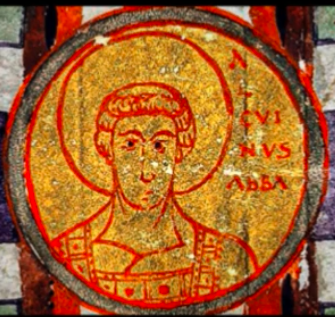
• Alcuin of York (*Yorkshire, ca. 730-†Tours, 804) •
• La Bible dite „d’Alcuin d’York“ •
• Bamberg, Staatsbibliothek (Kaiser-Heinrich-Bibliothek) – Msc. Bibl. 1, fol. 5v •
• Origine: Marmoutier (Maius Monasterium) | 37100 Tours | Département: Indre-et-Loire, France •
• ca. 834-843 •
• https://www.gnm.de/objekte/alkuin-bibel-fol-5v/ •
• Nota bene (2): Dixit le BBC: « The [circular] image above is Alcuin’s portrait, found in a copy of the Bible manufactured and illuminated in the Scriptorium of his monastery, Saint-Martin of Tours, during the rule of his successor Abbot Adalhard (834–843). Painted in red on gold leaf, it shows Alcuin with a tonsure and a halo, signifying posthumus respect for his memory at the monastery where he had died in 804. His name and rank are spelled out alongside: Alcvinvs abba, ‘Alcuin the abbot’. It is held at the Staatsbibliothek Bamberg – Kaiser-Heinrich-Bibliothek – Msc. Bibl. 1, fol. 5v (photo by Gerald Raab) »: https://www.gnm.de/objekte/alkuin-bibel-fol-5v/ • cf. Apple Podcasts Preview: https://podcasts.apple.com/gb/podcast/in-our-time/id73330895?i=1000464108914 •
• Explicit | Melvyn Bragg •
• Breay (Claire), Story (Joanna), (sous la direction de), Anglo-Saxon Kingdoms: Art, Word, War, Londres (British Library Press), 2018 •
• Bremmer (Rolf H.) (University of Leiden), “Ælfaric’s Downsized Version of Alcuin’s Investigationes Sigewulfi in Genesin: Enough is Enough”, Session 1, Sources of Anglo-Saxon Literary Culture: Alcuin, 8-V-2008, (Valley III, Room 303), dans 43rd International Congress on Medieval Studies, Western Michigan University, 8-11-V-2008, p. 2: https://scholarworks.wmich.edu/medieval_cong_archive/3/ • Nota bene: Cette présentation de Rolf Bremmer, bien documentée, apporte de nouvelles perspectives quant à l’héritage intellectuel d’Alcuin d’York, et souligne son influence sur l’époque carolingienne à travers des oeuvres et sa correspondance abondante •
• Budny (Mildred),“Assembly Marks in the Vivian Bible and Scribal, Editorial, and Organizational Marks in Medieval “, dans Making the Medieval Book: Techniques of Production. Proceedings of the Fourth Conference of the Seminar in the History of the Book to 1500, Linda L. Brownrigg (éd.), Los Altos Hills, California (Anderson-Lovelace), 1995, p. 200-205 • cf. https://archivesetmanuscrits.bnf.fr/ark:/12148/cc8447n • https://gallica.bnf.fr/ark:/12148/btv1b8455903b/f438.item •
• Bullogh (Donald A.) Alcuin. Acheivement and Reputation. Series: Education and Society in the Middle Ages and Renaissance | Volume 16, Leiden, • Boston (Brill), 2003 •
• Bullogh (Donald A.), « York, Bede’s Calendar and a Pre-Bedan English Martyrology », dans Analecta bollandiana, 121 (2), 2003-12, p. 329-355 •
• Burnett (Charles), « The Twelfth-Century Renaissance », dans The Cambridge History of Science. Volume 2: Medieval Science, David C. Lindberg, Michael H. Shank (éds.), Cambridge University Press – en ligne: 5-IX-2013, chapitre 15: p. 365-384: https://www.academia.edu/40269603/THE_TWELFTH_CENTURY_RENAISSANCE •
• Butlân (Ibn) (Abū al-Ḥasan al-Mukhtār ibn ʿAbdūn ibn Saʿdūn ibn Butlan: ابو الحسن المختار ابن عبدون بن سعدون ابن بطلان), médecin irakien chrétien nestorien (*1001-†Bagdad, 1066), auteur vers l’an 1050 d’un traité médical consacré à l’entretien de la santé, intitulé: Taqwīm al-Ṣiḥḥa تقويم الصحة (Tacuinum sanitatis, c’est-à-dire, « La préservation de la santé » ou « Tables de santé ») • cf.: Tacuinum sanitatis in medicina. Codex Vindobonensis Series Nova 2644. Rome, (Salerno Editrice), 1986, 2 Volumes, Vol. 1: 216 pages | Vol. 2: 136 pages • Hans Schott, Tacuini sanitatis Elluchasem Elimithar medici de Baldath de sex rebus non naturalibus, earum naturis, operationibus et rectificationibus […] recens exarati, Straßburg 1531. Digitalisat Ub Düsseldorf Digitalisat MDZ; deutsche Übersetzung: Michael Herr, Schachtafelen der Gesuntheyt. Hans Schott, Straßburg 1533 | Nachdruck Darmstadt, um 1970 | Neudruck: Leipzig (Weinheim a. d. Bergstraße), 1988 (avec prologue par Marlit Leber et Elfriede Starke) • Hans Zotter, Das Buch vom Gesunden leben. Die Gesundheitstabellen des Ibn Butlan in der illustrierten deutschen Ûbertragung des Michael Herr | Nach der bei Hans Schott erschienen Ausgabe Strassburg 1633. Mit 32 getreuen Farbwiedergaben aus dem Tacuinum sanitatis Codex Vindobonensis 2396. Graz (Akademische Druck- und Verlagsanstalt), 1988, 295 pages, 32 Illustrations couleur • Luisa Cogliati Arano (éd.), Tacuinum Sanitatis. Das Buch der Gesundheit, préfacé par Heinrich Schipperges et Wolfram Schmitt, München 1976 | Milano (Electa), 1988 • Hosam Elkhadem, Le Taqwim al-Sihha (Tacuini Sanitatis) d’ibn Butlan: un traité médical du XIe siècle | Histoire du texte, édition critique, traduction, commentaire. Louvain (Peeters), 1990, 346 pages, 6 Illustrations (Académie royale de Belgique, Classe des lettres, Fonds René Draguet, 7) • Alain Touwaide, « La diététique d’ibn Butlan: texte et histoire en Occident: Hosam Elkhadem, Le Taqwim al-Sihha (Tacuini Sanitatis) d’Ibn Butlan: un traité médical du XIe siècle », dans Revue d’histoire de la pharmacie, 81ᵉ année, n°297, 1993. pp. 242-244: www.persee.fr/doc/pharm_0035-2349_1993_num_81_297_3736_t1_0242_0000_3 • Danielle Jacquart, “The influence of Arabic medicine in the medieval West”, dans Encyclopedia of the History of Arabic Science, Roshdi Rashed (éd..), London (Routledge), 1996, Volume 3, p. 963–984 • Nota bene: cf. Paris, Bibliothèque nationale de France, Nouveau fonds latin, 9333 | Tacuinum sanitatis | ca. 1474 [?] | origine: Köln [?] | Texte latin, avec traduction allemande ajoutée au XVIe siècle: https://archivesetmanuscrits.bnf.fr/ark:/12148/cc773750 • https://gallica.bnf.fr/ark:/12148/btv1b105072169 • https://gallica.bnf.fr/ark:/12148/btv1b10000510z/f263 •
• Butzer (P.), Kerner (M.), Oberschelp (W.), éditeurs, [ouvrage collectif composé de 21 articles issus du Colloquium Carolus Magnus: 1200 Years of Civilisation and Science in Europe, tenu à Aix-la-Chapelle du 19 au 26 mars 1995], Karl der Grosse und sein Nachwirken. 1200 Jahre Kultur und Wissenschaft in Europa. Volume I, Wissen und Weltbild, Turnhout (Brepols), 1997: https://www.brepolsonline.net/doi/book/10.1484/m.sths-eb.5.107289 •
• Butzer (P.), Oberschelp (W.), Jongen (H.), éditeurs, avec la collaboration de J. Bemelmans, W. Dahmen, A. Krieg, W. Plesken, [ouvrage collectif 48 contributeurs, composé de 41 articles issus du Colloquium Carolus Magnus: 1200 Years of Civilisation and Science in Europe, tenu à Aix-la-Chapelle du 19 au 26 mars 1995], Karl der Grosse und sein Nachwirken. 1200 Jahre Kultur und Wissenschaft in Europa. Volume II, Mathematisches Wissen, Turnhout (Brepols), 1998: https://www.brepolsonline.net/action/showBook?doi=10.1484/M.STHS-EB.5.107290 •
• Butzer (Paul L.), „Scholars of the Mathematical Sciences in the Aachen-Liège-Maastricht Region during the past 1200 Years; an Overview“, dans Karl der Grosse und sein Nachwirken. 1200 Jahre Kultur und Wissenschaft in Europa, Volume II, Mathematisches Wissen, Butzer (P.), Oberschelp (W.), Jongen (H.), (éds.), avec la collaboration de J. Bemelmans, W. Dahmen, A. Krieg, W. Plesken, [ouvrage collectif de 48 contributeurs, composé de 41 articles issus du Colloquium Carolus Magnus: 1200 Years of Civilisation and Science in Europe, tenu à Aix-la-Chapelle du 19 au 26 mars 1995], Karl der Grosse und sein Nachwirken. 1200 Jahre Kultur und Wissenschaft in Europa, Turnhout (Brepols), 1998, p. 43-90 •
• Cabrol (Fernand), O.S.B., « Les écrits liturgiques d’Alcuin », dans Revue d’histoire ecclésiastique de Louvain, 19, 1923, p. 507-521 •
• Caiazzo (Irene), Lectures médiévales de Macrobe: Les « Glosae Colonienses super Macrobium »: étude et édition,(Études de Philosophie médiévale, 83), Paris (Vrin), 2002, 352 pages | ISBN 10 : 2711615405 ISBN 13 : 9782711615407 •
• Caiazzo (Irene), « Abbon de Fleury et l’héritage platonicien », dans Abbon de Fleury : Philosophie, science et comput autour de l’an 1000, sous la direction de B. Obrist, numéro spécial de la revue Oriens-Occidens. Sciences, mathématiques et philosophie de l’Antiquité à l’Age classique, 6 (2006), p. 11-41 : https://cnrs.academia.edu/IreneCaiazzo/Papers •
• Caiazzo (Irene), « Un commento altomedievale al De arithmetica di Boezio », Archivum Latinitatis Medii Aevi, 2000, 58 (58), pp.113-150: https://cnrs.academia.edu/IreneCaiazzo/Papers • Nota bene: This article is published on line by HAL <halshs-00132113> | https://halshs.archives-ouvertes.fr/halshs-00132113, submitted on the 21st of February, 2007, cf. https://halshs.archives-ouvertes.fr/halshs-00132113/document •
• Caiazzo (Irene), « Il rinvenimento del commento di Teodorico di Chartres al De arithmetica di Boezio », in Adorare caelestia, gubernare terrena, Atti del Colloquio internazionale in onore di Paolo Lucentini (Napoli, 6-7 novembre 2007), a cura di P. Arfé, I. Caiazzo, A. Sannino, Turnhout: Brepols 2011, p. 183-203; cf. https://cnrs.academia.edu/IreneCaiazzo/Papers •
• Caiazzo (Irene), (ed.), Thierry of Chartres: The Commentary on the De arithmetica of Boethius. Studies and Texts 191, Toronto, Pontifical Institute of Medieval Studies (PIMS), 262 pages, ISBN 978-0-88844-191-1 | 2015 • Cover: Dame Philosophy | Leipzig, Universitätsbibliothek, Ms 1253, 12th century (1st half), Origin: Pegau [?] | Boethius: De consolatione philosophiae, f. 3r • © Photo: Dr. Monica Linder, Leipzig, UBL | January 2004 • Table of Contents: Preface – p. ix • Abbreviations – p. xi • Introduction – p. 3 • [Section 1]: Thierry of Chartres and the School of Chartres – p. 3 • [Section 2]: Commentary and Commentator – p. 22 • [Section 3]: Thought, Language, Philosophy – p. 34 • [Section 4]: Traditions of Commentary on the De arithmetica – p. 70 • [Section 5]: Some Concluding Reflections – p. 80 • [Section 6]: The Present Work: From Manuscript to Edition – p. 81 • [Section 7]: Teodoricus Carnotensis: Commentum super Arithmeticam Boethii – p. 91 • Appendix: A Handlist of Medieval Commentaries on Boethius’s De arithmetica – p. 209 • Bibliography – p. 211 • Index – p. 237 • http://www.pims.ca/publications/new-and-recent-titles/publication/thierry-of-chartres-the-commentary-on-the-de-arithmetica-of-boethius | https://cnrs.academia.edu/IreneCaiazzo/Books •
• Caiazzo (Irene), « Mundana Sapientia. Jean de Salisbury et le quadrivium », dans C. Grellard et F. Lachaud (éds.), Jean de Salisbury, nouvelles lectures, nouveaux enjeux, Firenze (Sismel-Edizioni del Galluzzo), 2018, p. 253-262: https://cnrs.academia.edu/IreneCaiazzo/Papers •
• Caiazzo (Irene), « Teaching the Quadrivium in the Twelfth-Century Schools », dans A Companion to Twelfth-Century Schools, Cédric Giraud (éd.), Brill’s Companions to the Christian Tradition, 88, Leiden (Brill), 2020, chapitre 8 – p. 180-202: https://cnrs.academia.edu/IreneCaiazzo •
• Caiazzo (Irene), « Medieval Commentaries on Boethius’s De arithmetica: A Provisional Handlist », Bulletin de philosophie médiévale, 62 (2020), p. 3-13: https://cnrs.academia.edu/IreneCaiazzo/Papers •
• Caiazzo (Irene), « L’astronomie de Martianus Capella à la Faculté des arts », dans Le Moyen Âge et les sciences. Textes réunis par D. Jacquart et A. Paravicini Bagliani, Firenze 2021: SISMEL-Edizioni del Galluzzo, p. 201-222 : https://cnrs.academia.edu/IreneCaiazzo/Papers •
• Calcidius (ca. IVe – Ve siècle), J. H. Waszink (éd.), “Timaeus” a Calcidio translatus commentarioque instructus, (Plato latinus IV), London | Leiden, 1972, 2e édition: 1975, p. IX-XVII: “De Calcidio”, p. CVI-CXXX: “Elenchus codicum”; p. 1-52: Timaeus Platonis, p. 53-346: Commentarius, p. 98: “De numeris” §XLIX, Descriptio tertia • 3 Sources: (1) Lyon, B. m., 324 (257) 9th c. | (2) Valenciennes, B. m., 293 (283), 9th c. | (3) Paris, Bibliothèque nationale de France, Fonds latin 2164, 10th c.; cf. John Magee, On Plato’s Timaeus. Calcidius, edition | English translation, Harvard (Dumberton Oaks Medieval Library 41), 2016; cf. E. Mensching, “Zur Calcidius Überlieferung”, dans Vigiliae christianae Nr. 19, 1965, 43-50; J. Marenbon, From the Cercle of Alcuin to the School of Auxerre: Logiqic, Theology and Philosophy in the Early Middle Ages, Cambridge (G.B.), London, 1981, p. 57 et 167; G. Madec, Jean Scot et ses auteurs: annotations érigéniennes, Paris, 1988, p. 32 (Calcidius): Annotationes in Marcianum 10: 16, p. 49 (Plato): Annotationes in Marcianum 10: 16; Michel Huglo, “La réception de Calcidius et des Commentarii de Macrobe à l’époque carolingienne”, dans Scriptorium, t. XLIV, 1990, 1, p. 3-20, voir p. 4-10; Illo Humphrey, “Les 12 divisions de l’As, leur emploi chez Calcidius et chez Boèce”, dans Colloquia Aquitana II-2006 Boèce ([Boethius, Rome, ca. 480 - Pavie, 524): l'homme, le philosophe, le scientifique, son oeuvre et son rayonnement, Illo Humphrey (ed.), Paris (Éditions Le Manuscrit), 2009, Volume 2, chapitre 12, pages 261-274. Nota bene (1): Le Timaeus Platonis et Commentarius sont les seules oeuvres connues de Calcidius qui nous sont parvenues. Connues en Gaule et en Espagne déjà dès le VIe s., et connues peut-être même aussi d’Alcuin d’York au VIIIe s., elle furent citées au milieu du IX e s. par Johannnes Scottus Eriugena dans ses Annotationes in Marcianum, 10:16. Nota bene (2): La traduction inachevée du Timaios de Platon par Calcidius correspond au Πλάτωνος Τίμαιος ἢ περὶ Φύσεως М´ 17a-53c, lequel commence au [chapitre] 17a and se termine au [chapitre] 92c; cf. Th.-H. Martin, Études sur le Timée de Platon, t. I, p. 57-244, t. II, p. 389, 398-399; cf. Christina M. Hoenig, Plato’s Timaeus and the Latin Tradition, Cambridge (Cambridge University Press | Cambridge Classical Studies), August, 2018, chapitre 4 « Calcidius »: pages 160-213 •
• Cazaux-Kowalski (Christelle), et alia, Les Noces de Philologie et de Musicologie. Textes et musiques du Moyen Âge. Sous la direction de Christelle Cazaux-Kowalski, Christelle Chaillou-Amadieu, Anne-Zoé Rillon-Marne et Fabio Zinelli, Paris (Classiques Garnier), 2017 (Civilisation médiévale, 22). 570 pages: https://scb.academia.edu/ChristelleCazaux/Books •
• Chadwick (Henry), Boethius. The Consolations of Music, Logic, Theology, and Philosophy, Oxford, Clarendon Press, 1981 / 1990 / Oxford Scholarship Online: 2011 •
• Chabi (Kolawole) (OSA, Pontificium Institutum Patristicum Augustinianum), « Augustin et les écoles philosophiques antiques dans sa Lettre 118 à Dioscorus. Une analyse des paragraphes 12-34 », dans Revista Isidorianum Facultad de Teología San Isidoro de Sevilla, Volume 32, n° 1, 2023, p. 153-90: https://www.sanisidoro.net/publicaciones/index.php/isidorianum/article/view/Augustin-philosophie/455 • https://patristicum.academia.edu/KOLAWOLECHABI •
• Cicero (Marcus Tullius) (*106 BCE – †43 BCE), De oratore I,71; III, 32 [127]: humanitas | artes liberales •
• Cicero (Marcus Tullius) (*106 BCE – †43 BCE), Partitiones oratoriae 76-79: « summum bonum divinum » (Sommet de la bonté divine) •
• Cicero (Marcus Tullius) (*106 BCE – †43 BCE), De oratore I, 3, 11: artes liberales •
• Cicero (Marcus Tullius) (*106 BCE – †43 BCE), Pro Archia Poeta, II, 2: « Etenim omnes artes quae ad humanitatem pertinent, habent quoddam commune vinculum et quasi cognatione quadam inter se continentur »: https://www.thelatinlibrary.com/cicero/arch.shtml#2 •
• Cicero (Marcus Tullius) (*106 BCE – †43 BCE), De finibus I, 71: « in quibus nulla solida utilitas omnisque puerilis est delectatio, aut se, ut Plato, in musicis, geometria, numeris, astris contereret » | cf. https://www.thelatinlibrary.com/cicero/fin1.shtml#71 •
• Cochrane (Laura E.), « Secular Learning and Sacred Purpose in a Carolingian Copy of Boethius’s De institutione arithmetica (Bamberg, Staatsbibliothek, Msc. Class. 5) », dans Peregrinations: Journal of Medieval Art and Architecture, Volume V, Number 1, (Autumn 2015): https://mtsu.academia.edu/LauraCochrane •
• Codices Boethiani I: a Conspectus of Manuscripts of the Works of Boethius I. Great Britain and the Republic of Ireland, M. T. Gibson, L. Smith, J. Ziegler (eds.), (Warburg Institute Surveys and Texts, XXV), London, (Warburg Institute | University of London), 1995, XV-288 pages, Plates, cf. p. 42; http://warburg.sas.ac.uk/publications/surveys-and-texts/ •
• Codices Boethiani II: a Conspectus of Manuscripts of the Works of Boethius II, Austria, Belgium, Danmark, Luxembourg, The Netherlands, Sweden, Switzerland, Lesley Smith, T. Christchev, R. Gameson, A. Holdenried, F. Robb, T. Webber, J. Ziegler (eds.), (Warburg Institute Surveys and Texts, XXVII), London-Torino (Warburg Institute | University of London | Nino Aragno Editore), 2001, ISBN: 0 85481 121 4 •
• Codices Boethiani III: a Conspectus of Manuscripts of the Works of Boethius III, Italy and the Vatican City Lesley Smith, V. Longo, S. Magrini, M. Passalacqua (eds.), (Warburg Institute Surveys and Texts, XXVIII), London-Torino (Warburg Institute | University of London | Nino Aragno Editore), 2001, XXI-619 pages, ISBN: 0 85481 123 0 •
• Codices Boethiani IV: a Conspectus of Manuscripts of the Works of Boethius IV, Portugal and Spain, Lesley Smith (ed.), (Warburg Institute Surveys and Texts, XXIX),London, (Warburg Institute |University ofLondon), 2010, ISBN: 978 0 85481 150 2 •
• Contreni (John J.), “The Tenth Century, The Perspective from the Schools”, dans Haut Moyen-Âge. Culture, éducation et société. Études offertes à Pierre Riché, Michel Sot (éd.), (Centre de Recherche sur l’Antiquité tardive et le Haute Moyen-Âge de l’Université Paris-X Nanterre), Paris (Publidix), 1990, chapitre XII, p. 379-387 •
• Contreni (John J.), Carolingian Learning. Masters and Manuscripts (Variorum collected Studies Series 363), Aldershot 1992 •
• Contreni (John J.), The Cathedral School of Laon from 850 to 930. Its Manuscripts and Masters. München (Arbeo-Gesellschaft), Münchener Beiträge zut Mediävistik und Renaissance-Forschung 29, 1978, in-8°, xv-212 p., 4 Planches •
• Conybeare (Catherine), Compte rendu: « Walsh (P.G.) Augustine: De civitate Dei (The City of God), Books I & II. Edited with an Introduction, Translation and Commentary. (Aris & Phillips Classical Texts.) Pp. viii + 228. Oxford: Oxbow Books, 2005. Paper, £16.50. ISBN: 0-85668-753-7 (0-85668-752-9 hbk) »: https://brynmawr.academia.edu/CatherineConybeare?from_navbar=true •
• Conybeare (Catherine), The irrational Augustine, (Oxford Early Christian Studies), Oxford, 2006 | London, (Routledge), 2016 •
• Costrino (Artur), Alcuin’s Disputatio de rhetorica: A critical edition with studies of aspects of the text, the stemma codicum, the didactic diagrams and a reinterpretation of sources for the problem of the duality of the dialogue. PhD thesis, University of York, 2016); see full text: https://etheses.whiterose.ac.uk/17792/1/Artur-Thesis-Final2.pdf •
• Courcelle (Pierre), La Consolation de Philosophie dans la tradition littéraire, antécédents et postérité de Boèce, Paris (Études augustiniennes), 1967, chapitre II, « Alcuin et la tradition littéraire du IXe au XIe siècle sur Philosophie », p. 29-66: https://fr.scribd.com/document/444937242/La-Consolation-de-philosophie-dans-la-tradition-litte-raire-pdf •
• Courcelle (Pierre), « Les sources antiques du prologue d’Alcuin sur les disciplines », dans Philologus 110, Berlin, 1966, p. 293-305 • • Dahan (Gilbert), « Gersonide, un philosophe, un homme de science en Provence au XIVe siècle », Communauté nouvelle 37 (mai-juin 1988), p. 157-165 •
• Dahan (Gilbert), Les intellectuels chrétiens et les juifs au Moyen Âge, (Collection Cerf Patrimoines), Paris (Les éditions du Cerf), 1990 •
• Dahan (Gilbert), (éd.), Gersonide et son temps. Science et philosophie médiévales, préface de Charles Touati, Louvain – Paris (Peeters), 1991, 384 pages • Compte rendu: Attias (Jean-Christophe), « G. Dahan (éd.). Gersonide en son temps. Science et philosophie médiévales, préf. de C. Touati », dans Revue de l’histoire des religions, tome 212, n°4, 1995. pp. 495-499 • https://www.persee.fr/doc/rhr_0035-1423_1995_num_212_4_1260 •
• Dahan (Gilbert), Venard (Olivier-Thomas), (OP), « Thomas d’Aquin », KTOTV, La foi prise au mot, émission présentée par Régis Burnet, le 8 novembre 2009: https://www.youtube.com/watch?v=ebMGbn7xX1o •
• Dahan (Gilbert), « Les genres grammaticaux dans un traité d’herméneutique de la fin du XIIe siècle, le De expositione sacrae Scripturae », dans La rigueur et la passion. Mélanges en l’honneur de Pascale Bourgain, C. Giraud, D. Poirel, (éds.) Turnhout (Brepols), 2016, p. 347-357 •
• Dahan (Gilbert), Les Juifs en France médiévale, préface de Danièle Iancu-Agou, (Collection Cerf Patrimoines), Paris, (Les éditons du Cerf), 2017 •
• Dales (Douglas), Alcuin: His Life and Legacy, Cambridge, UK (James Clarke & Company), 2012, 226 pages •
• Dales (Douglas), Alcuin: Theology and Thought, (Préface: Rowan Williams), Cambridge, UK (James Clarke & Company), 2013, 360 pages, cf. p. 192 • Compte rendu: Eric Knibbs, cf. https://scholarworks.iu.edu/journals/index.php/tmr/article/view/18604/24717 •
• Davis (Jennifer R.), (Catholic University of America), “Alcuin’s Letters to Kings”, Session 1, Sources of Anglo-Saxon Literary Culture: Alcuin, 8-V-2008, (Valley III, Room 303), dans 43rd International Congress on Medieval Studies, Western Michigan University, 8-11-V-2008, p. 2: https://scholarworks.wmich.edu/medieval_cong_archive/3/ • Nota bene: Cette présentation de Jennifer Davis, bien documentée, apporte de nouvelles perspectives quant à l’héritage intellectuel d’Alcuin d’York, et souligne son influence sur l’époque carolingienne à travers des oeuvres et sa correspondance abondante •
• Deshusses (Jean), « Les messes d’Alcuin », dans Archiv für Liturgiewissenschaft, 14, 1972, p. 7-41 •
• Delbrück (Richard), “Denkmäler spätantiker Kunst: Diptychon mit Dichter und Muse”, dans Antike Denkmäler, Bd. 4, Berlin (de Gruyter), 1927 / 1931, 8-10, at 8 •
• Depreux (Philippe), « Lieux de rencontre, temps de négociation : quelques observations sur les plaids généraux sous le règne de Louis le Pieux », dans La royauté et les élites dans l’Europe carolingienne (du début du ixe aux environs de 920) [en ligne]. Lille (Publications de l’Institut de recherches historiques du Septentrion), 1998 (16-V-2021): http://books.openedition.org/irhis/2568 | ISBN : 9782905637994 •
• Depreux (Philippe), « Ambitions et limites des réformes culturelles à l’époque carolingienne », dans Revue historique, Volume 623 / n° 3, 2002, p. 721-753 •
• Depreux (Philippe), Charlemagne et les Carolingiens, Collection « La France au fil de ses rois », Paris (Tallandier), 2002 •
• Depreux (Philippe), Judic (Bruno), (sous la direction de), Alcuin, de York à Tours. Écriture, pouvoir et réseaux dans l’Europe du haut Moyen Âge, (Actes du Colloque international de Tours, 4-6 mars 2004), Annales de Bretagne et des Pays de l’Ouest, t. 111/3, Rennes (Presses universitaires de Rennes), 2004 • cf. Compte rendu: Palazzo (Eric), « Alcuin. De York à Tours. Écriture, pouvoir et réseaux dans l’Europe du haut Moyen Âge, dir. Philippe Depreux et Bruno Judic. Rennes, PUR, 2004 (Annales de Bretagne et des Pays de l’Ouest, 111/3) », dans Cahiers de civilisation médiévale, 49e année (n°194), Avril-juin 2006. La médiévistique au XXe siècle. Bilan et perspectives, sous la direction de Martin Aurell, pp. 177-178: www.persee.fr/doc/ccmed_0007-9731_2006_num_49_194_2938_t1_0177_0000_3 •
• Destrez (Jean) | OP (*1887-†1950), La « pecia », dans les manuscrits universitaires du XIIIe et du XIVe siècle, Paris (Vautrain), 1935, in-quarto, 104 pages, 35 planches en phototypie • Comptes rendus: (1) Alain de Boüard de La Forest, « La « pecia » dans les manuscrits universitaires du XIIIe et du XIVe siècle by Jean Destrez », dans Revue Historique 177, no. 3 (1936): p. 658-60 (Accessed July 30, 2021): http://www.jstor.org/stable/40945681 • (2) Auguste Dumas, « Jean Destrez. La « pecia » dans les manuscrits universitaires du XIIIe et du XIVe siècle », dans Revue d’histoire de l’Église de France, tome 22, n°96, 1936. p. 355-357: www.persee.fr/doc/rhef_0300-9505_1936_num_22_96_2775_t1_0355_0000_2 • (3) Guy Fink-Errera, « Jean Destrez et son œuvre: la pecia dans les manuscrits universitaires du XIIIe et du XIVe siècle », dans Scriptorium, tome 11 n°2, 1957. p. 264-280 | DOI: https://doi.org/10.3406/scrip.1957.2944 | www.persee.fr/doc/scrip_0036-9772_1957_num_11_2_2944 •
• Djuth (Marianne), “Vera philosophia in Augustine’s thought after 386”, dans Augustiniana 40 (Volume 53), 2003, pages 217-232 •
• Djuth (Marianne), “Augustine, Monica, and the Love of Wisdom”, dans Augustinian Studies (Volume 40 | Nr. 2), 2009, pages 217-232 •
• Djuth (Marianne), “The Body, Sensation, and the Art of Medicine in Augustine’s Early Writings 386-395”, dans Augustiniana (Volume 66), 2016, pages 63-83 •
• Doignon (Jean), (éd.), Œuvres de saint Augustin, Volume 4 – 2, Dialogues philosophiques. De ordine – L’ordre, (Institut d’Études augustiennes | Collection Bibliothèque augustinienne) [traduction française], Turnhout (Brepols), 1997 • Nota bene: Dixit Brepols – « L’ordre du monde…! Un sujet qui, cher à la pensée antique, a tenu en haleine, il y a seize siècles, pendant trois journées d’automne, le petit groupe d’étudiants avec lequel Augustin s’était « retiré » dans un domaine des environs de Milan. D’abord, au cours d’épisodes « retransmis en direct », le maître laisse parler les choses (un incident technique dans l’installation d’eau, un bruit de souris, un combat de coqs) et les hommes: l’un des jeunes est engoué de poésie. Monique, la « femme philosophe », témoigne du « royaume qui n’est pas de ce monde ». Dans un second temps, Augustin donne un « cours » sur la philosophie de l’ordre, formant les consciences à passer de la référence à l’autorité, à l’autonomie de la raison et, à cette fin, déroulant un programme d’études « libérales » (arts et sciences), qui conduit à la contemplation de Dieu. Témoin privilégié de l’expérience intellectuelle et spirituelle d’Augustin avant son acheminement au baptême, l’Ordre reflète aussi, avec une vie intense, l’effervescence culturelle d’une jeunesse universitaire à la fin de l’Antiquité. Le traité est livré dans une édition critique nouvelle du texte latin par Jean Doignon, accompagnée, outre l’introduction et la traduction, de notes complémentaires traitant des problèmes d’art et de pensée soulevés au fil des débats. » •
• Dolbeau (François), Augustin d’Hippone, Vingt-six sermons au peuple d’Afrique, Paris (Institut des études augustiniennes), 1996 •
• Dolbeau (François), Augustin et la prédication en Afrique: recherches sur divers sermons authentiques, apocryphes ou anonymes, Paris (Institut des études augustiniennes), 2005 •
• Dolbeau (François) (dir.), Saint Augustin: Le Passeur des Deux Rives, Nantes (Éditions d’Orbestier), 2010 •
• Dolbeau (François), Bibliographie | Paris | Mise à jour : 2014 | https://www.aibl.fr/IMG/pdf/dolbeau-francois_bibliographie.pdf •
• Donaghey (B.), Kaylor (N. H.), Phillips (P. E.), Szarmach (P. E.), (éds.), Remaking Boethius. The English Language Translation Tradition of ‘The Consolation of Philosophy’, Turhout (Brepols), 2019, XXVIII-496 pages, http://www.brepols.net/Pages/ShowProduct.aspx?prod_id=IS-9782503584676-1 • Compte rendu: Anthony G. Cirilla, Noel H. Kaylor: “Remaking Boethius: The English Language Translation Tradition of The Consolation of Philosophy by Brian Donaghey, Noel Harold Kaylor Jr., Philip Edward Phillips, Paul Szarmach, with assistance from Kenneth C. Hawley, Arizona Center for Medieval and Renaissance Studies | Turnhout (Brepols), 2019”, dans Carmina Philosophiae [International Boethius Society], numéros: 26 et 27, 2017, p. 201–204 • https://www.jstor.org/stable/27031203 •
• Doyle (Matthew), Peter Lombard and His Students, (Studies and Texts, 201; Mediæval Law and Theology, 8), Toronto (Pontifical Institute of Mediæval Studies), 2016, xii-302 pages • Nota bene: Dixit PIMS – [¶1] “Peter Lombard is best known for his groundbreaking theological work, the Sentences. But the exclusive focus on this work has tended to divert attention away from other aspects of his life and work. This book therefore takes a broadly biographical approach to Peter Lombard, examining him in relation to his environment and milieu. • [¶2] The book is divided into two parts, corresponding to its title. The first details Peter’s career. He came to Paris to study theology with the assistance of Bernard of Clairvaux and Uberto, bishop of Lucca, key players in the papal schism of the 1130s. After several years building a reputation in Paris, he gained entry to the canons of Notre Dame. This is seen against the background of wider changes in the church of Paris, while the canons themselves and their relationship with the cathedral school are outlined thoroughly. Part one finishes with Peter’s greatest achievements, the composition of the Sentences and his rise in the church of Paris to archdeacon and finally bishop. • [¶3] The second part, “The Master and His Students,” opens with a comprehensive treatment of Peter’s sermons, his most neglected and in some ways most revealing works. They were preached to an audience that included his students. The chapters on his students examine those who are known to have studied with him, as opposed to a loosely defined group of theologians who show his influence. This allows for a close focus on how a school operated in the twelfth century. While few of the students became full-time theologians, their training in Peter’s school was of considerable value for their future careers, and it influenced their works. In the two decades following Peter’s death, the students also increased awareness of their master’s work and defended his reputation. This was particularly important during the controversy over his Christological teachings.”: https://pims.ca/publication/isbn-978-0-88844-201-7/ • Compte rendu (1): Clare Monagle, dans The Medieval Review (IU ScholarWorks Journal), 17-IV-2014: https://scholarworks.iu.edu/journals/index.php/tmr/artic • Compte rendu (2): Donald Ostrowski, dans Speculum, Volume 93 / 4 (October), p. 1191 | https://www.journals.uchicago.edu/doi/full/10.1086/699776 •
• Dronke (Peter), Verse with Prose from Petronius to Dante. The Art and Scope of mixed form, Cambridge, Mass., 1994, voir chapitre I, “Menippean Elements”, p. 1-26 •
• Dulon (Jean), (réalisateur), Saint Augustin : Parcours d’un Berbère Romain, KTOTV, Un coproduction KTO/Grand Angle Productions 2020, avec la participation de Dominique Martinet, Nacéra Benseddik (نَصِيرة بِن صِدّيق | Université d’Alger), Samir Aounallah (Institut national du patrimoine de Tunis), Catherine Conybeare (Bryn Mawr College, Pennsylvanie | USA), Silvio Moreno (Cathédrale de Tunis), Claire Sotinel (Université Paris Est-Créteil), etc. • Nota bene: Dixit KTOTV – « ‘Le monde est comme un livre celui qui ne voyage jamais n’en lit que la première page’. Thagaste où [saint Augustin] est né, Madaure, où il a fait ses études de grammaire, Hippone dont il est devenu l’évêque, le documentaire marche sur les pas de Saint Augustin. Fils de l’Afrique Romaine, ce Père de l’Eglise Latine fascine et interroge aussi bien les chrétiens que les musulmans. S’il est connu à travers ses écrits et sa méditation sur la chute des empires, il l’est moins comme voyageur. Pourtant ses déplacements nombreux ont profondément influencé sa pensée. Le film propose donc d’emprunter les routes de l’auteur des Confessions et de la Cité de Dieu, le regard tourné vers son enseignement qui, développé dans la Tunisie Proconsulaire (Algérie et Tunisie d’aujourd’hui) d’un empire romain finissant, parle encore de nos jours. Pour entrer pleinement dans ce voyage sans risquer de se perdre les équipes de tournage ont marché sur la Via Augustina crée et présidée par un passionné de l’évêque d’Hippone: Dominique Martinet. La Via Augustina, fait partie des itinéraires Culturels du Conseil de l’Europe »: https://www.youtube.com/watch?v=26D5a5DjAI0&t=59s •
• Dutton (P. E.), Kessler (H. L.), The Poetry and Paintings of the First Bible of Charles the Bald, Ann Arbor (University of Michigan Press, c1997), 1998 • cf. https://archivesetmanuscrits.bnf.fr/ark:/12148/cc8447n • https://gallica.bnf.fr/ark:/12148/btv1b8455903b/f438.item •
• Dwyer (Ruth), “Pythagoras and the Hagia Sophia” • Nota bene: This video lecture, “is the 1st installment in Ruth Dwyer’s lecture series « Ancient Symmetria« ”, [presented in] October, 2012. [It] “discusses the role of Pythagorean mathematics and astronomy in the design of the Hagia Sophia (Ayasofia) in Istanbul, Turkey. The sophisticated, elegant and complex design make this one of the truly great buildings on Earth. The design of Hagia Sophia (Church of Holy Wisdom) is revealed to be based on [the concept of] Symmetria, the « balance and harmony of all things, based on one basic unit.” The basic unit is discovered here: the Imperial Monogram, located at the centre of the capitals on the columns in the nave”: https://www.academia.edu/4086446/Pythagoras_and_the_Hagia_Sophia • https://www.youtube.com/watch?v=x9a-qCIBdAw •
• Dwyer (Ruth), “The Comet of 536 and the Ravenna Mosaics” • Nota bene: [This video lecture, “is the 2nd installment in Dr. Dwyer's lecture series "Ancient Symmetria"”, presented in 2013]. [Here, she] discusses how the Ravenna Mosaics depict life in Justinian’s Empire before, during and after the [apocalyptic and catastrophic] Comet [in the spring of] 536”; cf.: https://www.academia.edu/4086438/The_Comet_of_536_and_the_Ravenna_Mosaics •
• https://utoronto.academia.edu/RuthDwyer •
• https://www.youtube.com/watch?v=t4WBALFPmw4 •
• Dwyer (Ruth), “Boethius, the Quadrivium and the Hagia Sophia” • Nota bene: This video lecture was presented at the 48th International Congress on Medieval Studies, Western Michigan University, Kalamazoo, Michigan, 2013; cf.: • https://www.academia.edu/4086405/Boethius_the_Quadrivium_and_the_Hagia_Sophia •
• https://www.youtube.com/watch?v=q3rOdkfQgAc •
• https://utoronto.academia.edu/RuthDwyer • https://www.youtube.com/watch?v=q3rOdkfQgAc •
• Dwyer (Ruth), “Boethius, Justinian and the Ravenna Mosaics” • Nota bene: This video lecture was presented at the 49th International Congress on Medieval Studies, Western Michigan University, Kalamazoo, Michigan, 2014; cf.: https://www.academia.edu/7018001/Boethius_Justinian_and_the_Ravenna_Mosaics • • https://www.academia.edu/4086405/Boethius_the_Quadrivium_and_the_Hagia_Sophia • • ttps://utoronto.academia.edu/RuthDwyer • https://www.youtube.com/watch?v=KpGI7MBppyY •
• Edmunds-Coopey (Jack Robert), « Alcuin and Logic: The Task of True Philosophical Thinking in the Carolingian Renaissance in Alcuin’s Prologue », dans Britain’s early Philosophers (Durham, April 1-2, 2019), University of Durham, avril 2019: https://boscobae.academia.edu/JackRobertEdmundsCoopey/Papers •
• Ellard (P. G.), « Alcuin and some favored votive masses », dans Theological Studies, 1, 1940, p. 37-61 •
• Feingold (Mordechai), (sous la direction de), History of universities, XVI/1, XVII, XVIII/1, XVIII/2, XIX, XX/1, XX/2, XXI/1, XXI/2, XXII/1, XXII/1, XXIII/2, XXIV/1 & 2, XXV/2, XXVI/1, XXVII/1, XXVIII/1 & 2, XXIX/1 (Mordechai Feingold | éd.) & 2 (Mordechai Feingold, Alexander Broadie | éds.), XXX/1 & 2, XXXI/1 & 2, XXXII/1 & 2 (Mordechai Feingold, John Watts | éds.), XXXIII/1 (Mordechai Feingold | éd.) & 2 (Mordechai Feingold, Andrea Sangiacomo | éds.), XXXIV/1 & 2 (Ku-ming Chang, Alan J. Rocke | éds.), Oxford (Oxford University Press), 2000-2021 •
• Feiss (Hugh), Mousseau (Juliet) (éds.), A Companion to the Abbey of Saint Victor in Paris, Brill (Leiden | Boston), 2017, XVIII-644 pages: (ChristianTradition: a series of handbooks and reference works on the intellectual and religious life of Europe, 500–1800), Volume 79, présenté par Christopher M. Bellitto: http://www.brill.com/products/reference-work/companion-abbey-saint-victor-paris • Compte rendu: Speculum, Volume 94, n° 4, octobre 2019, p. 1150 •
• Fink-Errera (Guy), « Une institution du monde médiéval: la “pecia” », dans Revue Philosophique de Louvain, 1962, vol. 60, numéro 66, p. 197, 3e série, tome 60, n°66, 1962, pages 184-243, DOI: https://doi.org/10.3406/phlou.1962.5153 | www.persee.fr/doc/phlou_0035-3841_1962_num_60_66_5153 •
• Fried (Johannes), „Karl der Große, die Artes liberales und die karolingische Renaissance“, Karl der Grosse und sein Nachwirken. 1200 Jahre Kultur und Wissenschaft in Europa, Volume I, Wissen und Weltbild, Butzer (P.), Kerner (M.), Oberschelp (W.), éditeurs, [ouvrage collectif composé de 20 articles issus du Colloquium Carolus Magnus: 1200 Years of Civilisation and Science in Europe, tenu à Aix-la-Chapelle du 19 au 26 mars 1995], Turnhout (Brepols), 1997, p. 25-43 •
• Fitzgerald (Allan D.), O.S.A. – S.T.D., [Blog] The works of Saint Agustine: a chronological list, Allan D. Fitzgerald, Professor, Historical Theology, Director of Special Projects, Augustinian Institute, St Augustine Center Liberal Arts Rm 451, Villanova University – Liberal Arts and Sciences: https://exploringaugustine.weebly.com/chronological-list.html •
• Fitzgerald (Allan D.), O.S.A. – S.T.D., Djuth (Marianne), (éds.), Augustine Through the Ages: An Encyclopedia, Grand Rapids, Michigan | USA (W. B. Eerdmans), 1999, 951 pages •
• Fitzgerald (Allan D.), O.S.A. – S.T.D., Vannier (Marie-Anne), (éds.), Encyclopédie saint Augustin. La Méditerranée et l’Europe IVe-XXIe siècle | Sous la direction de Allan D. Fitzgerald | Édition française sous la direction de Marie-Anne Vannier | Préface par Serge Lancel, Paris (Éditions du Cerf), 2005 • Compte rendu: Matthieu Arnold, « Encyclopédie saint Augustin. La Méditerranée et l’Europe IVe-XXIe siècle. Sous la direction de Allan D. Fitzgerald. Édition française sous la direction de Marie-Anne Vannier. Préface par Serge Lancel, Paris, Cerf, 2005 », dans Revue d’histoire et de philosophie religieuses, 86e année n°3, Juillet-septembre 2006. p. 444 • www.persee.fr/doc/rhpr_0035-2403_2006_num_86_3_1205_t8_0444_0000_2 •
• Fitzgerald (Allan D.), O.S.A. – S.T.D., Djuth (Marianne), O’Donnell (Jim), Van Fleteren (Frederick), Cavadini (John), (éds.), Préface: Jaroslav Pelikan, Augustine Through the Ages: An Encyclopedia, Grand Rapids, Michigan | USA (W. B. Eerdmans), 2009, 952 pages •
• Fleckenstein (Josef), „Alcuin im Kreis der Hof- gelehrten Karls des Grossen“, dans Science in Western and Eastern civilization in Carolingian Times, Paul Leo Butzer, Dietrich Lohrmann (éds.), Basel (Birkhäuser), 1993, p. 3-21 • Compte rendu: Bernard Ribémont dans Revue d’histoire des sciences, tome 49, n°4, 1996, www.persee.fr/doc/rhs_0151-4105_1996_num_49_4_1270_t1_0588_0000_3 •
• Folkerts (Menso), “The importance of the Pseudo-Boethian Geometria during the Middle Ages”, dans Boethius and the Liberal Arts. A collection of Essays, (Utah Studies in Literature and Linguistics, 18), M. Masi (éd.), Bern, Frankfurt-am-Main, Las Vegas, 1981, p. 187-209 •
• Fox (Michael), (University of Alberta), “Alcuin’s Letters in Anglo-Saxon England”, Session 1, Sources of Anglo-Saxon Literary Culture: Alcuin, 8-V-2008, (Valley III, Room 303), dans 43rd International Congress on Medieval Studies, Western Michigan University, 8-11-V-2008, p. 2: https://scholarworks.wmich.edu/medieval_cong_archive/3/ • Nota bene: Cette présentation de Michael Fox, bien documentée, apporte de nouvelles perspectives quant à l’héritage intellectuel d’Alcuin d’York, et souligne son influence sur l’époque carolingienne à travers ses œuvres et sa correspondance abondante •
• Fox (Michael), (Western University, Canada), “Alcuin as Exile and Educator: uir undecumque doctissimus,” dans Latin Learning and English Lore: Studies in Anglo-Saxon Literature for Michael Lapidge, O’Brien O’Keeffe (Katherine), Orchard (Andrew), (éds.), 2 Volumes, Toronto (Toronto University Press), 2005, Vol. I, p. 215-36 •
• Frank (Isnard Wilhelm), „Bettelorden“, in Lexikon für Teologie und Kirche, 3rd edition, Volume 2, Freiburg im Breisgau (Herder), 1994, columns 341-342 •
• Frank (Karl Suso), Geschichte des christlichen Mönchtums, Darmstadt (Wissenschaftliche Buchgesellschaft), 1988, p. 86–108 •
• Fuhrer (Therese), Adam (Simone), (éds.), Aurelius Augustinus. Contra Academicos [p.2], edidit et apparatu critico instruxit Therese Fuhrer, De beata vita [p. 86], edidit et apparatu critico instruxit Simone Adam, De ordine [p. 116], edidit et apparatu critico instruxit Therese Fuhrer, Berlin | Boston (De Gruyter), Göttingen (Hubert & Co. GmbH & Co. KG), 2017, Préface: Th. Fuhrer, S. Adam [p. VII-LIII], Éditions critiques/Appendix/Index nominum: p. 1-188 •
• Gadrat (Christine), Studio e «studia»: le scuole degli ordini mendicanti tra XIIIe XIV secolo, atti del XXIX convegno internazionale, Assisi, 11-13 ottobre 2001, dans Bibliothèque de l’école des chartes. 2004, tome 162, livraison 1. pp. 283- 285; https://www.persee.fr/doc/bec_0373-6237_2004_num_162_1_463341_t13_0283_0000_2 •
• Galonnier (Alain), éditeur, Boèce ou la chaîne des savoirs. Actes du Colloque international Singer-Polignac, Louvain, Paris (Peeters), Philosophes médiévaux 44, 2003, 36 études, XVIII – 789 pages, Index des auteurs cités, ISBN: 90-429-1250-2 (Peeters Leuven | Peeters Paris) • 38 Contributors | cf. Illo Humphrey: http://www.colloquiaaquitana.com/?page_id=754 | cf. Illo Humphrey | Boethius and the Liberal Arts: http://www.colloquiaaquitana.com/?page_id=754 - Bibliography II •
• Ganz (David), « Corbie and Neustrian Monastic Culture (661-849) », dans La Neustrie. Les pays au Nord de la Loire de 650 à 850. Colloque historique international, Atsma (Hartmut) (éd.), Sigmaringen (Thorbecke), 1989, Tome 2, p. 339-347 •
• Ganz (David), Corbie in the carolingian renaissance, (Beihefte der Francia, herausgegeben vom Deutschen Historischen Institut Paris, Band 20), Sigmaringen, (Thorbecke),1990, 176 page, 16 planches • Compte rendu : Gasparri (Françoise), « David Ganz, Corbie in the carolingian renaissance. Sigmaringen, 1990 (Beihefte der Francia, 20) », dans Scriptorium, Tome 47 n°1, 1993. pp. 110-114: www.persee.fr/doc/scrip_0036-9772_1993_num_47_1_1664_t1_0110_0000_3 •
• Garand (Monique-Cécile), « Les anciennes bibliothèques du XIIIe au XIVe siècle », dans Histoire des bibliothèques françaises – Les bibliothèques médiévales du VIe siècle à 1530, Vernet (André), (sous la direction de), Tome 1, Paris, (Promodis – Éditions du Cercle de la Librairie), 1989, p. 44-63 •
• Garrison (Mary Delafield), Alcuin’s World through his Letters and Verse, (Dissertation submitted for the degree of Doctor of Philosophy | Christ’s College and Corpus Christi College | University of Cambridge | December, 1995), 391 pages: https://www.academia.edu/35146344/Alcuins_World_through_his_Letters_and_Verse •
• Garrison (Mary Delafield), „The English and Irish in the Court of Charlemagne“, dans Karl der Grosse und sein Nachwirken. 1200 Jahre Kultur und Wissenschaft in Europa, Volume I, Wissen und Weltbild, Butzer (P.), Kerner (M.), Oberschelp (W.), éditeurs, [ouvrage collectif composé de 20 articles issus du Colloquium Carolus Magnus: 1200 Years of Civilisation and Science in Europe, tenu à Aix-la-Chapelle | 19-26-III-1995], Turnhout (Brepols), 1997, p. 97-118, Bibliography, p. 118-123: https://york.academia.edu/MaryGarrison/Papers •
• Garrison (Mary Delafield), « The Social World of Alcuin. Nicknames at York and at the Carolingian Court », dans Alcuin of York. Scholar at the Carolingian Court, Larj Houwen, Alasdair MacDonald (éds.), Groningue (Egbert Forsten), 1998, p. 59-79: https://york.academia.edu/MaryGarrison/Papers •
• Garrison (Mary Delafield), « Les correspondants d’Alcuin », ch. V – Les réseaux d’Alcuin et la formation d’une culture européenne, dans Annales de Bretagne et des Pays de l’Ouest, Tome 111, n° 3, 2004: https://york.academia.edu/MaryGarrison/Papers •
• Garrison (Mary Delafield), « The Library of Alcuin’s York », dans The Cambridge History of the Book in Britain: Volume 1, c. 400-1100, Richard Gameson, (éd.). Cambridge (CambridgeUniversity Press), 2011/2012: online/2019, p. 633-664: https://york.academia.edu/MaryGarrison/Papers •
• Gaskoin (Charles Jacinth Bellairs) (*1826-†1909), Alcuin: His Life and Work, London (Clay & Sons), 1904 • • Gasparri (Françoise), « Bibliothèque et archives de l’abbaye de Saint-Victor de Paris au XIIes », dans Scriptorium, 55 (2001), p. 275-284 •
• Ghisalberti (Alessandro), Tarzia (Antonio), (éds.), Cassiodoro primo umanista, préface de Franco Cardini, (Biblioteca di Cultura Medievale), Milano, (Jaca Book), 2021 •
• Gilli (Patrick), (éd.), Les élites lettrées au Moyen Âge Modèles et circulation des savoirs en Méditerranée occidentale (xiie−xve siècles), Actes des séminaires du CHREMMO, Presses universitaires de la Méditerranée, 2008 | Sommaire – Introduction : p. 9 • Enrica Salvatori : (Université de Pise) Les Malaspina : bandits de grands chemins ou champions du raffinement courtois ? Quelques considérations sur une cour qui a ouvert ses portes aux troubadours (xiie-xiiie siècles) : p. 11 • Huguette Taviani-Carozzi (Université de Provence) Culture et pratique juridiques du iudex civitatis en Italie du Sud lombarde et normande (xie-xiie siècles) : p. 29 • Pierre Racnie (Professeur émérite, Université Marc-Bloch, Strasbourg) Le notaire dans la société communale italienne (xiie-xiiie siècles) p. 59 • Joan Molina Figueras (Universitat de Girona) Francesc Eiximenis et les images de la ville idéale dans la couronne d’Aragon : p. 75 • Élisabeth Crouzet-Pavan (Université de Paris IV-Sorbonne) À propos des élites politiques vénitiennes : p. 111 • Tiziana Pesenti (Università di Roma La Sapienza ) Libri di medicina tra Padova, Bologna e Montpellier nel secolo XIV : p. 135 • Olga Weijers (Huygens Instituut, La Haye) La disputatio comme moyen de dialogue entre les universitaires au Moyen Âge : p. 155 • Pierre Jugie (Chargé de recherche, C.N.R.S.-I.R.H.T., Orléans) Les cardinaux de la papauté d’Avignon, des lettrés ? : p. 171 • Jacques Verger (Université de Paris IV-Sorbonne) Étudiants et gradués des universités du Midi à la fin du Moyen Âge : problèmes d’effectifs et d’origine : p. 195 • Jacques Verger (Université de Paris IV-Sorbonne) Le rôle des « nations » étudiantes dans la mobilité universitaire au Moyen Âge : p. 217 • Patrick Gilli (Université Paul-Valéry, Montpellier III) Les Pandectes pisanes : fortunes et infortunes d’un texte au Moyen Âge : p. 233 • Patrick Gilli (Université Paul-Valéry, Montpellier III) Les consilia de Baldo degli Ubaldi et l’élévation ducale de Gian Galeazzo Visconti : un intellectuel au service du prince ? : p. 257 • Carlos Heusch (Professeur de Littérature médiévale espagnole, École normale supérieure Lettres et sciences humaines, Lyon) Alfonso de Madrigal, dit « El Tostado », et la diffusion du savoir des Artiens de Salamanque (première moitié du xve siècle) : p. 281 • Carlos Heusch (Professeur de Littérature médiévale espagnole, École normale supérieure Lettres et sciences humaines, Lyon) Proto-humanisme et élites lettrées dans la Castille du xve siècle : p. 303 • Index des lieux : p. 333 • Index des noms : p. 337 • voir texte intégral : https://hal.science/hal-03050705/file/Elites_lettrees_HAL.pdf •
• Giraud (Cédric), A Companion to Twelfth-Century Schools, Cédric Giraud (éd.), Brill’s Companions to the Christian Tradition, 88, Leiden (Brill), 2020 • Nota bene: Dixit Brill – “Description: Leiden ; Boston : Brill, [2020] | Series: Brill’s companions to the Christian tradition, 1871-6377 ; volume 88 | Includes bibliographic reference and index. | In English; introduction and Chapters 2, 3, 7, 8, 9, and 11 were translated from French by Ignacio Duran. | Summary: “The ambition of this Companion to Twelfth-Century Schools is to provide an updateon the research regarding a question that has seen many renewals in the last three decades. The discovery of new texts, the progress made in critical attribution, the growing attention given to the conditions surrounding the oral and written dissemination of works, the use of the notion of “communityof learning”, the reinterpretation of the relations between the cloister and the urban school, the link between institutional history and social history, in short, the entire contemporary renewal of culturalhistory within international medieval studies allow to offer a new synthesis on the schools of the 12th century. Contributors are: Alexander Andrée, Irene Caiazzo, Cédric Giraud, Frédéric Goubier, Danielle Jacquart, Thierry Kouamé, Constant J. Mews, Ken Pennington, Dominique Poirel, Irène Rosier-Catach, Sita Steckel, Jacques Verger, and Olga Weijers” – Provided by publisher.”: https://brill.com/view/book/edcoll/9789004410138/front-4.xml?language=en • https://brill.com/view/title/32341?language=en •
• Godman (Peter), ed., Alcuin.The Bishops, Kings and Saints of York, Oxford Medieval Texts, Oxford (Claredon), 1982, p. 123-126 •
• Gori (Anton Francesco) [*1691-†1757] (ed.), Thesaurus veterum Diptychorum consularium et ecclesiasticorum, Firenze, 1759, Vol. 3, p. 245-248 •
• Gorochov (Nathalie), Le Collège de Navarre de sa fondation (1305) au début du XVe siècle (1418). Histoire de l’institution, de sa vie intellectuelle et de son recrutement, Paris (Éditions Honoré Champion), 1997, 753 pages • Compte rendu: Compère (Marie-Madeleine), « Nathalie Gorochov, Le Collège de Navarre : de sa fondation (1305) au début du XVe siècle (1418): histoire de l’institution, de sa vie intellectuelle et de son recrutement, Paris (Éditions Honoré Champion), 1997, (Études d’histoire médiévale: 1) », dans Histoire de l’éducation, n° 81, 1999. pp. 135-137 • https://www.persee.fr/doc/hedu_0221-6280_1999_num_81_1_3047 •
• Gorochov (Nathalie), Naissance de l’université. Les écoles de Paris d’Innocent III à Thomas d’Aquin (v.1200-v.1245), Paris (Éditions Honoré Champion), 2012, 651 pages • Compte rendu: Courtenay (William J.), (traduction française: Lucille Hagège), « Review of Naissance de l’université. Les écoles de Paris, d’Innocent III à Thomas d’Aquin, v.1200-v.1245, by Nathalie Gorochov. Annales. Histoire, Sciences sociales (French Edition), Volume 71: no. 3 », 2016, p. 788-790. Project MUSE, doi:10.1353/ahs.2016.0143 • https://muse.jhu.edu/article/644225/pdf •
• Gorochov (Nathalie), « Genèse et organisation des nations universitaires en Europe aux XIIe et XIIIe siècles », dans Nation et nations au Moyen Âge : XLIVe Congrès de la SHMESP (Prague, 23 mai-26 mai 2013), Paris (Éditions de la Sorbonne), 2014 (en ligne le 31-V-2021), p. 273-286 • http://books.openedition.org/psorbonne/21738 • https://books.openedition.org/psorbonne/21738?lang=fr • ISBN: 9791035101503 • DOI: https://doi.org/10.4000/books.psorbonne.21738 •
• Gousset (Marie-Thérèse): « Aanalyse géométrique de la miniature pleine page « David rex et prop[heta] » conservée dans [la 1ère Bible de Charles le Chauve]: Paris, BnF, Fonds latin 1, f. 215v », Paris, BnF, 23 mars 2002, 3 pages, 2 Planches (inédit): https://archivesetmanuscrits.bnf.fr/ark:/12148/cc8447n • https://gallica.bnf.fr/ark:/12148/btv1b8455903b/f438.item •
• Green (Rosalie B.), Evans (Michael), Bischoff (Christine), Curschmann (Michael), (éds.), Hortus deliciarum | Herrad of Hohenbourg (ca. 1130-1195), avec contributions de: Thomas Julian Brown, Kenneth Levy, sous la direction de Rosalie B. Green, Studies of the Warburg Institute (University of London) 36, London (Warburg Institute), Leiden (Brill), 1979, Vol. 1: Commentary, XIII-244 pages, Vol. 2: Reconstruction, XXXIII-508 pages, 360 figures ; illustrations •
• Gropp (Harald), „Propositio de lupo et carpa et fasciculo cauli – On the histoir of River-Crossing Problems“, dans Karl der Grosse und sein Nachwirken. 1200 Jahre Kultur und Wissenschaft in Europa, Volume II, Mathematisches Wissen, Butzer (P.), Oberschelp (W.), Jongen (H.), (éds.), avec la collaboration de J. Bemelmans, W. Dahmen, A. Krieg, W. Plesken, [ouvrage collectif de 48 contributeurs, composé de 41 articles issus du Colloquium Carolus Magnus: 1200 Years of Civilisation and Science in Europe, tenu à Aix-la-Chapelle du 19 au 26 mars 1995], Karl der Grosse und sein Nachwirken. 1200 Jahre Kultur und Wissenschaft in Europa, Turnhout (Brepols), 1998, p. 31- 41 •
• Guillaumin (Jean-Yves), Boèce. Institution arithmétique, (Introduction : p. VII-XCV, texte latin avec traduction française en regard : 1-178, Notes complémentaires, Livre I : p. 179-206, Notes complémentaires, Livre II : p. 207-226, Index : p. 227-252), Paris, 1995 •
• Guillelmi de Conchis (1080 [?]-1154 [?]), Glosae super Platonem, Editio nova trium codicum nuper repertorum testimonio suffulta, 1 vol. (CXLVI-402 pages, Plates), Corpus Christianorum Continuatio Mediaevalis (CCCM 203), Latin Text, Introduction: French, Bibliography p. CVII-CXLVI, Édouard Jeauneau (ed.), Turnhout (Brepols), 2006 : http://www.brepols.net/Pages/ShowProduct.aspx?prod_id=IS-9782503050393-1 • cf. also: Barbara Obrist, Irene Caiazzo (eds.), Guillaume de Conches: philosophie et science au XIIe siècle, Collection: Micrologus’ Library – 42, Florence (SISMEL-Edizioni del Galluzzo), 2011. XXVI-526 pages: http://compitum.fr/publications/2392-barbara-obrist-et-irene-caiazzo-guillaume-de-conches-philosophie-et-science-au-xiieme-siecle • William of Conches (c.1080-c.1160). De philosophia mundi, in Latin, France, second half of the 12th century: https://www.christies.com/lotfinder/Lot/william-of-conches-c1080-c1160-de-philosophia-mundi-1837650-details.aspx; http://www.thelatinlibrary.com/wmconchesphil.html • Édouard Jeauneau, Rethinking the School of Chartres, English Translation: C. Desmarais, Toronto (U.T.P.), 2009, see pages 43-56, 76, 120 • Andrew Hicks, Composing the World. Harmony in the Medieval Platonic Cosmos, Oxford (O.U.P.), 2017, cf. Appendix 1 (p. 263): William of Conches, Glosulae de magno Prisciano | Appendix 2 (p. 273): Hisdosus [Scholasticus], De anima mundi Platonica •
• Guyotjeannin (Olivier), Poulle (Emmanuel), (éds.), Autour de Gerbert d’aurillac. Le pape de l’an mil, Album de documents commentés, réunis sous la direction d’Olivier Guyotjeannin et Emmanuel Poulle, Paris (École des chartes), 37 contributeurs, 371 pages, 1996 •
• Hadot (Ilsetraut), Arts libéraux et philosophie dans la pensée antique, (Études augustiniennes • CNRS), Paris, 1984, cf. ch. I: « Les principales théories sur l’éducation et la culture générale (παιδεία | paideia) à l’époque classique », p. 11-24; ch. II: « Systèmes scolaires et culture générale à l’époque hellénistique » (6. La culture générale dans la tradition de l’Académie, le témoignage de Cicéron) p. 44-57; ch. III: « Les étapes préparatoires à la formation du cycle des sept arts libéraux dans le moyen-platonisme », p. 63-69, 69-100; ch. IV: « La naissance du cycle des sept arts libéraux dans le néoplatonisme et les conditions de sa réception par le Moyen Âge chrétien », p. 101-155; ch. VI: « L’« enkuklios paideia »: la notion et son contenu », p. 263-293 • Nota bene: Cet ouvrage, bien plus encore que celui de Henri-Irénée Marrou (Saint Augustin et la fin de la culture antique, Paris, 1958, 4e éd., 1983), constitue une contribution majeure sur l’origine, le rôle et l’organisation des sept arts libéraux dans l’Antiquité ainsi qu’au Moyen Âge. L’auteur propose, au chapitre VI, une étude approfondie sur ἡ ἐγκύκλιος παιδεία (encyclios paideia, i.e. le cycle des sept arts libéraux), lequel fut élaboré comme base de la culture générale. Ilsetraut Hadot, l’auteur de ce remarquable ouvrage, est, de par sa rigueur critique et historique, sa justesse dans l’analyse, puis par sa maîtrise de la tradition du savoir philosophique, la meilleure spécialiste actuelle sur la question de l’origine et l’évolution des sept arts libéraux •
• Hadot (Ilsetraut), « Systèmes éducatifs et culture générale : recherches sur l’origine du cycle des sept arts libéraux », dans Annuaire. t. XC, Résumés des conférences et travaux de l’école pratique des hautes études Ve section (Sciences Religieuses), Paris, 1981-1982, p. 313-316 •
• Hadot (Ilsetraut), « Geschichte der Bildung. Artes liberales », dans Einleitung in die lateinische Philologie, édité par Fritz GRAF, Stuttgart • Leipzig (Teubner Verlag), 1997, p. 17-34, cf. p. 25 (Artes liberales), p. 25-28 (Enkyklios paideia), p. 28-32 (Der Zyklus der sieben freien Künste), p. 32-34 (Varro, Disciplinae) •
• Hadot (Ilsetraut Ludoff-), Arts libéraux et philosophie dans la pensée antique. Contribution à l’histoire de l’éducation et de la culture dans l’Antiquité, Paris (CNRS), 1984 / Paris (Vrin), 2006, p. 52, 100, 101-155, 187-188, 221-222, 263-271, 272-293, etc. •
• Hadot (Ilsetraut Ludoff-), Le Néoplatonicien Simplicius à la lumière des recherches contemporaines : Un bilan critique (avec deux contributions de Philippe Vallat), Sankt Augustin, Banden-Baden (Academia Verlag), 2014 / 2020, 309 pages •
• Hadot (Ilsetraut Ludoff-), « Geschichte der Bildung. Artes liberales », dans Einleitung in die lateinische Philologie, édité par Fritz GRAF, Stuttgart • Leipzig (Teubner Verlag), 1997, p. 17-34, cf. p. 25 (Artes liberales), p. 25-28 (Enkyklios paideia), p. 28-32 (Der Zyklus der sieben freien Künste), p. 32-34 (Varro, Disciplinae) •
• Hadot (Ilsetraut Ludoff-), « Systèmes éducatifs et culture générale : recherches sur l’origine du cycle des sept arts libéraux », dans Annuaire. t. XC, Résumés des conférences et travaux de l’école pratique des hautes études Ve section (Sciences Religieuses), Paris, 1981-1982, p. 313-316 •
• Harrison (Dick), „The Lombards in the Early Carolingian Epoch“, dans Karl der Grosse und sein Nachwirken. 1200 Jahre Kultur und Wissenschaft in Europa, Volume I, Wissen und Weltbild, Butzer (P.), Kerner (M.), Oberschelp (W.), éditeurs, [ouvrage collectif composé de 20 articles issus du Colloquium Carolus Magnus: 1200 Years of Civilisation and Science in Europe, tenu à Aix-la-Chapelle du 19 au 26 mars 1995], Turnhout (Brepols), 1997, p. 125-154 •
• Hausmann (Axel), „» ..Inque pares numeros omnia conveniunt… « Der Bauplan der Aachener Palastkapelle“, dans Karl der Grosse und sein Nachwirken. 1200 Jahre Kultur und Wissenschaft in Europa, Volume I, Wissen und Weltbild, Butzer (P.), Kerner (M.), Oberschelp (W.), éditeurs, [ouvrage collectif composé de 20 articles issus du Colloquium Carolus Magnus: 1200 Years of Civilisation and Science in Europe, tenu à Aix-la-Chapelle du 19 au 26 mars 1995], Turnhout (Brepols), 1997, p. 321-366 •
• Heuclin (Jean), « Les abbés des monastères neustriens 650-850 », dans La Neustrie. Les pays au nord de la Loire de 650 à 850, (Colloque historique international tenu à Rouen, France | 1985), Hartmut Atsma (éd.), (Beihefte der Francia, 16/1), Sigmaringen (Thorbecke) 1989, ISBN 3-7995-7316-X, Tome I, p. 331, 334, 335, voir carte géographique, p. 337: ‘L’Ordo Palatii’ en Neustrie, p. 338: « Les Abbés du IXe s. », p. 339: « Les Abbés du VIIe s. », p. 340: « Les Abbés du VIIIe s. »): https://cour-de-france.fr/histoire-et-fonction/religion-spiritualite-et-esoterisme/etudes-modernes/article/les-abbes-des-monasteres-neustriens-650-850 •
• Hidrio (Guylène), « Philosophie et Sagesse divine dans les premières enluminures du De Consolatione Philosophiae de Boèce (Xe-XIe siècles): une lecture chrétienne du traité de Boèce, dans Colloquia Aquitana II – 2006 Boèce ([Boethius], Rome, ca. 480 – Pavie, ca. 524), l’homme, le philosophe, le scientifique, son oeuvre et son rayonnement, Illo Humphrey (éd.), Paris (Éditions Le Manuscrit), 2009, Tome I, chapitre 2, pages 231-238 (Notes: p. 261-278) •
• Hissette (Roland), [compte rendu]: « L’enseignement de la philosophie au XIIIe siècle. Autour du «Guide de l’étudiant» du ms. Ripoll 109. Actes du colloque international édités, avec un complément d’études et de textes, par Claude Lafleur avec la collaboration de Joanne Carrier », dans Revue Philosophique de Louvain, 4e série, Tome 100, n°3, 2002. p. 613-615: www.persee.fr/doc/phlou_0035-3841_2002_num_100_3_7439_t1_0613_0000_3 •
• Holtz (Louis), « Les bibliothèques antiques aux bibliothèques médiévales », dans Histoire des bibliothèques françaises – Les bibliothèques médiévales du VIe siècle à 1530, Vernet (André), (sous la direction de), Tome 1, Paris, (Promodis – Éditions du Cercle de la Librairie), 1989, p. 2-13 •
• Holtz (Louis), “Alcuin et la renaissance des arts libéraux”, dans Karl der Grosse und sein Nachwirken. 1200 Jahre Kultur und Wissenschaft in Europa, Butzer (P.), Kerner (M.), Oberschelp (W.), (éds.), [ouvrage collectif composé de 21 articles issus du Colloquium Carolus Magnus: 1200 Years of Civilisation and Science in Europe, tenu à Aix-la-Chapelle du 19 au 26 mars 1995], Vol. I, 1997, p. 45-60 • Houwen (L.), MacDonald (A.) (éds.), Alcuin and his Influence on European Culture: Proceedings of the Germania Latina III Conference, Groningen, September 1995 (University of Groningen), 1998 •
• Hroswitha von Gandersheim (*935 – †ca. 973-1002 [?]): Chanoinesse bénédictine allemande, poète, dramaturge, historienne Renaissance ottonienne • cf.: Minnis (Alastair), Voaden (Rosalynn), éds., Medieval Holy Women in the Christian Tradition c.1100-c.1500, xi + 748 p., 3 b/w ills., 156 x 234 mm, Turnhout (Brepols), 2010, BCEEC 1, HB, ISBN 978-2-503-53180-9 • Eckenstein (Lina) (†1931), Woman under monasticism: chapters on saint-lore and convent life between a. D. 500 and a. D. 1500, Cambridge University Press, 1896, xv, 496 pages, voir ch. V, p. 160-183 • Humphrey (Illo), Boethius. His Influence on the European Unity of Culture: from Alcuin of York (†804) to Thierry of Chartres (†ca. 1154), Nordhausen (Bautz), 2010 | 2e édition 2012, ch. 9: « Boethius and Hrotsvitha Gandersheimensis », p. 157-166 : https://u-bordeaux3.academia.edu/IlloHumphrey/Books • Humphrey (Illo), Boethius and the Liberal Arts (Database and Meta-Database): http://www.colloquiaaquitana.com/?page_id=754 | Bibliography III • ARLIMA: https://www.arlima.net/eh/hrotsvit_von_gandersheim.html •
• Hildegard von Bingen (*1098 – †1179): „La Sibylle du Rhein“ | Abbesse bénédictine allemande, fondatrice du cloître de Rupertsberg (Kloster Rupertsberg : 1147-1179, Bingen-am-Rhein, Germany 55411 | Rheinland-Pfalz [Rhénanie-Palatinat] • cf.: Minnis (Alastair), Voaden (Rosalynn), Medieval Holy Women in the Christian Tradition c.1100-c.1500, xi + 748 p., 3 b/w ills., 156 x 234 mm, Turnhout (Brepols), 2010, BCEEC 1, HB, ISBN 978-2-503-53180-9 • Eckenstein (Lina) (†1931), Woman under monasticism: chapters on saint-lore and convent life between a. D. 500 and a. D. 1500, Cambridge University Press, 1896, xv, 496 pages, voir ch. VIII, p. 256 • Humphrey (Illo), Boethius and the Liberal Arts (Database and Meta-Database): http://www.colloquiaaquitana.com/?page_id=754 | Bibliography III • ARLIMA : https://www.arlima.net/eh/hildegard_von_bingen.html •
• Herrade de Landsberg (*1125 – †1195): Abbesse bénédictine française de Hohenburg [Mont Sainte-Odile], France, l’auteur du manuscript Hortus Deliciarum (réalisé entre 1159 et 1185 | 324 feuilles de parchemin [648 pages] | grand format in-folio | 346 miniatures couleur | dessins au crayon à mine de plomb) • cf.: Minnis (Alastair), Voaden (Rosalynn), Medieval Holy Women in the Christian Tradition c.1100-c.1500, xi + 748 p., 3 b/w ills., 156 x 234 mm, Turnhout (Brepols), 2010, BCEEC 1, HB, ISBN 978-2-503-53180-9 • Hidrio (Guylène), “Philosophie et Sagesse divine dans les premières enluminures du De Consolatione Philosophiae de Boèce (Xe-XIe siècles): une lecture chrétienne du traité de Boèce”, dans Colloquia Aquitana II – 2006 Boèce [Boethius]…, Paris (Éditions Le Manuscrit), 2009, Illo Humphrey (éd.), Volume I, Chapter 2, p. 231-238 (Notes: p. 261-278) • Eckenstein (Lina) (†1931), Woman under monasticism: chapters on saint-lore and convent life between a. D. 500 and a. D. 1500, Cambridge University Press, 1896, xv, 496 pages, voir ch. VII, p. 222 • Humphrey (Illo), Boethius and the Liberal Arts (Database and Meta-Database): http://www.colloquiaaquitana.com/?page_id=754 | Bibliography III •
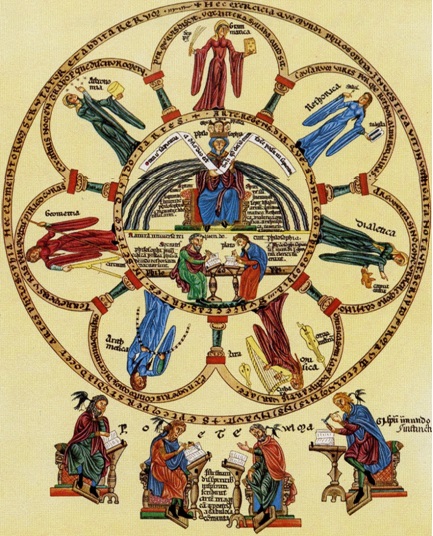
Herradis Landsbergensis (*ca. 1125 - †1195)
• (Le Jardin des Délices: Planche n° 8 | The Garden of Delights: Plate Nr. 8 | Der Wonnen-Garten: Bild Nr. 8) •
• Bibliothèque Alsatique du Crédit Mutuel | 34, rue du Wacken | 67913 Strasbourg cedex | France •
• http://www.bacm.creditmutuel.fr/fr/hortus.html •
• https://u-bordeaux3.academia.edu/IlloHumphrey/Teaching-Documents:-Peri-Paideias •
• Cf. « Péri Paideias » : p. 1 (Frontispiece) •
• Cf. « Pre-Carolingian-Carolingian-Post-Carolingian Iconography | 12 Images » | p. 10 •
Nota bene (1) | Hortus Deliciarum :
• Français: Le manuscript original d’Herrade de Landsberg, Hortus Deliciarum (Garden of Delights | Der Wonnen-Garten | L’Orto delle Delizie), fut détruit en 1870 par le feu dans l’incendie qui ravagea la Bibliothèque municipale de Strasbourg la nuit du 24 août suite à un bombardement survenu pendant la guerre Franco-Prussienne: http://www.crdp-strasbourg.fr/data/histoire/alsace_1870/bibliotheque.php?parent=8. Fort heureusement, une copie du codex avait été faite préalablement, laquelle est conservée aujourd’hui à Strasbourg dans la Bibliothèque Alsatique de la Banque Crédit Mutuel | 34, rue du Wacken | 67913 Strasbourg cedex | France : http://www.bacm.creditmutuel.fr/fr/hortus.html. Le manuscrit contient 12 descriptiones (illustrations | planches) dessinées à l’origine au crayon à la mine de plomb. Il faut noter que 12 des nombreuses descriptiones du manuscrit ont été reproduites à part en couleur en 1818 par l’artiste strasbourgeois Christian Maurice [Moritz] Engelhardt, dont la plus célèbre est la planche 8, consacrée au canon des sept arts libéraux: Quadruvium [sic] (ars arithmetica | ars musica | ars geometrica | ars astronomica) • Trivium (ars grammatica | ars dialectica or ars logica | ars rhetorica). Les sept arts libéraux sont représentés par sept femmes, séparées par sept colonnes dans une configuration circulaire, ayant Dame Philosophie [c’est-à-dire la Sagesse divine], Socrates et Platon placés au centre •
• Anglais: The original manuscript written by Herrade of Landsberg, Hortus Deliciarum (Garden of Delights | Der Wonnen-Garten | L’Orto delle Delizie), was destroyed by fire the 24th of August, 1870, following the bombing of the Municipal Library of Strasburg during the Franco-Prussian war. Fortunately, a copy of the original manuscript is conserved in Strasbourg, France at the Bibliothèque Alsatique of the Bank Crédit Mutuel Mutuel | 34, rue du Wacken | 67913 Strasbourg cedex | France : http://www.bacm.creditmutuel.fr/fr/hortus.html. Some of the original illustrations of this manuscript were done in pencil, from which 12 colour reproductions, that is to say 12 Plates, were painted in 1818 by the artist Christian Maurice [Moritz] Engelhardt. Plate nr. 8 of the said reproductions depicts the cycle of the Sevenfold Canon of the Liberal Arts: Quadruvium [sic] (ars arithmetica | ars musica | ars geometrica | ars astronomica) • Trivium (ars grammatica | ars dialectica or ars logica | ars rhetorica), represented by seven learned Women, separated by seven columns, arranged in a circle, with Lady Philosophy [that is to say Divine Wisdom], Socrates and Plato placed in the centre •
Nota bene (2) | Hortus Deliciarum:
• Français: Le symbolisme de la très emblématique descriptio 8 du Hortus Deliciarum, qui représente le canon des sept arts libéraux divisés par sept colonnes, s’inspire directement du traité d’Acluin d’York De grammatica [Disputatio de vera philosophia], lequel, à son tour, s’inspire en partie du traité sur la sagesse du roi Salomon, en l’occurrence : Sapientia [Proverbes] (Vulgata | Bonifatio Fischer OSB, Iohannes Gribomont OSB | 1983) IX, 1: “Sapientia ædificavit sibi domum excidit columnas septem” [« La sagesse a bâti sa maison, elle a taillé ses sept colonnes » (Louis Segond | 1910 / 1974)] •
• Anglais: This very emblematic representation of the Sevenfold Canon of the Liberal Arts of Plate nr. 8 in the Hortus Deliciarum can be traced back directly to the De grammatica [or Disputatio de vera philosophia] of Alcuin of York (†804), which in turn can be traced back to the biblical treatise of Solomon on wisdom, that is to say Sapientia [Proverbs] | (Vulgata) IX,I: “Sapientia ædificavit sibi domum excidit columnas septem” [“Wisdom hath builded her house, she hath hewn out her seven pillars” (Authorised Version | "King James Version" | 1611)] •
• Explicit | Herrade de Landsberg •
• Huglo (Michel), (*Lille, France, 14-XII-1921 – †Washington, D.C., USA, 13-V-2012), « Le développement du vocabulaire de l’Ars musica à l’époque carolingienne », dans Latomus 34, no. 1 (1975): p. 131-51 | http://www.jstor.org/stable/41529609 •
• Huglo (Michel), „Hans Schmid. Musica et Scholica Enchiriadis una cum aliquibus tractatulis adiunctis. Recensio nova post Gerbertinam altera ad fidem omnium codicum manuscriptorum quam edidit Hans Schmid“, Scriptorium, T. 36 n°2, 1982. p. 338-341. www.persee.fr/doc/scrip_0036-9772_1982_num_36_2_1287_t1_0338_0000_3 | https://www.musicologie.org/Biographies/m/musica_enchiriadis.html •
• Huglo (Michel), Les Tonaires. Inventaire, Analyse, Comparaison, Paris (Société Française de Musicologie), 1971 (Publications de la Société Française de Musicologie. Troisième série, tome II). 487 p. Avant-propos (2012) : http://www.musmed.fr/AdMMAe/Huglo_Tonaires_02.pdf •
• Huglo (Michel), « La réception de Calcidius et des Commentarii de Macrobe à l’époque carolingienne », dans Scriptorium, t. XLIV, 1990, n° 1, p. 3-20 •
• Huglo (Michel), « Musica ex numeris », with Appendix by Barbara Shailor and Notes by Manuel Pedro Ferreira edited by Barbara Haggh-Huglo and Graeme Boone, Academia.edu, May, 2020 • Nota bene: Dixit Barbara Haggh-Huglo - “Michel Huglo describes the history of the earliest tone systems of music from Pythagoras to Porphyry leading to a discussion of diagrams interpolated between the ‘Geometria’ and ‘Musica’ of Isidore’s ‘Etymologiae’ in Madrid, BN, ms. Vitr. 14-3, particularly a full-page diagram he attributes to Porphyry that is the earliest surviving Western tone system (scale). Following the article are: a postscript by Barbara Haggh-Huglo, a transcription by Barbara A. Shailor of the interpolations in Madrid, BN, ms. Vitr. 14-3 and ms. 10008 with translations by Leofranc Holford-Strevens, and research notes by Manuel Pedro Ferreira on the large diagram entitled “A Mozarabic musical scale?” The ensemble of texts are edited by Barbara Haggh-Huglo and Graeme Boone… This is a pre-publication copy of an article accepted for a book with publication delayed due to COVID-19.” • https://umd.academia.edu/BarbaraHaggh •
• Huglo (Michel), « Catalogues de bibliothèques médiévales et recherche en musicologie: l’exemple du Timée et le traité d’Hucblad », dans Amicorum Societas. Mélanges offerts à François Dolbeau pour son 65e Anniversaire, Études reunies par Jacques Elfassi, Cécile Lanéry, Anne-Marie Turcan-Verkerk, Estratto | Firenze (SISMEL – Edizioni del Galluzzo), 2013, p. 361-377: https://umd.academia.edu/BarbaraHaggh/Papers •
• Hugues de Saint-Victor [de Paris] (Hugo de Sancte Victore) (*1096-†1141), Didascalion. De arte legendi, (Manuel paratique sur les 7 arts libéraux écrit vers 1137), Jerome Taylor (éditeur | traducteur), The Didascalion of Hugh of Saint-Victor. A Guide to the Arts, New York | Londres (Columbia University Press), 1961 • cf. Paris, BnF, fonds latin 15256, XIIIe s. f.128-146: https://archivesetmanuscrits.bnf.fr/ark:/12148/cc759599 • https://catalogue.bnf.fr/ark:/12148/cb12222094v • cf. Leiden, Bibliothek der Rijkuniversiteit, Ms. Vucanius 45 (XIVe s.), f. 130: Portrait d’Hugues de Saint-Victor – MAGISTER• HVGO•) • cf. Antoine Destemberg, « Magister et majestas. La contribution des images à la construction de l’auctoritas magistrale à la fin du Moyen Âge », dans Faire et voir l’autorité pendant l’Antiquité et le Moyen Âge. Images et monuments, Anne-Orange Poilpré (dir.), actes de la journée d’étude tenue à Paris le 14 novembre 2014 à Institut national d’histoire de l’art, Paris, site de l’HiCSA, mis en ligne en mai 2016, p. 112-132 (voir p. 114 : note 9) • cf. Joseph Ghellinck, « Un catalogue des œuvres de Hugues de Saint-Victor », dans Revue néo-scolastique de philosophie, 20ᵉ année, n°78, 1913, p. 226-232 • cf. Arlima: https://www.arlima.net/eh/hugues_de_saint-victor.html •
• Huh (Min-Jun), “Boethius and the Problem of Universals: Focusing on the secondary commentary on Isagoge”, Seoul National University, 2023 • Dixit Min-Jun Huh: Porphyrius’ Isagoge, which is widely recognized as a major source of debate on the status of universals among Scholastic philosophers, was transmitted to the Middle Ages through Boethius’ first and second commentaries. Both commentaries delve into the ontological status of universals, but it is well acknowledged that the second commentary exerted a greater influence on later philosophers. In this second commentary, the debate on universals develops arguments against universals as realities, which seem to be partially derived from Aristotle’s third-man argument against Plato’s theory of Forms. Boethius subsequently provides a refutation, likely drawn from some Greek commentaries influenced by Alexander of Aphrosidias. The purpose of this paper is to present, for the first time, a Korean translation of the section of Boethius’ second commentary (ed. Brandt, p.160, 6-167, 20) that deals with universals, along with explanatory notes that incorporate the findings of previous studies. Additionally, my commentary aims to identify the influence of Plato’s Parmenides 132d1-133a6 as a potential source for the argument against universals. Boethius’ theory on universals appears to be further rooted in Aristotle’s theory of the soul and can be illuminated by Alexander’s treatment of mathematical universals, as it is discussed in his commentary on Aristotle’s Metaphysics (ed. Hayduck 52, 13-19) : https://snu-kr.academia.edu/minjunHuh •
• Humphrey (Illo), Boethius and the Liberal Arts (Database and Meta-Database): http://www.colloquiaaquitana.com/?page_id=754 •
• Humphrey (Illo), « Étude proto-philologique sur Boethii De institutione arithmetica libri duo, dans 5 manuscrits du IXe siècle: Paris, BnF: Fonds latin 14 064, latin 7183, latin 13009, n.a.l. 1614, latin 6639 ». Étude historique • Étude proto-philologique et édition critique princeps des gloses • Étude paléographique: glossaire critique de sténographie latine (158 entrées) • 7 planches hors-texte • catalogue des manuscrits mentionnés • glossaire critique de sténographie latine • glossaire critique de signes de renvoi (notae sentenciarum) • Carmina Philosophiae (© International Boethius Society: ISSN#1075-4407) n° 14, 2005, p. 57 – 158: https://u-bordeaux3.academia.edu/IlloHumphrey/Papers •
• Humphrey (Illo), “Boethii De institutione musica libri quinque : auctor, opus, interpres”, Review Essay, Meyer (Christian), éd., Boèce, Traité de la Musique (Introduction, traduction, notes), Turnhout, (Brepols), 2004, dans Carmina Philosophiae (Journal of the International Boethius Society, USA), n° 14, 2005, p. 167 – 175, ISSN: # 1075-4407: https://u-bordeaux3.academia.edu/IlloHumphrey/Papers (Compte rendu en langue française | Review-Essay in English) •
• Humphrey (Illo), Boethius De institutione arithmetica libri duo. Édition proto-philologique intégrale princeps d’un manuscrit du IXe siècle (Paris, Bibliothèque nationale de France, latin 14064), Texte, gloses, notes tironiennes, signes de renvoi. ©Institute of Medieval Music (IMM), Musicological Studies Volume LXXXVI, ISBN: 978-1-896926-90-2, Ottawa, Canada, 2007: https://u-bordeaux3.academia.edu/IlloHumphrey/Books • Nota bene: Cet ouvrage contient les éléments suivants: Prologue (en langue anglaise), Introduction (en langue française), Catalogue des manuscrits (en langue française), Édition critique proto-philologique intégrale princeps: texte, gloses, signs de renvoi du Boethii De institutione arithmetica libri duo, conservé dans le manuscrit Paris, BnF, Fonds latin 14064, IXe siècle (en langue latine), Glossaire critique de Latin Sténographie (notae tironianae): 1106 entrées, Glossaire critique des Signs de renvoi (notae sententiarum): 52 entrées, 7 Planches, Index latin, Index grec, Index des manuscrits • Nota bene: Cette publication constitue une version abrégée de la thèse de doctorat d’Illo Humphrey, soutenue, avec la mention Très honorable à l’unanimité, à l’Université de Paris X – Nanterre, le vendredi, 26 mars, 2004, enregistrée au Fichier central des Thèses (UPX-Nanterre): Nr. 9413058J •
• Humphrey (Illo), (éd.), 2 Volumes: Colloquia Aquitana II – 2006. Boèce [Boethius, Rome, ca. 480 – Pavie, ca. 524], l’homme, le philosophe, le scientifique, son oeuvre et son rayonnement, Actes des Colloquia Aquitana II – 2006, colloque tenu à Duras (France – 47120) du 3 au 5 août 2006 | Contient: 7 études préliminaires, 21 chapitres, 60 Planches hors-texte, 87 Figures, 21 Tableaux pédagogiques, Appendices: Bibliographies (Arts libéraux, Prosopographie, Hagiographie, Sitographie), Index-Glossaire général complet (Manuscrits cités,Noms, Lieux, Concepts, Vocabulaire grec, Figures), Paris (Éditions Le Manuscrit), Tome 1 (ISBN 978-2-304-00564-6): 535 pages; Tome 2 (ISBN 978-2-304-00566-0): 520 pages, mars 2009: https://u-bordeaux3.academia.edu/IlloHumphrey/Books •
• Humphrey (Illo), « La philosophie de l’image dans la pratique iconographique carolingienne (quelques observations sur la pratique iconographique en Neustrie au IXe siècle): l’exemple du scriptorium de Saint-Martin de Tours entre 830 et 851 », dans Colloquia Aquitana II – 2006 Boèce ([Boethius], Rome, ca. 480 – Pavie, ca. 524)…, Illo Humphrey (éd.), Paris (Éditions Le Manuscrit), 2009, Vol. 1, chapitre 3, p. 279-313: https://u-bordeaux3.academia.edu/IlloHumphrey/Papers • https://archivesetmanuscrits.bnf.fr/ark:/12148/cc8447n • https://gallica.bnf.fr/ark:/12148/btv1b8455903b/f438.item •
• Humphrey (Illo), “Le Régime de l’Octave: ses applications chez Pláton, chez Nikómachos o Gerasinós et chez Boèce”, in Colloquia Aquitana II – 2006 Boèce ([Boethius]: Rome, ca. 480 – Pavie, ca. 524): l’homme, le philosophe, le scientifique, son œuvre et son rayonnement, Illo Humphrey, (éd.), 2 Volumes, Actes des Colloquia Aquitana II du 3 au 5 août 2006, colloque tenu Duras (France – 47120), Paris (Éditions Le Manuscrit), 2009, Volume 2, chapitre 11, p. 233-260 (Notes: voir pages 256-260): https://u-bordeaux3.academia.edu/IlloHumphrey/Books •
• Humphrey (Illo), « Épilogue. Boethius, Ad mensam Philosophiæ », dans Colloquia Aquitana II – 2006 Boèce ([Boethius], Rome, ca. 480 – Pavie, ca. 524): l’homme, le philosophe, le scientifique, son œuvre et son rayonnement, Illo Humphrey (éd.), 2 Volumes, (Éditions Le Manuscrit), 2009, Volume 2, p. 469-476: https://u-bordeaux3.academia.edu/IlloHumphrey/Papers •
• Humphrey (Illo), Boethius. His Influence on the European Unity of Culture: from Alcuin of York (†804) to Thierry of Chartres (†1154), 237 pages, Nordhausen, Germany (Traugott Bautz Verlag), 2010 | 2012: https://u-bordeaux3.academia.edu/IlloHumphrey/Books •
• Humphrey (Illo), Boethius. His Influence on the European Unity of Culture: from Alcuin of York (†804) to Thierry of Chartres (†1154), Nordhausen, Germany (Traugott Bautz Verlag), 2010 | 2012, ch. 1: « Boethius and Alcuin of York », p. 49-59: https://u-bordeaux3.academia.edu/IlloHumphrey/Papers •
• Humphrey (Illo), Boethius. His Influence on the European Unity of Culture: from Alcuin of York (†804) to Thierry of Chartres (†ca. 1154), Nordhausen, (Bautz), 2010 | 2e édition 2012, ch. 5: “Boethius and the Cognitive Process”, p. 91-112; voir p. 93-95; 104-112: https://u-bordeaux3.academia.edu/IlloHumphrey/Papers •
• Humphrey (Illo), Boethius. His Influence on the European Unity of Culture: from Alcuin of York (†804) to Thierry of Chartres (†1154), Nordhausen, Germany (Taugott Bautz Verlag GmbH), 2010 | 2e édition 2012, ch. 11: « Boethius and Fulbertus Carnotensis », p.175-178; ch. 12: « Boethius and Theodoricus Carnotensis », p. 179-186: https://u-bordeaux3.academia.edu/IlloHumphrey/Papers •
• Humphrey (Illo), « Boethius. (*Rome, ca. 480 – Pavia, †ca. 524), the liberal arts, and the origin of the mediæval university: Studia generalia, a fundamentally humanitarian institution born out of the urban mediæval society ». Conférence présentée par Illo Humhprey, PhD-HDR, le jeudi 18 mars 2010, à l’University of Central Florida, Orlando, dans le cadre du Research Colloquium of the Department of Public Administration, organissé par le Center for Public and Nonprofit Management (CPNM): https://u-bordeaux3.academia.edu/IlloHumphrey/Talks •
• Humphrey (Illo), DVD: Boethius. The Origin of the Mediæval University. A Conversation with Jim Downing, Suchy Productions | Orange TV-Vision TV | Orlando, Floride | 28-V-2010: • https://u-bordeaux3.academia.edu/IlloHumphrey/Talks • • https://www.youtube.com/watch?v=Co0W0PdFEx0 • • https://www.youtube.com/user/colloquiaaquitana/videos?view=1 •
• Humphrey (Illo), Boethius. His Influence on the European Unity of Culture: from Alcuin of York (†804) to Thierry of Chartres (†ca. 1154), Illo Humphrey, Nordhausen, (Bautz), 2010 | 2e édition 2012, ch. 5: “Boethius and the Cognitive Process”, p. 91-112; voir p. 93-95; 104-112: https://u-bordeaux3.academia.edu/IlloHumphrey/Books •
• Humphrey (Illo), Boethius. His Influence on the European Unity of Culture: from Alcuin of York (†804) to Thierry of Chartres (†ca. 1154), Nordhausen, Germany (Taugott Bautz Verlag GmbH), 2010 | 2e édition 2012, ch. 11: « Boethius and Fulbertus Carnotensis”, p.175-178 ; ch. 12: “Boethius and Theodoricus Carnotensis”, p. 179-186: https://u-bordeaux3.academia.edu/IlloHumphrey/Books •
• Humphrey (Illo), « Le Régime de l’Octave: Principe fondamental de raisonnement arithmétique et musical chez Πλάτων, chez Νικόμαχος ὁ Γερασηνός et chez Manlius Boethius », (deuxième version augmentée), dans Colloque ICONEA-2014: Arithmetical Subjectivism or Unconscious Knowlegde ?, R. Dumbrill, éd., London, 2016: https://u-bordeaux3.academia.edu/IlloHumphrey/Papers •
• Humphrey (Illo), « Pre-Carolingian-Carolingian-Post-Carolingian Iconography: 12 Images », Teaching Documents-Peri Paideias | Academia.edu | 7-V-2021: https://u-bordeaux3.academia.edu/IlloHumphrey/Teaching-Documents:-Peri-Paideias •
• Humphrey (Illo), « Περὶ Παιδείας », Teaching Documents-Peri Paideias | Academia.edu | 7-V-2021: https://u-bordeaux3.academia.edu/IlloHumphrey/Teaching-Documents:-Peri-Paideias •
• Humphreys (Kenneth William), « Les bibliothèques des ordres mandiants », dans Histoire des bibliothèques françaises – Les bibliothèques médiévales du VIe siècle à 1530, Vernet (André), (sous la direction de), Tome 1, Paris, (Promodis – Éditions du Cercle de la Librairie), 1989, p. 124-145 •
• Iogna-Prat (Dominique), Jeudy (Colette), Lobrichon (Guy), (éds.), Lécole carolingienne d’Auxerre: De Muretach à Rémi (830-908), (Entretiens d’Auxxerre n° VII | 6-9-IX-1989), Préface de Georges Duby, Paris (Beauchesne), 23 contributeurs, 506 pages, 1991 •
• Irvine (Susan), Rudolf (Winfried), Childhood and adolescence in Anglo-Saxon literary culture, Toronto (University of Toronto Press), 2018, p. 162-201 •
• Irvine (Susan), The Old English Boethius with Verse Prologues and Epilogues Associated with King Alfred [avec la collaboration de Malcolm Godden], Dumbarton Oaks Medieval Library, Cambridge, Massachusetts (Harvard University Press), 2012 •
• Irvine (Susan), The Old English Boethius: An Edition of the Old English Versions of Boethius’s De Consolatione Philosophiae [avec la collaboration de Malcolm Godden], 2 Volumes, Oxford (Oxford University Press), 2009 •
• Jaeger (C. Stephen), “Victorine Humanism”, dans A Companion to the Abbey of Saint Victor in Paris, Hugh Feiss, Juliet Mousseau (éds.), Brill (Leiden | Boston), 2017, XVIII-644 pages, cf. chapitre 3, 79-112: https://www.academia.edu/35091275/Victorine_Humanism?email_work_card=view-paper •
• Jaeger (Werner Wilhelm) *Lobberich, Germany, 1988-†Cambridge, Massachusetts, 1961, Paideia: Die Formung des griechischen Menschen, Berlin (De Gruyter), 1954 / 1973, 2 vol., 1398 pages | [version italienne : Firenze (La Nuovo Italia), 1954 | version espagnole : Madrid (Fondo Cultura Económica), 1984 | version anglaise : New York (Oxford University Press), 1986 | version française : Paris (Gallimard), 1988] •
• Jaffé (Philipp) (*1819-†1870), Wattenbach (Wilhelm) (*1819-†1897), (éds.), Einharti Vita Caroli Magni, in-octavo, Berlin (Weidmann), 1876 •
• Jalabert-Guerreau (A.), Abbon de Fleury. Questiones grammaticales, Paris (Les Belles Lettres), 1982 | 2012: https://www.lesbelleslettres.com/livre/2186-questions-grammaticales •
• Jong (Mayke de), ‘From scholastici to scioli: Alcuin and the formation of an intellectual élite’, dans Alcuin of York. Scholar at the Carolingian Court, L.A.J.R. Houwen, A.A. McDonald (éds.), Germania Latina 3, Groningen, 1998, p. 45-57: https://uu.academia.edu/MaykedeJong •
• Judic (Bruno), Depreux (Philippe), (sous la direction de), Alcuin, de York à Tours. Écriture, pouvoir et réseaux dans l’Europe du haut Moyen Âge, (Actes du Colloque international de Tours, 4-6 mars 2004), Annales de Bretagne et des Pays de l’Ouest, t. 111/3, Rennes (Presses universitaires de Rennes), 2004 • cf. Compte rendu: Palazzo (Eric), « Alcuin. De York à Tours. Écriture, pouvoir et réseaux dans l’Europe du haut Moyen Âge, dir. Philippe Depreux et Bruno Judic. Rennes, PUR, 2004 (Annales de Bretagne et des Pays de l’Ouest, 111/3) », dans Cahiers de civilisation médiévale, 49e année (n°194), Avril-juin 2006. La médiévistique au XXe siècle. Bilan et perspectives, sous la direction de Martin Aurell, pp. 177-178: www.persee.fr/doc/ccmed_0007-9731_2006_num_49_194_2938_t1_0177_0000_3 •
• Jullien (Marie-Hélène), Perelman (Françoise), (éds.), Clavis Scriptorum Latinorum Medii Aevi. Auctores Galliae, [de] 735 [à] 987, II: Alcuinus, Turnhout (Brepols), 1999) • Compte rendu : Christian Menage, « Clavis scriptorum latinorum Medii Aevi Auctores Galliae, 735-987. (Clavis des auteurs latins du Moyen Age, Territoire français; 735-987), II, Alcuin, red. Marie- Hélène Jullien et Françoise Perelman. Turnhout, Brepols, 1999 », dans Bibliothèque de l’école des chartes. 2002, tome 160, livraison 2, pages 715-716: www.persee.fr/doc/bec_0373-6237_2002_num_160_2_461689_t1_0715_0000_2 •
• Kijewska (Agnieszka), “Divine Logos in the Heart of Boethius’s Path toword Summum Bonum”, dans Revista Española de Filosofía Medieval, 21 (2014), ISNN: 1133-0902, pp. 39-52: https://www.academia.edu/25995772/DIvINE_LOGOS_IN_ThE_hEART_OF_bOEThIUSS_pATh_TOwARD_SuMMuM_BONuM?email_work_card=view-paper •
• Knibbs (E.), Matter (E. A.), (éds.), Alcuini Eboracensis: De fide sanctae Trinitatis et de incarnatione Christi. Quaestiones de sancta Trinitate (Corpus Christianorum: Continuatio Mediaevalis 249), Turnhout (Brepols), 2012 • Nota bene: Dixit Brepols – « Alcuin wrote his De fide sanctae Trinitatiset de Incarnatione Christi in 802, as Charlemagne was concluding his decades-long war in Saxony. Considered by many to be Alcuin’s masterpiece, the De fide was one of the most widely read and circulated works in the entire Alcuinian corpus; today it survives in 100 medieval manuscripts. Alcuin wrote specifically to provide guidelines for the catechetical instruction of pagan Saxons. His short treatise thus provides rare, direct evidence for the content of early medieval missionary preaching. Together with several companion texts, including a credal statement, a litany, and a series of questions and answers addressed to Alcuin’s pupil Fredegisus, the De fide sheds light on a wide range of Carolingian-era theological preoccupations, with discussions on topics as diverse as the procession of the Holy Spirit, the Incarnation, the two natures of Christ, and the resurrection of the body. • Eric Knibbs is Assistant Professor of History at Williams College. • E. Ann Matter is the William R. Kenan, Jr. Professor in the Department of Religious Studies at the University of Pennsylvania. Her previous editions include Paschasius Radbertus’s De partu virginis (Corpus Christianorum, Continuatio Mediaeualis 56C). She has published on medieval biblical exegesis and spirituality from the fifth to the sixteenth centuries, including The Voice of My Beloved: The Song of Songs in Western Medieval Christianity (Philadelphia, 1990). • Table of Contents: [1] Alcuinus - De fide sanctae trinitatis et de incarnatione Christi (De fide sanctae et individuae trinitatis) - ed. E. Knibbs, E.A. Matter [2] Alcuinus - Quaestiones de sancta trinitate (De trinitate ad Fredegisum quaestiones XXVIII) - ed. E. Knibbs, E.A. Matter • Review[s]: [1] « This excellent critical edition, thanks to Professors Knibbs and Matter, provides a reliable text which will allow scholars to study and evaluate the contribution of Alcuin to the theology of his day as well as his influence upon theologians into the thirteenth century and beyond. » (Jerry Etzkorn, in: The Medieval Review, 13.07.12) [2] »This expert edition reminds us that Alcuin was the friend of Charlemagne because he could guide his master into the kingdom of heaven, and that his understanding of the more incredible Christian doctrines was more influential than any number of his letters or even his verses. It is good that Alcuin’s twenty-first-century friends know where to start. » (David Ganz, in: Early Medieval Europe, 2014, 22 (2), p. 233-234) » •
• Köhler (W.), Die karolingischen Miniaturen, Band I: Die Schule von Tours; Band 2: Die Bilder, p. 13, 27, 102; Tafelband, I (3): 72: https://archivesetmanuscrits.bnf.fr/ark:/12148/cc8447n • https://gallica.bnf.fr/ark:/12148/btv1b8455903b/f438.item •
• Laffitte (Marie-Pierre), Denoël (Charlotte), Trésors carolingiens. Livres manuscrits de Charlemagne à Charles le Chauve, (Exposition du 20-III-2007 au 24-VI-2007 à la Bibliothèque nationale de France-Site Richelieu), Catalogue de l’exposition réalisé avec la collaboration de Besseyre (Marianne), Préface de Caillet (Jean-Pierre), Paris (Éditions de la Bibliothèque nationale de France), 2007 • voir Expositon en ligne, Rubriques: « Repères – Principaux acteurs de la Renaissance carolingienne »: http://expositions.bnf.fr/carolingiens/reper/01.htm • « Bibliographie générale »: http://expositions.bnf.fr/carolingiens/reper/06.htm •
• Laffitte (Marie-Pierre), Denoël (Charlotte), Trésors carolingiens. Livres manuscrits de Charlemagne à Charles le Chauve, (Exposition du 20-III-2007 au 24-VI-2007 à la Bibliothèque nationale de France (Site Richelieu), Catalogue de l’exposition réalisé avec la collaboration de Besseyre (Marianne), Préface de Caillet (Jean-Pierre), Paris (Éditions de la Bibliothèque nationale de France), 2007 • voir Expositon en ligne, Rubriques: « Repères – Principaux acteurs de la Renaissance carolingienne »: http://expositions.bnf.fr/carolingiens/reper/01.htm • « Bibliographie générale »: http://expositions.bnf.fr/carolingiens/reper/06.htm •
• Lafleur (Claude), Carrier (Joanne), (éds.), L’enseignement de la philosophie au XIIIe siècle. Autour du «Guide de l’étudiant» du ms. Ripoll 109, Actes du colloque international édités, avec un complément d’études et de textes, (Studia Artistarum: Études sur la Faculté des arts dans les Universités médiévales | 5), xvm-721 pages, Turnhout (Brepols), 1997 • Compte rendu: Roland Hissette, « L’enseignement de la philosophie au XIIIe siècle. Autour du «Guide de l’étudiant» du ms. Ripoll 109. Actes du colloque international édités, avec un complément d’études et de textes, par Claude Lafleur avec la collaboration de Joanne Carrier », dans Revue Philosophique de Louvain, 4e série, Tome 100, n°3, 2002. p. 613-615: www.persee.fr/doc/phlou_0035-3841_2002_num_100_3_7439_t1_0613_0000_3 •
• Lafleur (Claude), Carrier (Joanne), Bibliographie: http://opac.regesta-imperii.de/lang_en/autoren.php?name=Lafleur%2C+Claude • https://philpeople.org/profiles/535638/publication_attributions?order=date&page=1&topic_id=&utf8=%E2%9C%93 •
• Lafleur (Claude), “ ‘Les guides de l’étudiant’ de la Faculté des Arts de l’Université de Paris au XIIIe siècle”, dans Philosophy and Learning. Universities in the Middle Ages, éds. : Maarten J.F.M. Hoenen, Jakob Hans Josef Schneider, Georg Wieland, (Education and Society in the Middle Ages | Volume 6), Leiden | New York | Köln (Brill), 1995, p. 137-200 •
• Lafleur (Claude), « L’enseignement philosophique à la Faculté des arts de l’Université de Paris en la première moitié du XIIIe siècle dans le miroir des textes didascaliques » Laval théologique et philosophique | Volume 60, n° 3, 2004, p. 409-448 •
• Lambertini (Gastone), „Die Schule von Salerno und die Universitäten von Bologna und Padua“, dans Illustrierte Geschichte der Medizin. Richard Toellner, u. a., (éds.), (Deutsche Bearbeitung), Sonderauflage, Salzburg, 1986, Band II, pages: 726–729 •
• Lancel (Serge) (éd.), Gesta Conlationis Carthaginiensis, anno 411 accedit sancti Augustini Breviulus Conlationis cum Donatistis, (Corpus Christianorum Series Latina CXLIX A), Turhout (Brepols), 1974, Préliminaires (Avant-Propos, Introduction): V-XXXIV pages: (Édition): 340 pages; cf. pages 4-52: Capitula Gestorum Marcelli; pages 53-257: Gesta Conlationis (1er, 3, 8 juin l’an 411); pages 261-306: Breviculus Conlationis Augustini [Patrologiae cursus completus. Series latina, éd. Jacques-Paul Migne, Tome 43, colonne 613]. Cet ouvrage constitue le n° CXLIX A (149 A) du Corpus Chistianorum Series Latina (CCSL), et le n° 194 dans Les Sources Chrétiennes (LSC), Éditions du Cerf, 1972 •
• Lebecq (Stephen), Perrin (Michel), Szerwiniack (Olivier), (éds.), Bède le Vénérable. Entre tradition et postérité, Symposium tenu à l’Université de Lille 3, Villeneuve d’Ascq, 3-6-VII-2002, Lille (France – 59000), CEGES, 2005 •
• Leff (Gordon), „Die artes liberales 1: Das Trivium und die drei Philosophien“, dans Geschichte der Universität in Europa, Rüegg (Walter), Ridder-Symoens (Hilde de) (éds.), Band I: Mittelalter, München (C. H. Beck), 1993, 4. Teil – Kapitel 10: p. 279–302 •
• Leff (Gordon), „Alcuin of York (c. 730/35 – 804)“, dans Karl der Grosse und sein Nachwirken. 1200 Jahre Kultur und Wissenschaft in Europa, Volume II, Mathematisches Wissen, Butzer (P.), Oberschelp (W.), Jongen (H.), (éds.), avec la collaboration de J. Bemelmans, W. Dahmen, A. Krieg, W. Plesken, [ouvrage collectif de 48 contributeurs, composé de 41 articles issus du Colloquium Carolus Magnus: 1200 Years of Civilisation and Science in Europe, tenu à Aix-la-Chapelle du 19 au 26 mars 1995], Turnhout (Brepols), 1998, p. 3-9 •
• Le Goff (Jacques), The Birth of Purgatory. English transltion by Arthur Goldhammer, Chicago (University of Chicago Press), 1984 •
• Lehmann (Paul), « Fuldaer Studien. Neue Folge », Sitzungsberichte, Bayerische Akademie (Philologische-Historische Klasse, 1927 | Abhandlung 2), p. 8-9, une étude sur l’Epistola Caroli regis de litteris colendis Bauogulfo abbati et omni congregationi…, dans Oxford, Bodleian laudianus Misc. 125 (VIIIe s., vers 787[?]) •
• Lines (David A), “The University and the City: Cultural Interactions”, dans A Companion to Medieval and Renaissance Bologna, Sarah Rubin Blanshei (éd.), Leiden (Brill), 2017, pages: 436–473 •
• Lombardus (Petrus) (Pierre Lombard, *Lumellogno, Novare-Piémont, Italie, ca. 1095-1100-†Paris, 1160), Libri quattuor sententiarum, cf.: [1] Pierre Lombard, Les Quatre livres des sentences. Premier livre, traduction: Marc Ozilou, Paris (Éditions du Cerf, Sagesses chrétiennes), 2012, 592 pages • [2] Pierre Lombard, Les Quatre livres des sentences. Second livre, traduction: Marc Ozilou, Paris (Éditions du Cerf, Sagesses chrétiennes), 2013, 512 pages • [3] Pierre Lombard, Les Quatre livres des sentences. Troisième livre, traduction: Marc Ozilou, Paris (Éditions du Cerf, Sagesses chrétiennes), 2014, 512 pages • [4] Pierre Lombard, Les Quatre livres des sentences. Quatrième livre, traduction: Marc Ozilou, Paris (Éditions du Cerf, Sagesses chrétiennes), 2015, 592 pages • Compte rendu: Isabel Iribarren, « Pierre Lombard, Les Quatre Livres des Sentences. Premier Livre », Revue des sciences religieuses [En ligne], 86/3 | 2012, mis en ligne le 15 juillet 2014, consulté le 19 juillet 2021: http://journals.openedition.org/rsr/1520 | DOI : https://doi.org/10.4000/rsr.1520 •
• Maarten (J.F.M.), Hoenen (Jakob), Schneider (J. Hans Josef), Wieland (Georg), (éds.), Philosophy and Learning. Universities in the Middle Ages, (Education and Society in the Middle Ages | Volume 6), Leiden | New York | Köln (Brill), 1995 •
• Madec (Goulven), (*1930-†2008), Saint Augustin et la philosophie. Notes critiques (Études augustiniennes. Série Antiquité, 149). 1 Volume | 24 x 16 | 166 pages | Paris, Institut d’Études Augustiniennes, 1996/2013 •
• Madec (Goulven), (*1930-†2008), Œuvres de saint Augustin, Volume 6, Dialogues philosophiques : De magistro – De libero arbitrio, édition critique, traduction et commentaire, Desclée de Brouwer, 1976 •
• Madec (Goulven), (*1930-†2008), Œuvres de saint Augustin, Volume 8 : La foi chrétienne : De uera religione, De utilitate credendi, De fide rerum quae non uidentur, De fide et operibus, Introductions, traduction et notes par J. Pegon. Mise à jour par G. Madec, Paris, Desclée de Brouwer, 1982 •
• Marchesin (Isabelle), L’Image organum. La représentation de la musique dans les psautiers médiévaux 800 – 1200, Turnhout (Brepols), 2000, p. : 14, 19, 21, 25-26, 54, 63, 83, 11-112, 123-124, 131, Illustrations: D • 12 • 12*: https://inha-fr.academia.edu/IsabelleMarchesin • cf. https://archivesetmanuscrits.bnf.fr/ark:/12148/cc8447n • https://gallica.bnf.fr/ark:/12148/btv1b8455903b/f438.item •
• Marenbon (John), From the Circle of Alcuin to the School of Auxerre: Logic, Theology and Philosophy in the Early Middle Ages, (Cambridge Studies in Medieval Life and Thought: Third Series), London | New York | Melbourne | etc. (Cambridge University Press), 1981 / 2006 •
• Marenbon (John), Boethius, Great Medieval Thinkers, New York (Oxford University Press), 2003, 252 pages •
• Marrou (Henri-Irénée), Histoire de l’éducation dans l’Antiquité, 2 volumes: t. I, Le Monde grec, t. II, Le Monde latin, Paris, 1948, 2e édition 1964, cf. t. I, chapitre VIII : « Le études scientifiques », p. 263-277, p. 404-405 (notes 3 et 5), t. II, chapitre III, « La question des langues : grec et latin », p. 53-61, et notes 13-22 : p. 192-195 •
• Marrou (Henri-Irénée), Saint Augustin et la fin de la culture antique (p. III-XV, 1-620), [et] « Retractatio » (p. 623-713), Paris, 1958 (4e édition) | réimpression 1983, cf. chapitre II : « Le cycle des sciences », p. 187-219, chapitre III : « Les sept arts libéraux, ‘egkyklios paideia’ », p. 211-235, chapitre IV : « Les arts libéraux chez s. Augustin », p. 251-266, 266-275, cf. aussi Appendice: Note B, p. 561-569 •
• Marrou (Henri-Irénée), « Les arts libéraux dans l’Antiqité classique », dans Arts libéraux et philosophie au Moyen Âge, (Actes du Congrès International de philosophie médiévale, tenu à Montréal du 27 août au 2 septembre 1967), Montréal • Paris, 1969, p. 5-27; cf. p. 20 •
• Martianus Minneus Felix Capella (Ve siècle), De nuptiis Philologiae et Mercurii, James Willis (éd.), Martianus Felix Capella, De nuptiis Philologiae et Mercurii, Leipzig (Teubner Verlag), 1983 •
• Liber I : De nuptiis Philologiae et Mercurii [Part 1] (p. 1-28) •
• Liber II : De nuptiis Philologiae et Mercurii [Part 2] (p. 28-58) constituent une allégorie sur le mariage entre Philologia et Mercurius. Les sept derniers livres sont des traités sur les sept arts libéraux, lesquels sont agencés dans l’ordre suivant •
• Liber III : De arte grammatica, p. 58-105 • • Liber IIII : De arte dialectica, p. 105-147 • • Liber V : De rhetorica, p. 147-201 • • Liber VI : De geometria, p. 201-258 • • Liber VII : De arithmetica, p. 259-302 • • Liber VIII : De astronomia, p. 302-337 •
• Liber VIIII : De harmonia, p. 337-386, (cf. Liber II, §107, p. 30: lignes 21-22), Liber IX, §930 (p. 356: ligne 1 – p. 357: l. 1), §934 (p. 359: l. 5-7), §951 (p. 366: l. 18- p. 367: l. 2), §952 (p. 367: l. 4-7), §952-953 (p. 367: l. 7), §953 (p. 367: l. 9), §960 (p. 370: l. 1-2), §980 (p. 377: l. 14-15); cf. ed. F. Eyssenhardt, Martiani Minnei Felicis Capellae De nuptiis Philologiae et Mercurii libri VIIII, accedunt Scholia in Caesaris Germanici Artea, Leipzig (Teubner Verlag), 1866, cf. Liber I, §11, p. 6: lignes 13-23, Liber II, §105-107, p. 29: l. 2-25, Liber VIIII, §930, p. 349: l. 1-3, Liber VIIII, §960, p. 360: l. 19-21 •
• Martianus Capella (*360-†428), De nuptiis philologiae, et Mercurii, et de septem artibus liberalibus libri novem • cf. Martianus Capella, Les noces de Philologie et de Mercure, Tome IX, Livre IX. L’Harmonie | Texte établi et traduit par Jean-Baptiste Guillaumin (*1980-) | Paris (Les Belles Lettres), 2011 • Compte rendu par Mireille Armisen-Marchetti, « Martianus Capella, Les noces de Philologie et de Mercure. Tome IX, Livre IX. L’Harmonie. -Texte établi et traduit par J.-B. Guillaumin. -Paris : Les Belles Lettres, 2011. In: Revue des Études Anciennes. Tome 114, 2012, n°2. pp. 639-641 » : https://gallica.bnf.fr/ark:/12148/btv1b10542191h/f1.item • https://archive.org/details/denuptiisphilolo00martuoft/page/n7/mode/2up (Ulricus Fredericus Kopp | 1836) • https://archive.org/details/martianuscapella00mart/page/n3/mode/2up (Franciscvs Eyssenhardt | 1866) • https://portail.biblissima.fr/ark:/43093/oedata27738e91ebc0d55744097965700e36a93efc8dff • https://www.arlima.net/mp/martianus_capella.html •
• Martinet (Dominique), Via Augunstina : https://www.via-augustina.org/ •
• McKitterick (Rosamond Deborah Pierce), The Carolingian Renaissance: A Study in the Education of a Society, PhD Dissertation inédite, soutenue sous la direction de Walter Ullmann à l’Université de Cambridge en 1976 | à ce propos, voir l’article de Marios Costambeys et Matthew Innes : https://assets.cambridge.org/97811071/98395/excerpt/9781107198395_excerpt.pdf •
• McKitterick (Rosamond), The Carolingians and the written Word, Cambridge (Cambridge University Press), 1989 / Online: 2009 •
• McKitterick (Rosamond) (éd.), Carolingian Culture: Emulation and Innovation, Cambridge (Cambridge University Press), 1994 •
• McKitterick (Rosamond), Charlemagne: the Formation of a European Identity, Cambridge, UK (Cambridge University Press), ISBN 978-0-521-88672-7, 2008 •
• Meier (Christel), „Baumeister Europas? Die Rzeption antiker Zivilisationstechniken im Zeitalter Karls des Großen“, dans Karl der Grosse und sein Nachwirken. 1200 Jahre Kultur und Wissenschaft in Europa, Volume I, Wissen und Weltbild, Butzer (P.), Kerner (M.), Oberschelp (W.), éditeurs, [ouvrage collectif composé de 20 articles issus du Colloquium Carolus Magnus: 1200 Years of Civilisation and Science in Europe, tenu à Aix-la-Chapelle du 19 au 26 mars 1995], Turnhout (Brepols), 1997, p. 279-319 •
• Meyer (Christian) (*1952-), Avranches, Bibliotheque patrimoniale, Ms. K8. Un témoin de la réception de la théorie de la musique du Haut-Moyen Âge a l’abbaye du Mont Saint-Michel Paris, CNRS, 27-I-2026 • Résumé de synthèse par Christian Meyer : « La Bibliothèque patrimoniale d’Avranches a acquis en 2018 un manuscrit provenant de l’abbaye du Mont Saint-Michel. Ce manuscrit composite contient un fascicule de 18 feuillets contenant deux traites de musique copies a l’abbaye du Mont Saint-Michel au cours de la première moitié du XIIe siècle : une compilation formée à partir de textes des Xe et XIe siècles et un abrégé inédit de la Musica et Scolica enchiriadis (c. 900) » | Texte intégral, ici : https://www.academia.edu/164837529/Avranches_Biblioth%C3%A8que_patrimoniale_Ms_K8?auto=download&email_work_card=download-paper •
• Meyer (Christian), Boèce. Traité de musique, Turnhout (Brepols), Introduction, traduction et notes, 2004 | Traduction française du Boethii De institutione musica libri quinque, avec le texte latin en regard à gauche • Compte rendu: Humphrey (Illo), “Boethii De institutione musica libri quinque : auctor, opus, interpres”, Review Essay, Meyer (Christian), éd., Boèce, Traité de la Musique (Introduction, traduction, notes), Turnhout, (Brepols), 2004, dans Carmina Philosophiae (Journal of the International Boethius Society, USA), n° 14, 2005, p. 167 – 175, ISSN: # 1075-4407: https://u-bordeaux3.academia.edu/IlloHumphrey/Papers (Compte rendu en langue française | Review-Essay in English) •
• Meyer (Christian), « L’Âme du monde dans la rationalité musicale: ou l’expérience sensible d’un ordre intelligible », dans Harmonia mundi. Musica mondana e musica celeste fra Antichità e Medioevo. Atti del Convegno internazionale di studi, Marta Cristiani / Cecilia Panti / Graziano Perillo (éds.), Roma, 14-15-XII-2005, Firenze, 2007, Micrologus’ Library, 19, p. 57-75: https://cnrs.academia.edu/ChristianMeyer/Papers •
• Moesch (Sophia), “Augustinian Thought in Alcuin’s Writing: A Philological-Historical Approach”, dans History of political Thought, Volume XXXIX, no. 1, Spring 2018, p.33-56 : https://uni-m.academia.edu/SophiaMoesch/Articles-Book-Chapters •
• Moesch (Sophia), Augustine and the Art of Ruling in the Carolingian Imperial Period: Political Discourse in Alcuin of York and Hincmar of Rheims, Abingdon and New York (Routledge | Taylor & Francis Group), 2019: https://www.routledge.com/Augustine-and-the-Art-of-Ruling-in-the-Carolingian-Imperial-Period-Political/Moesch/p/book/9780815361602 • Compte rendu: Charles West (University of Sheffield), dans IUScholarWorks Journal – The Medieval Review: https://scholarworks.iu.edu/journals/index.php/tmr/article/view/32438/36230 •
• Monk Olsen (Birger), « Les bibliothèques des bénédictines et les bibliothèques des cathédrales : les mutations des XIe et XIIe siècle », dans Histoire des bibliothèques françaises – Les bibliothèques médiévales du VIe siècle à 1530, Vernet (André), (sous la direction de), T. 1, Paris, (Promodis – Éditions du Cercle de la Librairie), 1989, p. 30-43 •
• Morris (Richard K.), Butler (L. A.), (éds), « Alcuin, York, and the Alma Sophia », dans The Anglo-Saxon Church: Papers on History, Architecture, and Archaeology in Honour of Dr H. M. Taylor, Council for British Archaeology, Research Report, n° 60, 1986, p. 80-89 •
• Mostert (Marco), « Le séjour d’Abbon de Fleury à Ramsey », dans Bibliothèque de l’école des chartes, 1986, tome 144, livraison 2, pages 199-208 | DOI: https://doi.org/10.3406/bec.1986.450415 | www.persee.fr/doc/bec_0373-6237_1986_num_144_2_450415 •
• Mostert (Marco), The Library of Fleury. A provisional list of Manuscripts (Middeleeuwse Studies en Bronnen, 3), Hilversum (Verloren), 1989, pages 46, 47, 68 •
• Mütherich (Florentine) | Fillitz (Hermann) | Schramm (Percy Ernst), Denkmale der deutschen Könige und Kaiser, Band. 1: Ein Beitrag zur Herrschergeschichte von Karl dem Großen bis Friedrich II. 768-1250, München (Prestel), édition 1962: 484 pages / édition aumentée (ergänzte Auflage) 1981: 508 pages ; (Veröffentlichungen des Zentralinstituts für Kunstgeschichte in München, II) •
• Mütherich (Florentine), « Les manuscrits enluminés en Neustrie », dans La Neustrie. Les pays au nord de la Loire de 650 à 850, éd. Hartmut Atsma, 2 Tomes, Sigmaringen (Thorbecke), 1989, T. II, p. 329, 331: https://archivesetmanuscrits.bnf.fr/ark:/12148/cc8447n • https://gallica.bnf.fr/ark:/12148/btv1b8455903b/f438.item •
• Nebbiai-Dalla Guardia (Donatella), « Le biblioteche degli ordini mendicanti (secoli XIII-XIV), dans Studio et studia. Le scuole degli ordini mendicanti tra XIIIe XIV secolo, Atti del XXIX Convegno internazionale, Assisi, 11-13-X-2001, Spoleto, 2002, pages 219-270 • • Nelson (Janet L.), Charles The Bald, New York (Langman), 1992, Londres (Routledge), 2014 •
• Nelson (Janet L.), King and Emperor: A New Life of Charlemagne, Londres (Penguin Books), 2019 •
• Nicholas (David), The Growth of the Medieval City From Late Antiquity to the Early Fourteenth Century, London and New York (Longman), 1997; Idem, The Later Medieval City: 1300-1500 (History of Urban Society in europe), London: Longman, 1997: cf. http://www.h-net.org/reviews/showrev.php?id=1329 ; http://www.questia.com/library/62086313/the-growth-of-the-medieval-city-from-late-antiquity •
• Nonn (Ulrich), „Zur Vorgeschichte der Bildungsreform Karls des Großen“, Karl der Grosse und sein Nachwirken. 1200 Jahre Kultur und Wissenschaft in Europa, Volume I, Wissen und Weltbild, Butzer (P.), Kerner (M.), Oberschelp (W.), éditeurs, [ouvrage collectif composé de 21 articles issus du Colloquium Carolus Magnus: 1200 Years of Civilisation and Science in Europe, tenu à Aix-la-Chapelle du 19 au 26 mars 1995], Turnhout (Brepols), 1997, p. 63-77 | voir texte intégral: https://www.mgh-bibliothek.de/dokumente/a/a119388.pdf •
• North (John), „Die artes liberales 2: das Quadrivium“, dans Geschichte der Universität in Europa, Rüegg (Walter), Ridder-Symoens (Hilde de) (éds.), Band I: Mittelalter, München (C. H. Beck), 1993, 4. Teil – Kapitel 10: p. 301–320 •
• Norton (C.), « The Anglo-Saxon Cathedral at York and the Topography of the Anglian City », dans Journal of the British Archaeological Association, 151, 1998, p. 14-15 •
• Novikoff (Alex J.), The Culture of Disputation in Medieval Europe: Pedagogy, Practice, and Performance, Philadelphia (University of Pennsylvania Press), 2013, 336 pages, 15 Illustrations, Printed Book: ISBN 978-0-8122-4538-7 • E-Bbook: ISBN 978-0-8122-0863-4 •
• Oberschelp (Walter), „Alcuin’s Camel and the Jeep Problem“, dans Karl der Grosse und sein Nachwirken. 1200 Jahre Kultur und Wissenschaft in Europa, Volume II, Mathematisches Wissen, Butzer (P.), Oberschelp (W.), Jongen (H.), (éds.), avec la collaboration de J. Bemelmans, W. Dahmen, A. Krieg, W. Plesken, [ouvrage collectif de 48 contributeurs, composé de 41 articles issus du Colloquium Carolus Magnus: 1200 Years of Civilisation and Science in Europe, tenu à Aix-la-Chapelle du 19 au 26 mars 1995], Karl der Grosse und sein Nachwirken. 1200 Jahre Kultur und Wissenschaft in Europa, Turnhout (Brepols), 1998, p. 411-422 •
• O’Brien O’Keeffe (Katherine), Orchard (Andrew), (éds.), Latin Learning and English Lore: Studies in Anglo-Saxon Literature for Michael Lapidge, 2 Volumes, Toronto (Toronto University Press), 2005 •
• Olson (Paul A.), The Journey to Wisdom. Self-Education in Patristic and Medieval Literature, Lincoln, [Nebraska | USA], (University of Nebraska), 1995 • Compte rendu: Pierre Riché, « Paul A. Olson. — The Journey to Wisdom. Self-Education in Patristic and Medieval Literature. Lincoln, University of Nebraska, 1995 », dans Cahiers de civilisation médiévale, 41e année (n°164), Octobre-décembre 1998, p. 418; https://www.persee.fr/doc/ccmed_0007-9731_1998_num_41_164_2735_t1_0418_0000_1 •
• Orchard (Andrew), “Alcuin’s Educational Dispute: The Riddle of Teaching and the Teaching of Riddles”, dans Childhood and adolescence in Anglo-Saxon literary culture, éds. Irvine (Susan), Rudolf (Winfried), Toronto (University of Toronto Press), 2018, p. 162-201 •
Otisk (Marek), “The Definitions of Number in Boethius’s Introduction to Arithmetic”, dans Philosophical Readings XIV.1 (2022), pp. 16-26 ; cf. Academia.edu : https://ostrava.academia.edu/MarekOtisk/Papers-in-English • https://www.academia.edu/74244381/The_Definitions_of_Number_in_Boethiuss_Introduction_to_Arithmetic •
Otisk (Marek), Arithmetic in the Thought of Gerbert of Aurillac, Berlin, Bern, Bruxelles, New York, Oxford, Warszawa, Wien (Peter Lang : https://www.peterlang.com/document/1168919), 2022, 242 pages, 47 figures (en noir et blanc), 16 tables •
• Otten (Willemien), « The Reception of Augustine in the Early Middle Ages (c. 700-c.1200): Presence, Absence, Reverence, and Other Modes of Appropriation », dans The Oxford Guide to the Historical Reception of Augustine, Karla Pollmann, Willemien Otten (éds.), Oxford (OUP), 2013 (imprimée) | 2014 (en ligne), p. 23-39: https://chicago.academia.edu/WillemienOtten/Augustine-and-other-early-Christian-materials •
• Ouy (Gilbert), « Saint-Victor de Paris », dans Histoire des bibliothèques françaises – Les bibliothèques médiévales du VIe siècle à 1530, Vernet (André), (sous la direction de), Tome 1, Paris, (Promodis – Editions du Cercle de la Librairie), 1989, cf. encadré, p. 86-89 •
• Ouy (Gilbert), Les manuscrits de l’abbaye de Saint-Victor. Catalogue établi sur la base du répertoire de Claude de Grandrue (1514), t. 2, Turnhout, Brepols, 1999 •
• Paduano Faedo (Lucia), “I sarcophagi romani con muse”, dans Aufstieg und Niedergang der römischen Welt, II, 12. 2, Berlin | New York (de Gruyter), 1981, p. 65-155 •
• Palazzo (Éric), « L’enluminure à Metz du Haut Moyen Age », dans Metz enluminé, Metz, 1989, p. 29, Planche C: https://archivesetmanuscrits.bnf.fr/ark:/12148/cc8447n • https://gallica.bnf.fr/ark:/12148/btv1b8455903b/f438.item •
• Palazzo (Éric), « Alcuin. De York à Tours. Écriture, pouvoir et réseaux dans l’Europe du haut Moyen Âge », dir. Philippe Depreux et Bruno Judic, Rennes (PUR), 2004 (Annales de Bretagne et des Pays de l’Ouest, 111/3). In: Cahiers de civilisation médiévale, 49e année (n°194), Avril-juin 2006. La médiévistique au XXe siècle. Bilan et perspectives. pp. 177-178: http://www.persee.fr/doc/ccmed_0007-9731_2006_num_49_194_2938_t1_0177_0000_3 •
• Papahagi (Adrian), “The transmission of Boethius’ De Consolatione Philosophiae in the Carolingian age”, dans Medium Aevum (Spring-Summer), 2009, pages 1-16 •
• Patzelt (Erna), (*Wien, 29-X-1894 – †Wien, 9-III-1987), Die karolingische Renaissance. Beiträge zur Geschichte der Kultur des frühen Mittelalters, Vienne (Autriche), 1924 •
• Pellegrini (Luigi), L’incontro tra due « invenzioni » medievali: Università e Ordini Mendicanti, Collection Scienze storiche, 1st edition Napoli (Liguori), 2003, IX-175 pages | 2nd edition Napoli (Liguori), 2005, 208 pages •
• Périn (Patrick), Feffer (Laure-Charlotte), (éds.), La Neustrie. Les pays au nord de la Loire de Dagobert à Charles le Chauve (VIIe-IXe siècles), Exposition organisée par les Musées départementaux de la Seine-Maritime, Rouen (Musées départementaux de la Seine-Maritime), 1985 • Nota bene: Cette exposition fut le complément du Colloque historique international tenu à Rouen, France, en 1985: La Neustrie. Les pays au nord de la Loire de 650 à 850, organisé et publié en deux volumes par Hartmut Atsma aux éditions Thorbecke (Sigmaringen | Deutschland) en 1989 •
• Perraut (Aurélie), L’Architecture des collèges parisiens au Moyen Âge, Preface: Dany Sandron (Presses Universitaires-Paris Sorbonne), 2009, 464 pages | 105 Illustrations •
• Phillips (Philip Edward) et Kaylor, Jr. (Noel Harold), eds., Carmina Philosophiae, Journal of the International Boethius Society, Vol. 1 : 1992, Vol. 2 : 1993, Vol. 3 : 1994, Volume 4 : 1995, Volume 5-6 : 1996-1997, Vol. 7 : 1998, Vol. 8-9 : 1999-200, Vol. 10 : 2001, Vol. 11 : 2002, Vol. 12: 2003, Vol. 13 : 2004, Vol. 14 : 2005, Vol. 15 : 2006, Vol. 16 : 2007, ISSN : # 1075-4407 • • Phillips (Philip Edward), “Boèce, le Quadrivium, et la Consolation de la Philosophie”, in Colloquia Aquitana II – 2006 Boèce ([Boethius], Rome, ca. 480 – Pavie, 524): l’homme, le philosophe, le scientifique, son oeuvre et son rayonnement, Illo Humphrey (ed.), Paris (Éditions Le Manuscrit), 2009, Volume I, chapter 1, p. 183-201 (Bibliography: p. 197-198; Notes: p.198-201) •
• Phillips (Philip Edward) et Kaylor, Jr. (Noel Harold), eds., New Directions in Boethian Studies, Introduction. 15 Contributors : Noel Harold Kaylor, Jr., Philip Edward Phillips • Part I: Boethius’s Latin De Consolatione Philosophiae: William J. Asbell, Jr., Christine Herold, Krista Sue-Lo Twu • Part II: Vernacular Translation of the Consolatio: J. Keith Atkinson, Glynnis M. Cropp, Francesca Ziino • Part III: Boethius in Art and Literary History: Ann W. Astell, Christoph Houswitschka, Michael Masi • Part IV: Boethius in Religion and Mythography: Romanus Cessario, Graham N. Drake • Part V: Reedition of The Boke of Coumfort of Bois: Noel Harold Kaylor, Jr., Jason Edward Streed, and William H. Watts, SMC XLV, Miedieval Institute Publications, Western Michigan University, Kallamazoo, Michigan (USA), 2007, xviii + 294 pages, ISBN 978-1-58044-100-1; ISBN 978-1-58044-101-8 •
• Phillips (Philip Edward) et KAYLOR, Jr. (Noel Harold), eds., A Companion to Boethius in the Middle Ages • 15 Contibutors: Noel Harold Kaylor, Jr. • Stephen C. McCluskey • Rosalind C. Love • Jean-Yves Guillaumin • Siobhan Nash-Marshall • John Patrick Casey • Paul E. Szarmach • Christine Hehle • Glynnis M. Cropp • Dario Brancato • Ian Johnson • Mark T. Rimple • Ann E. Moyer • Fabio Troncarelli • Philip E. Phillips • Leiden, Boston (Brill Publishers), 2012 | Hardcover | 1 Volume | XIX + 661 pages | Annotated Bibliography, Index of Primary sources (Manuscripts), General Index | ISSN 1871-6377 | ISBN (Hardcover): 978-90-04-18354-4 | ISBN (e-book): 978-90-04-22538-1 • http://www.brill.nl/companion-boethius-middle-ages • http://www.youtube.com/watch?v=vSqg4_rpv9A | http://www.colloquiaaquitana.com/?page_id=28
• Pollmann (Karla), Otten (Willemien), (éds.), The Oxford Guide to the Historical Reception of Augustine, 3 Volumes, Oxford (OUP), 2013 | 2014 (en ligne), p. 23-39: https://www.oxfordreference.com/view/10.1093/acref/9780199299164.001.0001/acref-9780199299164 •
• Pommerol (Marie-Hélène Jullien de), « Livres d’étudiants, bibliothèques de collège et d’universités », dans Histoire des bibliothèques françaises – Les bibliothèques médiévales du VIe siècle à 1530, Vernet (André), (sous la direction de), Tome 1, Paris, (Promodis – Éditions du Cercle de la Librairie), 1989, p. 92-111 •
• Rand (Edward Kennard), A Survey of the Manuscripts of Tours (Studies in the Script of Tours, I), 2 Vols., cf. Vol. I, xxxi, 245 pages, Vol. II, 200 plates, Cambridge, Massachusetts (Mediaeval Academy of America), 1929/2014 •
• Rand (Edward Kennard), « A Preliminary Study of Alcuin’s Bible », dans Harvard Theological Review, XXIV, 1931, p. 323-396 •
• Restani (Donatella), Embryology as a Paradigm for Boethius’ musica humana, Greek and Roman musical Studies 4, (Brill – brill.com/grms), 2016, pages 161-190 | http://unibo.academia.edu/DonatellaRestani | https://www.unibo.it/sitoweb/donatella.restani/pubblicazioni •
• Reznikoff (Iégor), “On primitive elements of musical meaning”, http://www.musicandmeaning.net/issues/showArticle.php?artID=3.2, The Journal of Music and Meaning), On-Line Journal of Music and Meaning (ISSN: 1603-7170), 3, Fall 2004/Winter 2005, section 2 •
• Reznikoff (Iégor), « L’âme, est-elle sonore ? Mythe ou réalité », dans Actes. Colloquia Aquitana II – 2006 Boèce [Boethius, Rome, ca. 480 – Pavie, ca. 524], l’homme, le philosophe, le scientifique, son oeuvre et son rayonnement, Illo Humphrey (éd.), Colloque tenu à Duras du 3 au 5 août 2006, au Musée Conservatoire du Parchemin et de l’Enluminure et au Château des Ducs de Duras, 2 volumes: 1055 pages, planches, appendices, index–glossaire, Paris (Éditions le Manuscrit-Université), 2009, chapitre 19, p. 441-461 •
• Ricciardi (Alberto), “Dal palatium di Aquisgrana al cenobio di Saint-Martin. Le nozioni di ordo e correctio in Alcuino di York tra l’esperienza della renovatio carolingia e i primi anni del soggiorno a Tours”, Università degli Studi Guglielmo Marconi: https://unimarconi.academia.edu/AlbertoRicciardi/Papers •
• Riché (Pierre) [†2019], Gerbert d’Aurillac : Le Pape de l’an mil, Paris (Fayard), 1987 •
• Riché (Pierre), « De la haute époque à l’expansion du réseau monastique », dans Histoire des bibliothèques françaises – Les bibliothèques médiévales du VIe siècle à 1530, Vernet (André), (sous la direction de), Tome 1, Paris, (Promodis – Éditions du Cercle de la Librairie), 1989, p. 14-27 •
• Riché (Pierre), Éducation et culture dans l’Occident barbare : VIe et VIIIe siècles, Paris (Seuil), collection « Points Histoire », 1995 (4e édition) • • Riché (Pierre), Les Carolingiens. Une famille qui fit l’Europe, Paris (Hachette | Collection « Pluriel »), 1983 / 1997 • • Riché (Pierre), (*Paris, 4-X-1921 - †Ivry-sur-Seine, 6-V-2019), Écoles et enseignement dans le haut Moyen Âge, Paris (Aubier), 1979 | Paris (Picard), 2000 •
• Riché (Pierre), Abbon de Fleury. Un moine savant et combatif (vers 950-1004), Turnhout (Brepols), 2004: https://www.brepolsonline.net/action/showBook?doi=10.1484/M.STMH-EB.5.112325 • Chronologie (p. 277-279) – Œuvres d’Abbon de Fleury (p. 280-283) – Manuscrits des œuvres d’Abbon de Fleury: d’après une liste établie par Marco Mostert (p. 284-288) – Bibliographie générale (p. 289-297) – Index (p. 298-305) – Table des matières (p. 307-311): https://www.brepolsonline.net/doi/pdf/10.5555/M.STMH-EB.4.00112 •
• Riché (Pierre) | Verger (Jacques), Des nains sur des épaules de géants. Maîtres et élèves au Moyen Âge, Paris (Tallandier), 2006 •
• Riché (Pierre), Die Welt der Karolinger, 2e édition, traduit du français par Cornelia et Ulf Dirlmeier, Leipzig (Reclam) 2016 •
• Richter (Michael), „die irische Erbe der Karolinger“, Karl der Grosse und sein Nachwirken. 1200 Jahre Kultur und Wissenschaft in Europa, Volume I, Wissen und Weltbild, Butzer (P.), Kerner (M.), Oberschelp (W.), éditeurs, [ouvrage collectif composé de 20 articles issus du Colloquium Carolus Magnus: 1200 Years of Civilisation and Science in Europe, tenu à Aix-la-Chapelle du 19 au 26 mars 1995], Turnhout (Brepols), 1997, p. 79-96 •
• Rodriguez de la Peña (Manuel Alejandro), “Eusebius and Alcuin on Constantine and Charlemagne. Sapiential rulership in Late Antiquity and the Early Middle Ages”, dans Espacio, Tiempo y Forma, Issue: 2, Vol. 34, 2021, pages 881-914 : https://uspceu-es.academia.edu/ManuelAlejandroRodr%C3%ADguezdelaPe%C3%B1a/Papers-(In-English) • Nota bene: Dixit M.A.R. de la Peña: “Time and again Eusebius of Caesarea and Alcuin of York chose to present in their writings their imperial masters, Constantine the Great and Charlemagne, as wise rulers, dressing them with Platonic and Solomonic robes. It is our assumption that to understand this sapiential discourse on kingship we should trace its roots to the Christian reception of the Greco-Roman and Biblical Wisdom tradition. Both the first Christian Emperor and the first ever Theologian-Prince, Constantine the Great had been vilified as a ruthless tyrant and an ill-educated ruler by authors ancient and modern. However, there is every indication that he was the prince with the highest cultural training since the Second century AD and a devoted patron of the arts. He was able not only to actively participate in fluent Greek in the heated debates at the Council of Nicaea but also to write theological tracts espousing a profound political theology which incorporated ideas and expressions from a great array of sources, both Christian and Pagan. In this regard, Eusebius presents us with a portrait of the first Christian Emperor that is appropriately Solomonic. In Eusebius’ Constantinian…” • https://uspceu-es.academia.edu/ManuelAlejandroRodr%C3%ADguezdelaPe%C3%B1a •
• Roessli (Jean-Michel), « Nature et signification du mythe d’Orphée dans le De Consolatione Philosophiae de Boèce », dans Archivum Bobiense 21, 1999, 27-72: https://concordia.academia.edu/JeanMichelRoessli/Papers •
• Roessli (Jean-Michel), Fux (Pierre-Yves), Wermelinger (Otto), (éds.), Augustinus Afer : saint Augustin, africanité, universalité, Actes du colloque international Alger-Annaba, 1-7 avril 2001, Préface: Serge Lancel, Paradosis 45/1-2 : Étude de littérature et théologie ancienne, 2 Volumes, 660 pages (Volume 1: iv + 347 pages | Volume 2: vii + 349 pages), Illustrations: couleur, noir et blanc • Compte rendu: Josef lössl, « Augustinus Afer: Saint Augustin, africanité et universalité. Actes du colloque international Alger-Annaba, 1–7 avril 2001 », dans The Journal of Theological Studies, Vol. 56/1, April 2005, p. 231–233, https://doi.org/10.1093/jts/fli046 • Nota bene: La publication inclut 55 contributeurs (42 en langue française, 11 en langue anglaise et une contribution en langue allemande), quelques inscriptions et textes en langue arabe, photographies par Michael von Graffenried présentées à l’exposition organisée en parallèle au colloque, Alger (Haut Conseil Islamique Algérie) | Fribourg, CH (Éditions-Université de Fribourg), 2003: https://concordia.academia.edu/JeanMichelRoessli?from_navbar=true • http://catalogo.bibliotecasagustinianas.es/cgi-bin/koha/opac-detail.pl?biblionumber=42799&shelfbrowse_itemnumber=43143 •
• Roessli (Jean-Michel), « Sagesse biblique et sagesse philosophique dans la Consolation de Philosophie de Boèce », dans Semitica & Classica: Revue internationale d’études orientales et méditerranéennes, Volvmen 12, Maria Gorea (Directrice), Turnhout (Brepols), 2019, pages 157-207: https://concordia.academia.edu/JeanMichelRoessli/Books-(edited) •
• Rosemann (Philipp W.), The Story of the great medieval book. Peter Lombard’s Sentences, (Rethinking the Middle Ages, 2), Peterborough (Ontario, Canada) / Orchard Park, New York (Broadview Press), 2007, 248 pages • Compte rendu: Claire Angotti, cf. https://journals.openedition.org/medievales/7147 •
• Rouse (Richard H. et Mary A.), « La bibliothèque du collège de Sorbonne », dans Histoire des bibliothèques françaises – Les bibliothèques médiévales du VIe siècle à 1530, Vernet (André), (sous la direction de), Tome 1, Paris, (Promodis – Éditions du Cercle de la Librairie), 1989, p. 112-123 •
• Rüegg (Walter), Ridder-Symoens (Hilde de) (eds.), A History of the University in Europe, Vol. I: University in the Middle Ages, Cambridge University Press, 1991 • 2003; contibutors: Walter Ruegg, Jacques Verger, Paolo Nardi, Aleksander Gieysztor, Rainer Christoph Schwinges, Peter Moraw, Hilde de Ridder-Symoens, Gordon Leff, John North, Nancy Jacques Verger, Les universities françaises, Leiden, London (E.J. Brill), 1995 •
• Rüegg (Walter), Ridder-Symoens (Hilde de) (éds.), Geschichte der Universität in Europa. Band 1: Mittelalter. München (C.H.Beck), 1993, ISBN 3-406-36952-9 •
• Rüegg (Walter), Ridder-Symoens (Hilde de) (éds.), Geschichte der Universität in Europa | Band 2: Von der Reformation zur Französischen Revolution (1500–1800), München (C.H.Beck), 1996, ISBN 3-406-36953-7 •
• Rüegg (Walter) (éd.), Geschichte der Universität in Europa | Band 3: Vom 19. Jahrhundert zum Zweiten Weltkrieg (1800–1945). München (C.H.Beck), 2004, ISBN 3-406-36954-5 •
• Rüegg (Walter) (éd.), Geschichte der Universität in Europa | Band 4: Vom Zweiten Weltkrieg bis zum Ende des 20. Jahrhunderts, München (C.H.Beck), 2010, ISBN 978-3-406-36955-1 •
• Schaller (Dieter), Könsgen (Ewald), Tagliabue (John), Klein (Thomas), Initia carminum Latinorum saeculo undecimo antiquiorum, Göttingen (Vandenhoeck & Ruprecht), 1977 •
• Schaller (Dieter), Studien zur lateinischen Dichtung des Frühmittelalters, Stuttgart (Hiersemann), 1995 • Compte rendu: Gregory Hays, „Dieter Schaller, Studien zur lateinischen Dichtung des Frühmittelalters“, dans The Journal of Medieval Latin, p. 239-241 | https://doi.org/10.1484/J.JML.2.304104 •
• Schaller (Dieter), Könsgen (Ewald), Tagliabue (John), Klein (Thomas), Initia carminum Latinorum saeculo undecimo antiquiorum, (Supplementband), Göttingen (Vandenhoeck & Ruprecht), 2005 •
• Schmid (Hans), Musica et Scolica Enchiriadis, una cum aliquibus tractatulis adiunctis, recensio nova post Gerbertinam altera ad fidem omnium codicum manuscriptorum, München (Verlag der Bayerischen Akademie der Wissenschaften), 1981, cf. p. 28, 29, 43-47, 116 : https://www.musicologie.org/Biographies/m/musica_enchiriadis.html •
• Sickel (Friedrich Adolf Theodor Ritter von) (*1826-†1909), Acta regum et imperatorum Karolinorum digesta et ennarata, Vol. 1 : Urkundenlehre, Vol. 2: Urkundenregesten, Wien (Carl Gerold’s Sohn Veralg), 1867-1868 •
• Σιμπλίκιος ὁ Κίλιξ (Simplicios o Kilix, *Cicilie, Turquie, ca. 480-†Athènes, ca. 540-560 | disciple d’Ἀμμώνιος ὁ Ἑρμείου [Ammonios, fils d’Hermias] et de Δαμάσκιος [Damascios], διάδοχος « successeur » [de Platon] à l’école de philosophie d’Athènes en 529, l’année où Justinien ordonna la fermeture de toutes les écoles de philosophie platonique), cf. Hadot (Ilsetraut Ludoff-), Le Néoplatonicien Simplicius à la lumière des recherches contemporaines : Un bilan critique (avec deux contributions de Philippe Vallat), Sankt Augustin, Banden-Baden (Academia Verlag): 2014, 309 pages / Traduction anglaise par Ian Drummond: Simplicius the Neoplatonist in Light of Contemporary Research, Banden-Baden (Academia Verlag: Philosophical Studies 67): 2020, 262 pages •
• Singmaster (David), „The History of Alcuin’s Propositions“, dans Karl der Grosse und sein Nachwirken. 1200 Jahre Kultur und Wissenschaft in Europa, Volume II, Mathematisches Wissen, Butzer (P.), Oberschelp (W.), Jongen (H.), (éds.), avec la collaboration de J. Bemelmans, W. Dahmen, A. Krieg, W. Plesken, [ouvrage collectif de 48 contributeurs, composé de 41 articles issus du Colloquium Carolus Magnus: 1200 Years of Civilisation and Science in Europe, tenu à Aix-la-Chapelle du 19 au 26 mars 1995], Karl der Grosse und sein Nachwirken. 1200 Jahre Kultur und Wissenschaft in Europa, Turnhout (Brepols), 1998, p. 11-29 •
• Sirat (Colette), Klein-Braslavy (Sara), Weijers (Olga), (éds), Les méthodes de travail de Gersonide et le maniement du savoir chez les scolastiques, avec la collaboration de Philippe Bobichon, Paris (Vrin), 2003, 394 pages • Compte rendu: Counet (Jean-Michel), « Les méthodes de travail de Gersonide et le maniement du savoir chez les scolastiques. Édité par Colette Sirat, Sara Klein-Braslavy et Olga Weijers avec la collaboration de Philippe Bobichon », dans Revue Philosophique de Louvain. 4e série, tome 104, n°2, 2006. pp. 431-432 • https://www.persee.fr/doc/phlou_0035-3841_2006_num_104_2_7670_t1_0431_0000_2 •
• Sohn (Andreas), Verger (Jacques) (eds.), Les collèges réguliers en Europe au Moyen Âge et à la Renaissance / Die regulierten Kollegien im Europa des Mittelalters und der Renaissance, Bochum (Éditions Winkler), 2011 (Ouvertures. Perspectives interculturelles en histoire, politique et religion, 4), 237 pages | De Gruyter | Publié en ligne 1-XI-2013: https://doi.org/10.1515/zrp-2013-0148 • https://winklerverlag.com/v1415x/v1415-00.pdf •
• Sot (Michel) (éd.), Haut Moyen-Âge. Culture, éducation et société. Études offertes à Pierre Riché, (Centre de Recherche sur l’Antiquité tardive et le Haute Moyen-Âge de l’Université Paris-X Nanterre), Paris (Publidix), 1990, chapitre XII, p. 379-387 •
• Sotinel (Claire), “Augustine’s Information circuits”, dans A Companion to Augustine, M. Vessey (dir.), Hoboken, New Jersey | USA (Wiley- Blackwell), 2012, p. 125-137 •
• Sotinel (Claire), « Augustin, l’ambitieux de Carthage », L’Histoire-Collections, 70, janvier-mars 2016: http://doc.espe-aquitaine.fr/pmb/opac_css/index.php?lvl=author_see&id=30571 •
• Steinschulte (Gabriel M.), „Zur Entstehung der europäischen Musikkultur in der karolingischen Epoche“, dans Karl der Grosse und sein Nachwirken. 1200 Jahre Kultur und Wissenschaft in Europa, Volume I, Wissen und Weltbild, Butzer (P.), Kerner (M.), Oberschelp (W.), éditeurs, [ouvrage collectif composé de 20 articles issus du Colloquium Carolus Magnus: 1200 Years of Civilisation and Science in Europe, tenu à Aix-la-Chapelle du 19 au 26 mars 1995], Turnhout (Brepols), 1997, p. 489-505 •
• Stevens (Wesley M.), „Astronomy in Carolingian Schools“, dans Karl der Grosse und sein Nachwirken. 1200 Jahre Kultur und Wissenschaft in Europa, Volume I, Wissen und Weltbild, Butzer (P.), Kerner (M.), Oberschelp (W.), éditeurs, [ouvrage collectif composé de 20 articles issus du Colloquium Carolus Magnus: 1200 Years of Civilisation and Science in Europe, tenu à Aix-la-Chapelle du 19 au 26 mars 1995], Turnhout (Brepols), 1997, p. 417-487 •
• Stoppacci (Patrizia), Clavis Gerbertiana. Gerbertus Aureliacensis, (Quadreni di C.A.L.M.A. 3), Firenze (SISMEL – Editioni del Galluzzo), 2016: https://www.academia.edu/25736684/Patrizia_Stoppacci_Clavis_Gerbertiana_Gerbertus_Aureliacensis?email_work_card=view-paper •
• Stoppacci (Patrizia), “Cassiodoro. Da Vivarium alla scuola di York, alla Palatina carolingia”, dans Cassiodoro primo umanista, (Biblioteca di Cultura Medievale), Ghisalberti (Alessandro), Tarzia (Antonio), (éds.), préface de Franco Cardini, Milano, (Jaca Book), 2021, p. 27-35 •
• Story (Joanna), Carolingian Connections: Anglo-Saxon England and Carolingian Francia, c. 750-870, Series: Studies in Early Medieval Britain. Burlington: Ashgate, 2003 | xviii, 311 pages | compte rendu: https://scholarworks.iu.edu/journals/index.php/tmr/article/view/15700/21818 •
• Story (Joanna), Charlemagne: empire and society, Manchester | New York (Manchester University Press), 2005, p. 104, 115, 153, etc.: http://opac.regesta-imperii.de/lang_en/autoren.php?name=Story%2C+Joanna+E •
• Strecker (Karl), (éd.), Die Cambridger Lieder [Carmina Cantabrigiensia], dans Monumenta Germaniae Historica, Berlin, 1926, 3e édition, Berlin, 1955, pages 113 – 115 ; cf. version intégrale du Carmen XXXVII Ad mensam Philosophiae, dans Appendix II, Bibliotheca Augustana: http://www.fh-augsburg.de/~harsch/Chronologia/Lspost11/CarminaCantabrigiensia/can_carm.html#a2 | Source: Alençon (France | Orne, Normandie, 61000), Médiathèque de la Communauté urbaine d’Alençon (Bibliothèque municipale), ms. 10, XIIe s., début, f.94r, originaire de l’Abbaye de Saint-Evroult Notre-Dame-du-Bois en Pays d’Ouche (F-61550, Orne, Normandie), cf. Illo Humphrey, « Boethius | Ad mensam Philosophiæ » | Colloquia Aquitana II – 2006 Boèce ([Boethius], Rome, ca. 480 – Pavie, 524): l’homme, le philosophe, le scientifique, son œuvre et son rayonnement, Paris (Éditions Le Manuscrit), 2009, Tome 2, « Épilogue », chapitre 21, p. 469-476: https://u-bordeaux3.academia.edu/IlloHumphrey/Papers •
• Tacuinum sanitatis (Taqwīm al-Ṣiḥḥa تقويم الصحة : c’est-à-dire, « La préservation de la santé » ou « Tables de santé »), traité médical consacré à l’entretien de la santé écrit vers l’an 1050 par Butlân (Ibn) (Abū al-Ḥasan al-Mukhtār ibn ʿAbdūn ibn Saʿdūn ibn Butlan: ابو الحسن المختار ابن عبدون بن سعدون ابن بطلان), médecin irakien chrétien nestorien (*1001-†Bagdad, 1066) • cf.: Tacuinum sanitatis in medicina. Codex Vindobonensis Series Nova 2644. Rome, (Salerno Editrice), 1986, 2 Volumes, Vol. 1: 216 pages | Vol. 2: 136 pages • Hans Schott, Tacuini sanitatis Elluchasem Elimithar medici de Baldath de sex rebus non naturalibus, earum naturis, operationibus et rectificationibus […] recens exarati, Straßburg 1531. Digitalisat Ub Düsseldorf Digitalisat MDZ; deutsche Übersetzung: Michael Herr, Schachtafelen der Gesuntheyt. Hans Schott, Straßburg 1533 | Nachdruck Darmstadt, um 1970 | Neudruck: Leipzig (Weinheim a. d. Bergstraße), 1988 (avec prologue par Marlit Leber et Elfriede Starke) • Hans Zotter, Das Buch vom Gesunden leben. Die Gesundheitstabellen des Ibn Butlan in der illustrierten deutschen Ûbertragung des Michael Herr | Nach der bei Hans Schott erschienen Ausgabe Strassburg 1633. Mit 32 getreuen Farbwiedergaben aus dem Tacuinum sanitatis Codex Vindobonensis 2396. Graz (Akademische Druck- und Verlagsanstalt), 1988, 295 pages, 32 Illustrations couleur • Luisa Cogliati Arano (éd.), Tacuinum Sanitatis. Das Buch der Gesundheit, préfacé par Heinrich Schipperges et Wolfram Schmitt, München 1976 | Milano (Electa), 1988 • Hosam Elkhadem, Le Taqwim al-Sihha (Tacuini Sanitatis) d’ibn Butlan : un traité médical du XIe siècle | Histoire du texte, édition critique, traduction, commentaire. Louvain (Peeters), 1990, 346 pages, 6 Illustrations (Académie royale de Belgique, Classe des lettres, Fonds René Draguet, 7) • Alain Touwaide, « La diététique d’ibn Butlan: texte et histoire en Occident: Hosam Elkhadem, Le Taqwim al-Sihha (Tacuini Sanitatis) d’Ibn Butlan: un traité médical du XIe siècle », dans Revue d’histoire de la pharmacie, 81ᵉ année, n°297, 1993. pp. 242-244: www.persee.fr/doc/pharm_0035-2349_1993_num_81_297_3736_t1_0242_0000_3 • Danielle Jacquart, “The influence of Arabic medicine in the medieval West”, dans Encyclopedia of the History of Arabic Science, Roshdi Rashed (éd..), London (Routledge), 1996, Volume 3, p. 963–984 • Nota bene: cf. Paris, Bibliothèque nationale de France, Nouveau fonds latin, 9333 | Tacuinum sanitatis | ca. 1474 [?] | origine: Köln [?] | Texte latin, avec traduction allemande ajoutée au XVIe siècle:
• https://archivesetmanuscrits.bnf.fr/ark:/12148/cc773750 • • https://gallica.bnf.fr/ark:/12148/btv1b105072169 •
• https://gallica.bnf.fr/ark:/12148/btv1b10000510z/f263 •
• Tavares Magalhães (Ana Paula), “The medieval university and the ethos of knowledge: Franciscan friars, patristic tradition, and scholastic ‘instruments’”, dans Acta Scientiarum. Education, Maringá (Brésil), Volume 37, n. 3, p. 237-245, July-Sept., 2015 •
• Teeuwen (Mariken), “Reading Boethius around 900: Manuscripts of Boethius’s Texts and Their Annotations”, dans Knowledge and Culture in Times of Threat: The Fall of the Carolingian Empire (ca. 900), W. Pezé (éd), Stuttgart (Hiersemann), 2020, 279-305: https://knaw.academia.edu/MarikenTeeuwen/Papers •
• Tischler (Matthias Martin), Einharts Vita Karoli. Studien zur Entstehung, Überlieferung und Rezeption (Monumenta Germaniæ Historica. Schriften 48, I–II), Hannover 2001, Volume 1: LXX and 896 pages, 8 plates, Volume 2: VIII and 932 pages | https://icrea.academia.edu/MatthiasMartinTischler/Books •
• Tischler (Matthias Martin), « Alcuin, biographe de Charlemagne. Possibilités et limites de l’historiographie littéraire au moyen âge », dans Annales de Bretagne et des Pays de l’Ouest Anjou. Maine. Poitou-Charente. Touraine, 111 : n°3 | 2004, p. 443-459 • mis en ligne le 20 septembre 2006, http://journals.openedition.org/abpo/1271 ; DOI : 10.4000/abpo.1271 https://icrea.academia.edu/MatthiasMartinTischler/Papers •
• Tischler (Matthias Martin), « El consejero exiliado. El papel de la ‘Consolatio Philosophiae’ de Boecio en las cortes de Carlomagno y Luis el Piadoso », dans Enrahonar. Quaderns de filosofía 54 (2015) p. 33–54 • cf. page 43, Figura 1: Seligenstadt, Landschaftsmuseum, LAS 20/326, 9th c. (Origin ?), p. 2 • https://icrea.academia.edu/MatthiasMartinTischler/Papers •
• Tornau (Christian), « Saint Augustine », The Stanford Encyclopedia of Philosophy (Summer 2020 Edition), Edward N. Zalta (éd.): https://plato.stanford.edu/entries/augustine/#Enga | https://plato.stanford.edu/archives/sum2020/entries/augustine/ •
• Trelenberg (Jörg): Augustins Schrift De Ordine., Tübingen (Mohr Siebeck), 2009 •
• Troncarelli (Fabio), “Forbidden Memory: The Death of Boethius and the Conspiracy of Silence”, dans Medieval Studies 73 (Pontifical Institute of Medieval Studies) 2011, p. 183-205 • cf. https://unitus.academia.edu/TroncarelliFabio •
• Troncarelli (Fabio), “La consolazione del dolore. Nuove ipotesi sul Dittico del poeta et della musa”, dans Arte medievale, IV serie – anno 1, 2010-2011, p. 9-29 • cf. https://www.academia.edu/6704509/La_consolazione_del_dolore_Nuove_ipotesi_sul_Dittico_del_Poeta_e_della_Musa •
• Verger (Jacques), „Grundlagen“, dans Geschichte der Universität in Europa, Rüegg (Walter), Ridder-Symoens (Hilde de) (éds.), Band I: Mittelalter, München (C. H. Beck), 1993, 2. Teil – Kapitel 2: p. 49–80 (voir p. 70 – Verzeichnis der Universitäten des Mittelalters) •
• Verger (Jacques), Les universités françaises au Moyen Âge, Leiden, London (E. J. Brill), 1995 •
• Verger (Jacques), Culture, enseignement et société en Occident aux XIIe et XIIIe siècles, ch. 1: « Abélard et le début de l’école urbaine », Presses universitaires de Rennes, 1999: https://books.openedition.org/pur/21359?lang=fr •
• Verger (Jacques), Sohn (Andreas) (eds.), Die universitären Kollegien im Europa des Mittelalters und der Renaissance / Les collèges universitaires en Europe au Moyen Âge et à la Renaissance (Aufbrüche, 2), Bochum (Winkler Verlag), 2011, 237 pages | De Gruyter | Publié en ligne 1-XI-2013: https://doi.org/10.1515/zrp-2013-0148 • https://winklerverlag.com/v1415x/v1415-00.pdf •
• Verger (Jacques), « L’université de Paris au Moyen Âge (XIIIe – XIVe s.) », dans Le Paris du Moyen Âge, Boris Bove (ed.), chapitre 9, p. 175-193, Paris (Belin Éditeur | « Alpha »), 2018 •
• Vernet (André), (sous la direction de), Histoire des bibliothèques françaises – Les bibliothèques médiévales du VIe siècle à 1530, T. 1, Paris, (Promodis – Éditions du Cercle de la Librairie), 29 contributeurs, 1989, 463 pages •
• Veyrard-Cosme (Christiane), “Bède dans les Lettres d’Alcuin: de la source à l’exemplum”, dans Bède le Vénérable. Entre tradition et postérité, Lebecq (Stephen), Perrin (Michel), Szerwiniack (Olivier), (éds.), Lille (France – 59000), CEGES, 2005, p. 223-230; Symposium tenu à l’Université de Lille 3, Villeneuve d’Ascq, 3-6-VII-2002 • Nota bene: Dans les quelques 300 lettres personnelles laissées par Alcuin d’York, ainsi que son poème bien connu Versus de patribus regibus et sanctis Euboricensis ecclesiæ, le nom de Bède le Vénérable est mentionné de nombreuses fois avec respect et vénération: « Bæda praeclarus doctor », etc. • cf.: Dümmler (E.), u. a. (éds.), Epistolae (II), MGH, Berlin, 1895/1994, p. 1-493; Allott (S.), Alcuin of York: His Life and Letters, York, 1974; Bullough (D.), Alcuin: Achievement and Reputation, p. 43-110: ici, Bullough affirme que seules environ 285 lettres d’Alcuin ont survécu •
• Von Hülsen-Esch (Andrea), “Frauen an der Universitât? Überlegungen Anläßlich Einer Gegenüberstellung von mittelalterlichen Bildzeugnissen und Texten”, Zeitschrift Für Historische Forschung, Volume 24, no. 3, 1997, pp. 315–346 • cf. JSTOR (3 June 2021): www.jstor.org/stable/43568964 •
• Wallach (Luitpold), “Charlemagne’s De Litteris Colendis and Alcuin: A Diplomatic-Historical Study”, dans Speculum | Volume 26, no. 2, 1951, p. 288–305 •
• Wallach (Luitpold), Charlemagne and Alcuin: Diplomatic Studies in Carolingian Epistolography, dans Traditio | Volume 9, 1953, p. 127-154 • Mise en ligne par la Cambridge University Press le 29-VII-2016 •
• Wallach (Luitpold), Caplan (Harry), Hutton (James), Kirkwood (G. M.), Solmsen (Friedrich), (éds.), Alcuin and Charlemagne: studies in carolingian history and literature, (Cornell studies in classical philology | Volume 32), Cornell University Press, Ithica, N. Y., 1959 • Compte rendu: Paul van de Woestijne, “Luitpold Wallach, Alcuin and Charlemagne: Studies in Carolingian History and Literature”, dans L’antiquité classique, Tome 31, fasc. 1-2, 1962. p. 602: www.persee.fr/doc/antiq_0770-2817_1962_num_31_1_3669_t1_0602_0000_1 •
• Wallach (Luitpold), « Charlemagne’s De litteris colendis and Alkuin », dans Alcuin and Charlemagne. Studies in Carolingian History and Literature, Wallach (Luitpold), Caplan (Harry), Hutton (James), Kirkwood (G. M.), Solmsen (Friedrich) (éds.) (Cornell Studies in Classical Philology | Volume 32), Cornell University Press, Ithaca NY 1959, chapitre XI, p.198-226, voir note 2 sur l’Epistola Caroli regis de litteris colendis dans Oxford, Bodleian laudianus Misc. 125 (VIIIe s., vers 787[?]): https://www.mgh-bibliothek.de/dokumente/0/086370.pdf •
• Wei (Ian P.), “Intellectual Culture in Medieval Paris”, dans Intellectual Culture in Medieval Paris: Theologians and the University, c.1100–1330, Ian P. Wei (éd.), Cambridge: (Cambridge University Press), 2012, pages I-Ii •
• Wei (Ian P.), “The University of Paris in the thirteenth century”, dans Intellectual Culture in Medieval Paris: Theologians and the University, c.1100–1330, Ian P. Wei (éd.), Cambridge: (Cambridge University Press), 2012, ch. 3, p. 87-169 •
• Wei (Ian P.), Thinking about Animals in Thirteenth-Century Paris: Theologians on the Boundary Between Humans and Animals Cambridge (Cambridge University Press), 2020 | DOI:10.1017/9781108907552, Corpus ID: 225180247 •
• Wei (Ian P.), Publications: https://www.semanticscholar.org/author/Ian-P.-Wei/104595528 • • Weijers (Olga), ed., La ‘disputatio’ à la Faculté des arts de Paris (1200-1350 environ), Turnhout (Brepols), 1995 •
• Weijers (Olga), “Les règles d’examen dans les universités médiévales”, dans Philosophy and Learning. Universities in the Middle Ages, M. Hoenen, J. Schneider, G. Wieland (eds.), Education & Society in the Middle Ages & Renaissance Series, Vol. 6, ISBN 9004102124, 435 pages, Leiden (Brill), 1995, p. 201-223 (n. 4, n. 9): cf. Liber Decanorum Facultatis Philosophicae Universitatis Pragensis (1367-1585), Pars I, Prague, 1830, cf. Rubrica II,16 (1380): “nullus magistrandus, licentiandus, baccalauriandus deberet in determinatione sua positionem suam legere interius de carta uel libro” ([nul candidat préparant le diplôme de Maîtrise, nul candidat préparant le diplôme de Licence, nul candidat préparant le diplôme de Baccalauréat, n'a le droit pendant l'examen de lire ou de consulter des notes inscrites sur papier, sur carton, sur fichier, ou dans aucun livre que ce soit, en rapport avec le sujet dudit examen] • [English: no candidate preparing for the] master [of arts] degree, [no candidate preparing for the] licentiate degree, [no candidate preparing for the] bachelor [of arts] degree, is allowed, during his [or her] examination, to read [or consult] his [or her] subject matter, [contained] in the interior of [any] paper], card or book [whatsoever]) •
• Weijers (Olga), “De la joute dialectique à la dispute scolastique”, in Académie des Inscriptions et Belles-Lettres, Comptes rendus des séances de l’année 1999, Paris, 2000, p. 508-518 • • Weijers (Olga), La ‘disputatio’ dans les Facultés des arts au Moyen Âge, Turnhout (Brepols), 2002, 383 pages, ISBN 2-503-51356-5 • • Weijers (Olga), “Quelques observations sur les divers emplois du terme disputatio”, dans Itinéraires de la raison, Louvain-la-Neuve, 2005, p. 35-48 •
• Weijers (Olga), “The medieval disputatio”, in Hora est ! On Dissertations, Douwe D. Breimer, Jos Damen, Joseph S. Freedman, Marten Hofstede, Jet Katgert, Trudi Noordermeer, Olga Weijers (eds.), see pages 23-29, ISSN 0921–9293, Vol. 71, (Catalogue of an exhibition in Leiden University Library, December 8, 2005 – February 4, 2006) Universiteitsbibliotheek Leiden, Leiden, 2005 : http://www.ascleiden.nl/Pdf/horaestklein.pdf •
• Weijers (Olga), Queritur utrum. Recherches sur la ‘disputatio’ dans les universités médiévales, Turnhout (Brepols), 2009 (Studia Artistarum, 20), 308 pages: ISBN 978-2-503-53195-3 •
• Weijers (Olga), http://www.irht.cnrs.fr/annuaire/olga-weijers • • Weijers (Olga), http://www.irht.cnrs.fr/search/node/olga%20weijers • • Weijers (Olga), http://www.irht.cnrs.fr/recherche/latine.htm • • Weijers (Olga), http://www.bookfinder.com/author/olga-weijers/ • • Weijers (Olga), http://www.huygensinstituut.knaw.nl/weijers •
• Wemple (Suzanne Fonay) [†2017], Women in Frankish Society. Marriage and the Cloister, 500 to 900, Philadelphia (University of Pennsylvania Press), 1981 / 1985 •
• Werner (Karl Ferdinand), Histoire de France, Tome 1 : Les origines, 540 pages : Commentaire (p. 1-499 | Repères chronologiques (p. 501-506) | Orientation bibliographique (p. 507-516) | Index des noms propres et des noms de lieux (p. 517-536) | Table des matières (p. 537-540), publié sous la direction de Jean Favier, Paris (Fayard), 1984 •
• Zanker (Paul), The Mask of Socrates. The Image of the Intellectual in Antiquity | Traduit de l’allemand (Die Maske des Socrates, Berlin, 1994) par Alan Shapiro, Berkeley-Los Angeles, University of California Press (« Sather Classical Lectures », v.59), 1995. 426 p., 179 illustrations • Compte rendu: Daniel Russo, « Paul Zanker, The Mask of Socrates. The Image of the Intellectual in Antiquity, (Die Maske des Socrates, Berlin, 1994) », Traduction: Alan Shapiro, Berkeley-Los Angeles, University of California Press (« Sather Classical Lectures », v.59), 1995. 426 p., 179 ill. en n. et bl.. dans Revue de l’Art, 1996, n°114. p. 87 •
• Zhmud (Leonid), Pythagoras and the Early Pythagoreans, (traduit du russe par Kevin Windle et Rosh Ireland), Oxford (OUP), 2012, xxiv-491 pages • Compte rendu (1) : Jean-Luc Périllié, « Leonid Zhmud, Pythagoras and the Early Pythagoreans. Translated from Russian by Kevin Windle and Rosh Ireland », dans Revue Philosophique de Louvain. Troisième série, tome 112, n°1, 2014. pp. 121-123 : www.persee.fr/doc/phlou_0035-3841_2014_num_112_1_8338_t1_0121_0000_3 • Compte rendu (2) : Carl Huffman, «Leonid Zhmud, Pythagoras and the Early Pythagoreans. (traduit du russe par Kevin Windle et Rosh Ireland; 1ère publication : 1994). Oxford, New York (OUP), 2012, xxiv, 491 », dans Bryn Mawr Classical Review, 30-VIII-2014 : https://bmcr.brynmawr.edu/2014/2014.08.30/ • https://www.academia.edu/3480424/Pythagoras_and_the_Early_Pythagoreans •
• Zhmud (Leonid), « Pythagorean Number Doctrine in the Academy », (Pythagorean Number Doctrine in the Academy and Lyceum), Oxford Scholarship Online: September 2012, dans On Pythagoreanism. G.Cornelli, R. McKirahan, C. Macris, (éds.). Berlin (De Gruyter), 2013, chapitre 13, pages 323-344 : https://www.academia.edu/3516356/Pythagorean_Number_Doctrine_in_the_Academy •
• Ziolkowski (Jan M.), (éd.), The Cambridge songs (Carmina Cantabrigiensia), édition et traduction anglaise, New York, Londres (Garland), 1994, Arizona (Medieval and Renaissance Texts and Studies 192), 1998 • Compte rendu: Gernot Wieland, « Jan M. Ziolkowski edition and translation. The Cambridge songs (Carmina Cantabrigiensia). New York and London: Garland, 1994, Pp. lxiv-408 », dans The Journal of Medieval Latin, vol. 6, 1996, pp. 238–241. JSTOR, www.jstor.org/stable/45019893, Accessed 25 Aug. 2021: https://www.academia.edu/2629822/The_Cambridge_songs_Carmina_Cantabrigiensia_ •
• © Illo Humphrey | PhD-HDR | Université Bordeaux Montaigne | UR 24142 Plurielles – LaPRIL •
• Die dominico• septimo kalendas octobres• anno Domini B• bis millesimo vicesimo secundo •
• 25-IX-2022 •
•
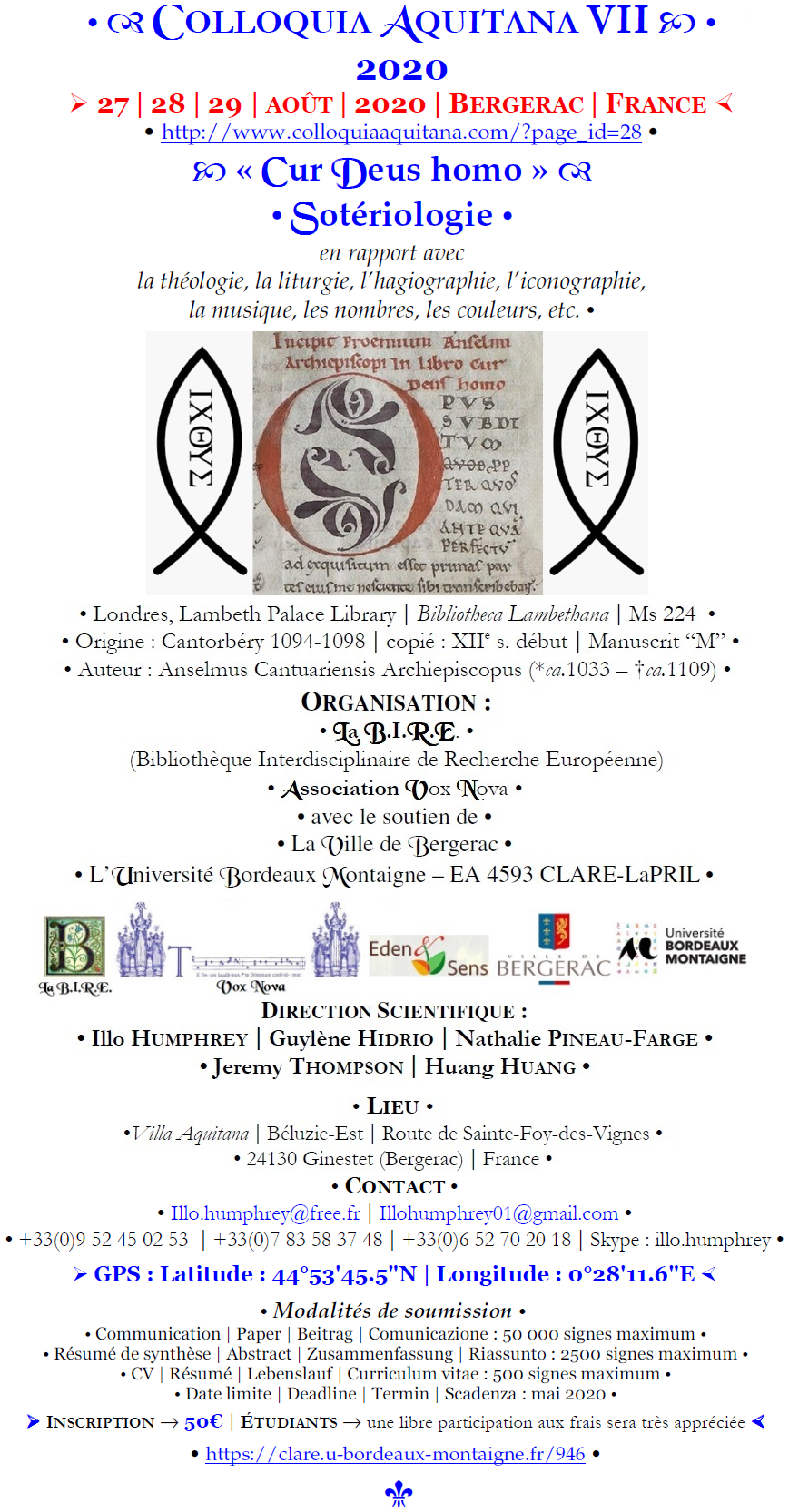
________________________________________________________________________________
Avec option :Vidéoconférence via Zoom
________________________________________________________________________________
• Programme.Colloquia-Aquitana-VII-2020.Cur-Deus-homo.Sotériologie.27-28-29-VIII-2020 •
• Colloquia-Aquitana-VII.27-28-29-VIII-2020.Cur-Deus-homo.Sotérilologie.1-VII-2020.Français •
• Colloquia Aquitana VII.27-28-29-VIII-2020.Cur-Deus-homo.Sotériologie.31-VII-2020.English •
• Colloquia-Aquitana-VII.27-28-29-VIII-2020.Cur-Deus-homo.Soterilologie.1-VII-2020.Deutsch •
• https://u-bordeaux3.academia.edu/IlloHumphrey/Colloquia-Aquitana •
• https://clare.u-bordeaux-montaigne.fr/946 •
• https://www.facebook.com/illo.humphrey •
• https://calenda.org/753806 •
•
Colloquia Aquitana VII: 27-28-29-VIII-2020
(The Colloquia Aquitana VII-2020 will begin en Zoom 27-VIII-2020 at 3 p. m. Paris time)
« Cur Deus homo »
• Soteriologie •
in relationship to
Theology, Liturgy, Hagiography, Iconography, Music, Numbers, Colours, etc.
• https://www.facebook.com/illo.humphrey •
• http://www.colloquiaaquitana.com/?page_id=28 • https://clare.u-bordeaux-montaigne.fr/946 •
• The Event: The Colloquia Aquitana VII – 2020, entitled « Cur Deus homo »: Soteriology, in relationship to Theology, Philosophy, Liturgy, Hagiography, Iconography, Music, Numbers, Colours, etc., will be held in south-western on the 27th, 28th, 29th of August each day as of 3 p. m. (Paris time), in the lovely mediæval city of Bergerac, situated in the Département of the Dordogne-Périgord. The colloquium is organized by the Bibliothèque Interdisciplinaire de Recherche Européenne (La B.I.R.E.) and by the Association Vox Nova under the patronage of the city of Bergerac and with the support of the University Bordeaux Montaigne: EA 4593 CLARE-LaPRIL •
• The Direction: The Colloquia Aquitana VII – 2020 are organised under the collegial direction of Illo Humphrey, Mediævalist | Musicologist | Proto-Philologist (Université Bordeaux Montaigne: EA 4593 CLARE-Laboratoire LaPRIL), Guylène Hidrio, Mediævalist | Art Historian (Université Lille 3: IRHiS- CNRS), Nathalie Pineau-Farge, Mediævalist | Art Historian (Institut Catholique de Paris), Jeremy Thompson, Mediævalist | Historian | Latinist (Friedrich-Alexander Universität Erlangen-Nürnberg), Huang Huang, Musicologist | Historian: Antiquity & the Middle Ages (University of London – SOAS) •
• The Invitation: We cordially invite pluri-disciplinary affiliated and non-affiliated researchers, scholars, teachers, graduate and undergraduate students alike, to participate in this 7th edition of the Colloquia Aquitana, which will take place in the beautiful Aquitanian Region of France during the first weekend of August 2020.
• Call for Papers: • Colloquia-Aquitana-VII-2020.Cur-Deus-homo.Sotérilologie.27-28-29-VIII.Appel-à-communications.30.VIII-2020 • • Registration Form: • Colloquia-Aquitana-VII-2020.Cur-Deus-homo.Sotérilologie.27-28-29-VIII.Bulletin-d’inscription.30-VIII-2020 • • Registration Fee: 50€ • • Students: A free-will contribution will be greatly appreciated • _____________________________
• Nota bene (1) | Soteriology: « Cur Deus homo », which means literally: « Why did God become Man ? », is the title of a treatise on the Christian doctrine of Salvation-Redemption-Expiation, doctrine which is called « Soteriology » in theological jargon. The treatise Cur Deus homo was written at the end of the 11th century between 1094 and 1098 by Saint Anselm, Archbishop of Canterbury (*Aosta, Italy, ca.1033 – †Canterbury, England, ca.1109). This small but important theological treatise, divided into two short books (Cur Deus homo in duos libellos), is the principal mediæval text on the Christian doctrine of Salvation. Saint Anselm of Canterbury wrote the treatise in the traditional dialogue form used in wisdom literature – that is to say, the treatise « Cur Deus homo » is a simple conversation on the Christian doctrine of Salvation, between Saint Anselm himself and one of his contemporary disciples, named Boso •
• Nota bene (2) | Etymology: The term « Soteriology » is derived from several Greek words, namely: (1) ἡ Σωτηρία, τῆς Σωτηρίας | Latin: salus, salutis | satisfactio, satisfactionis, which mean: salvation, redemption, deliverance, liberation, satisfaction [expiation]; (2) τὸ Σωτήριον, τοῦ Σωτήριου | Latin: salus, salutis, which means: the power of salvation, liberation, deliverance, healing; (3) ὁ σωτήρ, τοῦ σωτῆρος | Latin: salvator, salvatoris | redemptor, redemptoris, liberator, liberatoris, which mean: saviour, redeemer, liberator. Soteriology is therefore the Christian doctrine of the original sin, the redemption, and the salvation of humanity and the human habitat, both flora and fauna. The definition of this doctrine is essentially based on 2 New Testament biblical texts, namely: Acts of the Apostles IV, 11, 12, and the Epistle to the Ephesians II, 8, 9, 10 •
• Nota bene (3) | • Ι • Χ • θ • Ύ • Σ • | ὁ ἰχθύς: One of the principal symbols of the Christian doctrine of Soteriology is crystallized in the christogram-acronym-acrostic • Ι • Χ • θ • Ύ • Σ • of the Greek word « ὁ ἰχθύς, τοῦ ἰχθύος », which means fish. This christogram-acronym-acrostic is at the origin of the well-known Greek expression dating from the 2nd century CE: « Ἰησοῦς Χριστὸς• Θεοῦ Υἱὸς• Σωτήρ » | Latin: « Iesus Christus• Dei Filius• Salvator » (Jesus Christ, Son of God, Saviour) •
• © Illo Humphrey, PhD-HDR | scripsi et subscripsi | 1-I-2021 • • Université Bordeaux Montaigne | EA 4593 CLARE-LaPRIL •
•
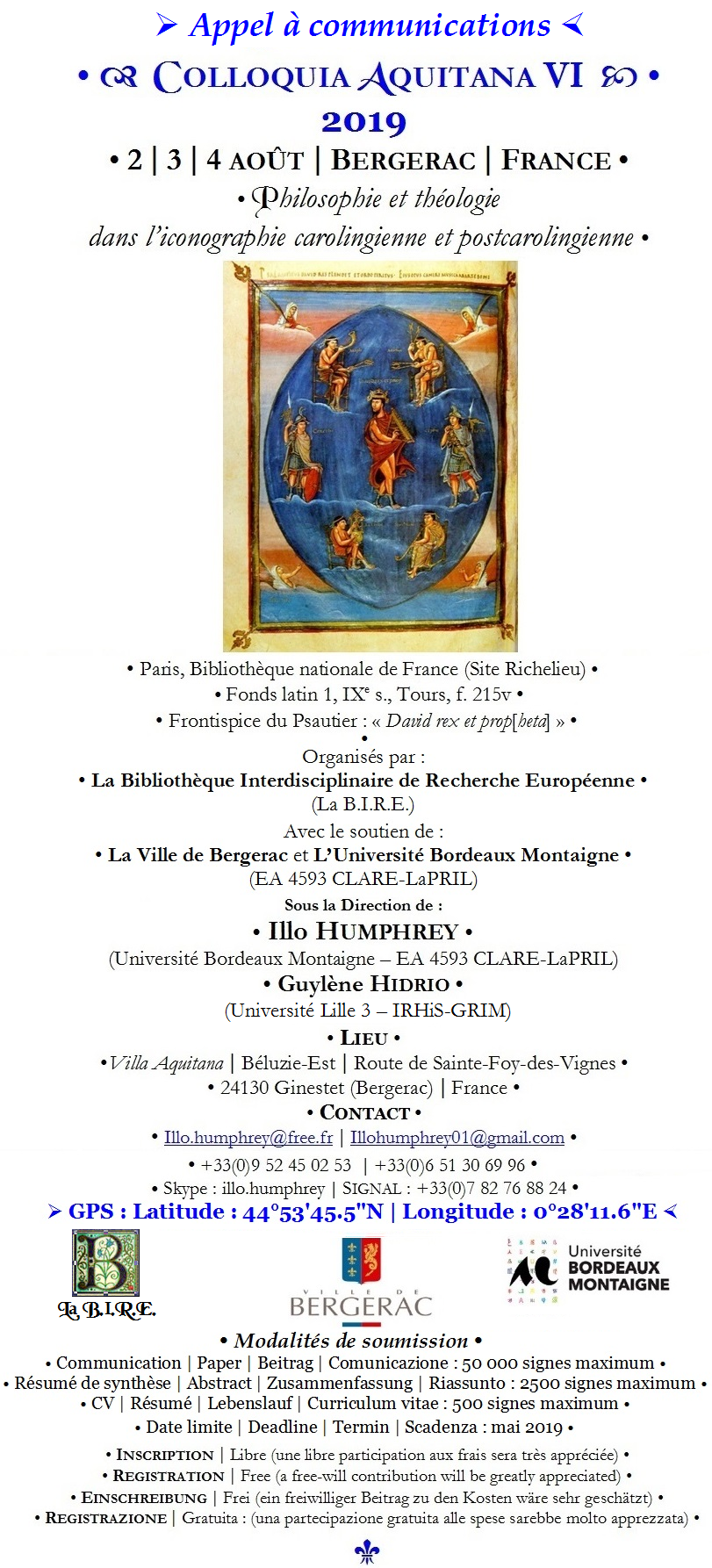
• Colloquia-Aquitana-VI-2019.2-3-4-Août.Annonce.Appel-à-communications.Call-for-Papers.31-I-2019 •
• Colloquia-Aquitana-VI-2019.2-3-4-Août.Bulletin-d’inscription.31-I-2019 •
• https://clare.u-bordeaux-montaigne.fr/818 •
• https://calenda.org/552318 •
•
• Colloquia Aquitana VI : 2 | 3 | 4 – VIII – 2019 | Bergerac, France •
•
Comité scientifique | Scientific Planning Committee :
• Illo Humphrey (Université Bordeaux Montaigne : EA 4593 CLARE-LaPRIL) •
• Guylène Hidrio (Université Lille 3 : IRHiS-GRIM-CNRS | UMR 8529) •
• Nathalie Pineau-Farge | Médiéviste-Historienne d’art (Institut Catholique de Paris) •
• Jeremy Thompson | Médiéviste-Historien (Friedrich-Alexander Universität Erlangen-Nürnberg) •
• Patrick Huang | Médiéviste-Musicologue (University of London – SOAS) • •
•
• Programme.Colloquia-Aquitana-VI.2-3-4-août-2019.22-VII-2019 •
•
• Philosophie et théologie dans l’iconographie carolingienne et postcarolingienne •
• Philosophy and Theology in Carolingian and Post-Carolingian Iconography •
• Philosophie und Theologie in der karolingischen und nach-karolingischen Ikonographie •
• Filosofia e teologia nell’iconografia carolingia e post-carolingia •
•
• https://www.colloquiaaquitana.com/?page_id=28 •
• https://www.colloquiaaquitana.com/?page_id=4 •
• https://u-bordeaux3.academia.edu/IlloHumphrey/Colloquia-Aquitana-VI-2019-Carolingian-Iconography •
• https://www.facebook.com/illo.humphrey •
•
• À propos des Colloquia Aquitana VI : 2, 3, 4 – VIII – 2019 | Bergerac, France •
• Les Colloquia Aquitana VI – 2019, intitulés Philosophie et théologie dans l’iconographie carolingienne et postcarolingienne, se tiendront les 2 | 3 | 4 août dans le sud-ouest de la France à Bergerac, dans le département de la Dordogne-Périgord. La rencontre est organisée par La B.I.R.E. (Bibliothèque Interdisciplinaire de Recherche Européenne), et par l’Association Vox Nova sous le haut patronage de la Ville de Bergerac et avec le soutien de l’Université Bordeaux Montaigne : EA 4593 CLARE-Laboratoire LaPRIL.
• Direction : Illo Humphrey, Médiéviste | Musicologue | Proto-Philologue (Université Bordeaux Montaigne : EA 4593 CLARE-Laboratoire LaPRIL), et Guylène Hidrio, Médiéviste | Historienne d’art (Université Lille 3 : IRHiS-CNRS-GRIM | UMR 8529).
• La B.I.R.E. et l’association Vox Nova (Associations culturelles pour la sauvegarde du patrimoine matériel et immatériel européen), poursuivant des recherches cette année sur l’iconographie médiévale et s’inspirant des initiatives du Département des manuscrits de la Bibliothèque nationale de France en partenariat avec le GRIM et l’INHA (https://manuscripta.hypotheses.org/), et celles du Research Group of Manuscript Evidence (http://manuscriptevidence.org/wpme/), invitent des chercheurs pluridisciplinaires à participer à la sixième édition des Colloquia Aquitana : « Colloquia Aquitana VI-2019 ».
• L’objectif premier de cette rencontre est d’approfondir l’étude de l’iconographie carolingienne et postcarolingienne à travers l’art de l’enluminure principalement, mais également des autres supports (sculpture, architecture…), suivant une approche à la fois philosophique et théologique, sans ignorer cependant les aspects archéologiques et les questions méthodologiques.
• Son objectif second est de mettre en avant la pertinence, la modernité et la pluridisciplinarité du champ d’étude de l’iconographie médiévale, avec comme perspective de questionner tout à la fois l’éventuelle « multiculturalité » de la période envisagée et ce qui peut relever de son évolution vers une possible « unité culturelle européenne ».
• Enfin, son troisième objectif est d’encourager la nouvelle génération de chercheurs du XXIe siècle venant d’horizons différents, notamment : médiévistes, historiens de l’art, philosophes, théologiens, liturgistes, musicologues, paléographes, proto-philologues, littéraires, médecins, chimistes, artisans, artistes, spécialistes des sept arts libéraux, etc., à continuer à collaborer étroitement, dans le but de démontrer conjointement la richesse et la complexité des études en iconographie médiévale et plus spécifiquement en art de l’enluminure.
•
• About the Colloquia Aquitana VI : 2nd, 3rd, 4th – VIII – 2019 | Bergerac, France •
• The Colloquia Aquitana VI – 2019, entitled Philosophy and Theology in Carolingian and Post-Carolingian Iconography, will be held in south-western France on the 2nd, 3rd, and 4th of August in the city of Bergerac, which is situated in the Département of the Dordogne-Périgord. The event is organized by the Bibliothèque Interdisciplinaire de Recherche Européenne (La B.I.R.E.) and by the Association Vox Nova under the patronage of the city of Bergerac and with the support of the University Bordeaux Montaigne: EA 4593 CLARE-Laboratoire LaPRIL.
• Direction: Illo Humphrey, Mediævalist | Musicologist | Proto-Philologist (Université Bordeaux Montaigne : EA 4593 CLARE – Laboratoire LaPRIL), and Guylène Hidrio, Mediævalist | Art Historian (Université Lille 3: IRHiS-CNRS-GRIM | UMR 8529).
• The Bibliothèque Interdisciplinaire de Recherche Européenne (La B.I.R.E.) and Association Vox Nova (non-profit organizations for the protection of the tangible and intangible European cultural heritage), centering research this year on mediæval iconography, and following the examples of recent initiatives of the Manuscript Department of the Bibliothèque nationale de France in partnership with the GRIM and the l’INHA (https://manuscripta.hypotheses.org/), and those of the Research Group of Manuscript Evidence (http://manuscriptevidence.org/wpme/), invite pluri-disciplinary researchers and scholars to participate in the 6th edition of the Colloquia Aquitana: Colloquia Aquitana VI-2019.
• The prime objective this year is to delve deeper into the study of Carolingian and Post-Carolingian iconography, mainly through the art of manuscript illumination from the twofold perspective of philosophy and theology, including of course aspects of archaeology and methodology.
• Its second objective is to highlight the pluri-disciplinary aspects of mediæval iconography, and to show that it is indeed still pertinent in modern society, reflecting both its “multicultural characteristics” and its evolution towards a future “European unity of culture”.
• Finally, the third objective is to encourage the new generation of scholars and researchers of the 21st century, coming from different horizons, namely: mediævalists, historians, art historians, philosophers, theologians, liturgists, musicologists, palæographers, proto-philologists, writers, poets, medical doctors, chemists, artisans, artists, and specialists of the sevenfold canon of the liberal arts, etc., to continue to collaborate closely with each other, in order to better explore conjointly all the cognate studies, and all the fascinating complexities of mediæval iconography in general, and mediæval manuscript illumination, in particular.
•
• Über die Colloquia Aquitana VI : 2. 3. 4. – August – 2019 | Bergerac, Frankreich •
• Die Colloquia Aquitana VI – 2019, deren Titel Philosophie und Theologie in der karolingischen und nach-karolingischen Ikonographie ist, werden am 2. 3. u. 4. August in Südwest-Frankreich in der Stadt Bergerac stattfinden. Diese wissenschaftliche Begegnung wird von den Vereinen La B.I.R.E. und Vox Nova organisiert, unter der Schirmherrschaft der Stadt Bergerac, und mit der Unterstützung der Universität Bordeaux Montaigne : Forschungsteam EA 4593 CLARE – Laboratoire LaPRIL.
• Wissenschaftliche Leitung : Illo Humphrey, Mediävist | Musikwissenschaftler | Proto-Philologe (Université Bordeaux Montaigne : EA 4593 CLARE – Laboratoire LaPRIL), und Guylène Hidrio, Mediävistin | Kunstkistorikerin (Université Lille 3 : IRHiS-CNRS-GRIM | UMR 8529).
• Die Vereine La B.I.R.E. und Vox Nova (Veriene für den Schutz des tastbaren und untastbaren europäischen Kulturerbes), in Folge der Initiativen der Handschriftsabteilung der Pariser Nationalbibliothek in Partnerschaft mit dem GRIM und dem INHA (https://manuscripta.hypotheses.org/), und des Research Group of Manuscript Evidence (http://manuscriptevidence.org/wpme/), laden pluridisziplinäre Forscher ein, um an den 6. Colloquia Aquitana teilzunehmen, bzw. Colloquia Aquitana VI-2019.
• Das erste Ziel dieser Konferenz ist die Forschung der karolingischen und nach-karolingischen Ikonographie hauptsächlich durch Buchmalerei-Kunst, aber auch durch Bildhauerkunst und Architektur, zu vertiefern, und zwar gleichzeitig von einer philosophischen und theologischen Perspektive, mit Betrachtungen auch auf archäologische und methodologische Fragen.
• Das zweite Ziel der Colloquia Aquitana VI ist die Relevanz, die Modernität und die Pluridisziplinarität des Bereichs der mittelalterlichen Ikonographie in den Vordergrund zu stellen, ebenso wie die Perspektive einer eventuellen „Multikulturalität“ der karolingischen u. nach-karolingischen Periode, und einer möglichen Entwicklung hin zu einer zukünftigen „europäischen Kultureinheit“ deutlich herauszustellen.
• Zum Schluß, das dritte Ziel der Colloquia Aquitana VI besteht darin, die neue Generation von Forschern des 21. Jahrhunderts, die aus unterschiedlichen Disziplinen kommen, bzw.: Mediävisten u. Mediävistinnen, Historiker u. Historikerinnen, Kunsthistoriker u. Kunsthistorikerinnen, Philosophen u. Philosophinnen, Theologer u. Theologinnen, Spezialisten u. Spezialistinnen der Liturgie, Musikwissenschaftler u. Musikwissenschaftlerinnen, Paläographer u. Paläographinnen, Proto-Philologer u. Proto-Philologinnen, Schriftsteller u. Schriftstellerinnen, Dichter u. Dichterinnen, Ärzte u. Ärztinnen, Chemiker u. Chemikerinnen, Handwerker u. Handwerkerinnen, Künstler u. Künstlerinnen, sowie Spezialisten u. Spezialistinnen des Kanons der Sieben Freien Künste, usw., zu ermutigen, damit sie ständig Hand in Hand arbeiten, um gemeinsam alle verwandte Bereiche und alle faszinierende Komplexitäten der mittelalterliche Ikonographie, im allgemeinen, und die karolingische u. nach-karolingische Buchmalerei-Kunst, insbesondere, noch besser erforschen zu können.
•
• Thèmes principaux | Thèmes annexes •
• Main Topics | Sub-topics • Hauptthemen | Unterthemen • Temi principali | Sottotemi •
• Histoire des idées religieuses • Philosophie • Boèce • Exégèse • Théologie • Liturgie • Musicologie • Organologie (l’étude des instruments de musique), e.g. : Instrumentarium de Chartres | etc.) • Art médiéval • Art carolingien • Art post-carolingien • Architecture • Sculpture • Mosaïque • Iconographie • Exégèse visuelle • Rapport texte-image • Les 7 Arts libéraux : Quadruvium [sic] (ars arithmetica• ars musica• ars geometrica• ars astronomica) | Trivium (ars grammatica• ars dialectica uel logica• ars rhetorica) • Manuscrits • Enluminure • Tradition manuscrite • Supports et instruments d’écriture et de peinture • Scriptoria carolingiens et postcarolingiens •
•
• Modalités de soumission •
(Submission Procedures | Beitragseinreichung | Modalità di presentazione)
• Communication | Paper | Beitrag | Comunicazione : 50 000 signes maximum •
• Résumé de synthèse | Abstract | Zusammenfassung | Riassunto : 2500 signes maximum •
• CV | Résumé | Lebenslauf | Curriculum vitae : 500 signes maximum •
• Date limite | Deadline | Termin | Scadenza : mai 2019 •
•
• Inscription | Registration | Einschreibung | Registrazione •
• Inscription | Libre (une libre participation aux frais sera très appréciée) •
• Registration | Free (a free-will contribution will be greatly appreciated) •
• Einschreibung | Frei (ein freiwilliger Beitrag zu den Kosten wäre sehr geschätzt) •
• Registrazione | Gratuita : (una partecipazione gratuita alle spese sarebbe molto apprezzata) •
• Colloquia-Aquitana-VI-2019.2-4-Août.Bulletin-d’inscription.20-I-2019 •
•
• Lieu •
• Villa Aquitana | Béluzie-Est | Route de Sainte-Foy-des-Vignes | 24130 Ginestet (Bergerac) | France •
• GPS : Latitude : 44°53’45.5″N | Longitude : 0°28’11.6″E •
• Contact •
• Illo.humphrey@free.fr | Illohumphrey01@gmail.com •
• +33(0)9 52 45 02 53 | +33(0)6 51 30 69 96 | Skype : illo.humphrey •
•
• https://calenda.org/552318 •
• https://u-bordeaux3.academia.edu/IlloHumphrey •
• https://www.colloquiaaquitana.com/?page_id=28 • https://www.colloquiaaquitana.com/?page_id=4 •
• https://www.facebook.com/illo.humphrey •
•
• À propos de l’enluminure « David rex et prop[heta] » | Paris, BnF, Fonds latin 1 : f. 215v •
• L’image vedette des Colloquia Aquitana VI-2019 est la célèbre enluminure « David rex et prop[heta] »[1], qui constitue le frontispice du Psautier de la 1ère Bible in-folio de Charles II dit « le Chauve » [2], feuillet 215v. Il s’agit d’une des plus belles œuvres de la production iconographique de la non moins célèbre l’abbaye de Saint-Martin de Tours[3], et l’une des pages enluminées des plus magnifiques et complexes de toute la production iconographique médiévale. Cette enluminure, en effet, est représentative du haut niveau de culture, au sens large du terme, du réseau impérial des monastères et cathédrales carolingiens, appelé « ordo palatii »[4], puis elle est un exemple classique du syncrétisme philosophique, théologique, historique et scientifique présent dans l’iconographie carolingienne du IXe siècle[5]. Elle reflète, en particulier, l’enseignement des sept arts libéraux, l’enrichissement du fonds de la bibliothèque de l’abbaye Saint-Martin de Tours, et le développement artistique et artisanal de son scriptorium sous les abbatiats d’Alcuinus (796-804), Fridugisius (804-834), Adalhardus (834-844), Vivianus (845-851), Hilduinus (851-860), etc.[6] Ainsi, dès la fin du VIIIe siècle, l’abbaye Saint-Martin de Tours est devenue un véritable « réceptacle » de la tradition du savoir philosophique, théologique, religieuse, liturgique, scientifique, technologique, intellectuelle et artistique en Europe occidentale. Elle devint aussi un haut lieu de production de manuscrits enluminés[7], puis un centre d’études supérieures de premier plan, où les sept arts libéraux (Quadruvium [sic] : ars arithmetica• ars musica• ars geometrica• ars astronomica• | Trivium : ars grammatica• ars dialectica uel logica• ars rhetorica•) furent enseignés et pratiqués assidument.
• L’enrichissement temporel et intellectuel de Saint-Martin de Tours, analogue à l’enrichissement des autres grands centres intellectuels de l’ordo palatii, est le résultat direct d’un siècle de « renovatio » ou « correctio » culturelle, désignée par l’historien français Jean-Jacques Ampère (1800-1864) « la renaissance carolingienne », laquelle fut instaurée par Pippinus « Brevis » III (Pépin dit « le Bref », *Jupille-sur-Meuse [?], auj. Liège, Belgique, ca. 714 – †Saint-Denis-en-France, 768), puis portée à son apogée sous l’impulsion de Karolus « Magnus » (Charlemagne, *[?], ca. 747 – †Aix-la-Chapelle, 814) avec le concours de son remarquable ministre d’éducation, Alcuinus Euboricensis (Alcuin d’York), qui fut abbé laïc de Saint-Martin de Tours, nous l’avons dit, de 796 jusqu’à sa mort en 804[8].
[1] Isabelle Marchesin, L’Image organum. La représentation de la musique dans les psautiers médiévaux 800 – 1200, Turnhout (Brepols), 2000, p. : 14, 19, 21, 25-26, 54, 63, 83, 11-112, 123-124, 131, Illust. : D • 12 • 12* : https://inha-fr.academia.edu/IsabelleMarchesin ; Illo Humphrey, « La philosophie de l’image dans la pratique iconographique carolingienne (quelques observations sur la pratique iconographique en Neustrie au IXe siècle) : l’exemple du scriptorium de Saint-Martin de Tours entre 830 et 851 », Colloquia Aquitana II – 2006 Boèce ([Boethius], Rome, ca. 480 – Pavie, ca. 524), l’homme, le philosophe, le scientifique, son œuvre et son rayonnement, 2 Vol., I. Humphrey (éd.), Paris (Éditions Le Manuscrit), 2009, Vol. 1, ch. 3, p. 279-313 : https://u-bordeaux3.academia.edu/IlloHumphrey.
[2] https://archivesetmanuscrits.bnf.fr/ark:/12148/cc8447n ; Wilhelm Köhler, Die karolingischen Miniaturen, t. I : Die Schule von Tours. 2 : Die Bilder, p. 13, 27, 102, Tafelband, I (3), Nr. 72 ; Florentine Mütherich, « Les manuscrits enluminés en Neustrie », La Neustrie. Les pays au nord de la Loire de 650 à 850, éd. Hartmut Atsma, t. I, Sigmaringen (Thorbecke), 1989, t. II, p. 329, 331 ; Eric Palazzo, « L’enluminure à Metz du Haut Moyen Age », Metz enluminé, Metz, 1989, p. 29, Planche C ; Marie-Thérèse Gousset (inédit) : « Analyse géométrique de la miniature pleine page « David rex et prop[heta] » conservée dans Paris, BnF, latin 1, f. 215v », Paris, BnF, 23 mars 2002, 3 pages, 2 Planches ; P. E. Dutton, H. L. Kessler, The Poetry and Paintings of the First Bible of Charles the Bald, Ann Arbor (University of Michigan Press, c1997), 1998 ; Mildred Budny, “Assembly Marks in the Vivian Bible and Scribal, Editorial, and Organizational Marks in Medieval “, Making the Medieval Book: Techniques of Production. Proceedings of the Fourth Conference of the Seminar in the History of the Book to 1500, Linda L. Brownrigg (éd.), Los Altos Hills, California (Anderson-Lovelace), 1995, p. 200-205.
[3] L’abbaye de Saint-Martin de Tours est un monastère d’obédience bénédictine fondée au Ve siècle en mémoire de saint Martin (*Pannonie, [Hongrie], 316, †397 à Candes-Saint-Martin | 37500, Indre-et-Loire, Arrondissement Chinon). Saint-Martin de Tours est devenu entre le Ve et le VIIIe siècle un immense domaine agricole et foncier doté de richesses, de privilèges et de pouvoir temporel par les souverains mérovingiens et carolingiens, atteignant son apogée au IXe siècle avant les invasions normandes en 853 ; cf. Hélène Noizet, « Le centre canonial de Saint-Martin de Tours et ses domaines périphériques en Val de Loire (IXe-Xe siècle) », dans Annales de Bretagne et des Pays de l’Ouest, Presses Universitaires de Rennes, 2002, 109 (2), p.14-37 : https://halshs.archives-ouvertes.fr/halshs-00088015, 2006.
[4] Jean Heuclin, « Les abbés des monastères neustriens 650-850 », La Neustrie…, éd. H. Atsma, t. I, 1988, p. 331, 334, 335, cf. p. 337, carte géographique : ‘L’Ordo Palatii’ en Neustrie. ; C. Torchet, Histoire de l’Abbaye royale de Notre-Dame de Chelles, Paris, 1889.
[5] Illo Humphrey, « La philosophie de l’image… », Colloquia Aquitana II – 2006, p. 294-295.
[6] Pierre Gasnault : « Les actes privés de l’abbaye de Saint-Martin de Tours du VIIIe au XIIe siècle », Bibliothèque de l’école des chartes, 1954, tome 112, p. 24-66 ; « Le tombeau de saint Martin et les invasions normandes dans l’histoire et dans la légende », Revue d’histoire de l’Église de France, tome 47, n°144, 1961. p. 51-66 ; Félix Peeters, « Le « scriptorium » de Tours d’après un ouvrage récent », Revue belge de philologie et d’histoire, t. 11, fasc. 1-2, 1932. p. 479-500.
[7] E. K. Rand, A Survey of the Manuscripts of Tours, 1929 ; Bernhard Bischoff, Paléographie de l’Antiquité romaine et du moyen âge occidental. Traduction française : H. Atsma et J. Vezin, Paris (Picard), 1985, p. 49, 229 ; F. Mütherich, « Les manuscrits enluminés en Neustrie », La Neustrie…, 1988, t. II, p. 329, 331.
[8] Pierre Riché, Les Carolingiens. Une famille qui fit l’Europe, Paris, Hachette, coll. « Pluriel », 1983 | 1997, p. 354 ; Illo Humphrey, Boethius. His Influence on the European Unity of Culture: from Alcuin of York (†804) to Thierry of Chartres (†1154), Nordhausen, Allemagne (Traugott Bautz Verlag), 2010 | 2e édition 2012, chapitre 1 : « Boethius and Alcuin of York », p. 49-59.
~•~
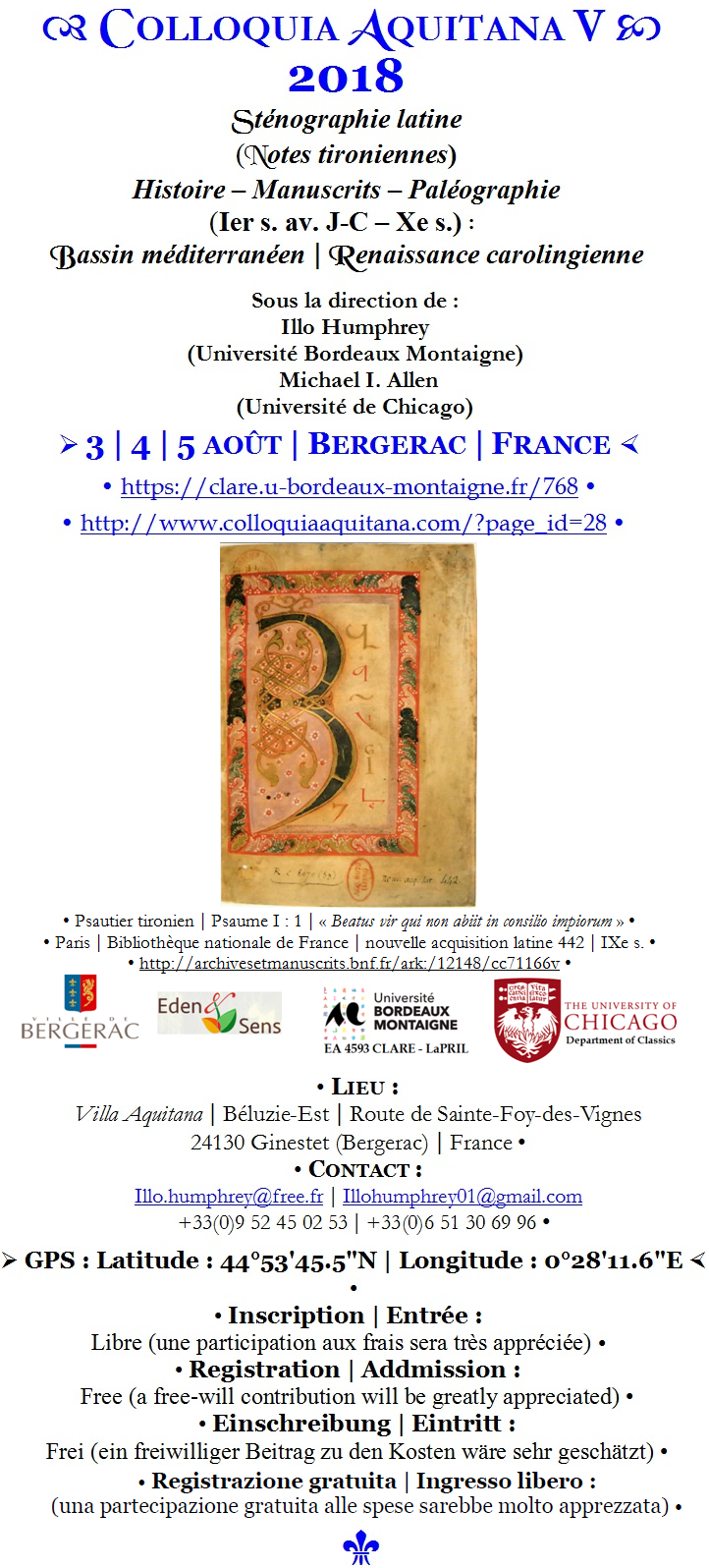
• https://clare.u-bordeaux-montaigne.fr/768 • https://www.facebook.com/illo.humphrey •
• https://u-bordeaux3.academia.edu/IlloHumphrey/Colloquia-Aquitana-V-2018-:-Latin-Stenography •
•
• Année C 2021 •
• Anno Domini C bis millesimo vicesimo primo •
• Littera dominicalis C | Numerus aureus 8 | Epactæ XVI | Indictio XIV •
• (Lettre dominicale C • Nombre d’or 8 • Épactes XVI • Indiction 14) •
• (Dominical Letter C • Golden Number 8 • Epactes XVI • Indiction 14) •
• (Sonntagsbuchstabe C • Goldene Zahl 8 • Epakten XVI • Indiktion 14) •
• (Lettera domenicale C • Numero aureo 8 • Epatta XVI • Indizione 14) •
~ • ~
• Illo Humphrey, PhD-HDR •
• Mediævalist | Musicologist | Proto-Philologist | 2021 •
•
• Associate Researcher | EA 4593 CLARE – LaPRIL | Université Bordeaux-Montaigne | 33607 Pessac| France •
• Fellow | Board Member | ICONEA | University of London – Institute of Musical Research | UK •
• http://www.iconea.org/?cat=23 • http://www.iconea.org/?p=444 •
• Fellow | Member | Université Populaire Méroë-Africa | Paris (France) •
• http://www.universitepopulairemeroeafrica.org/Illo-Humphrey •
• Director-Founder of La Bibliothèque Interdisciplinaire de Recherche Européenne •
• Director-Founder of the Colloquia Aquitana •
• Director-Founder of the Association Vox Nova •
•
• https://u-bordeaux3.academia.edu/IlloHumphrey •
• https://u-bordeaux3.academia.edu/IlloHumphrey/Academic-Biography-2018 •
• https://www.researchgate.net/profile/Illo_Humphrey •
• http://orcid.org/0000-0002-1130-0397 •
•
• Affiliations •
• Member of the Tombouctou Manuscripts Project •
• Member of the Mamma Haïdara Memorial Library in Timbuktu •
• Member of Academia.edu •
• Member of Webponder.com •
• Member of the International Boethius Society •
• Member of the Medieval Academy of America •
• Member of Musicologie Médiévale •
• Member of APEMUTAM •
• Member of the Amis Du Parchemin et du Cuir •
• Member of the ASDAL •
• Membre du CNFHPS •
• Member of the ACEOC •
• Member of the SACEM •
• Member of the SACD •
•
~ • ~
•
Actualités :
• Bibliographie | Bibliography | Fachliteratur | Bibliografia •
•
~ • ~
•
• PROGRAMME •
•
• Colloquia Aquitana V – 3 | 4 | 5 août 2018 •
•
• Colloquia Aquitana V – 3rd | 4th | 5th August 2018 •
•
• Colloquia Aquitana V – 3. | 4. | 5. August 2018 •
•
• https://u-bordeaux3.academia.edu/IlloHumphrey/Colloquia-Aquitana-V-2018-:-Latin-Stenography •
• http://www.colloquiaaquitana.com/?page_id=28 •
• https://www.facebook.com/illo.humphrey •
• https://clare.u-bordeaux-montaigne.fr/768 •
•
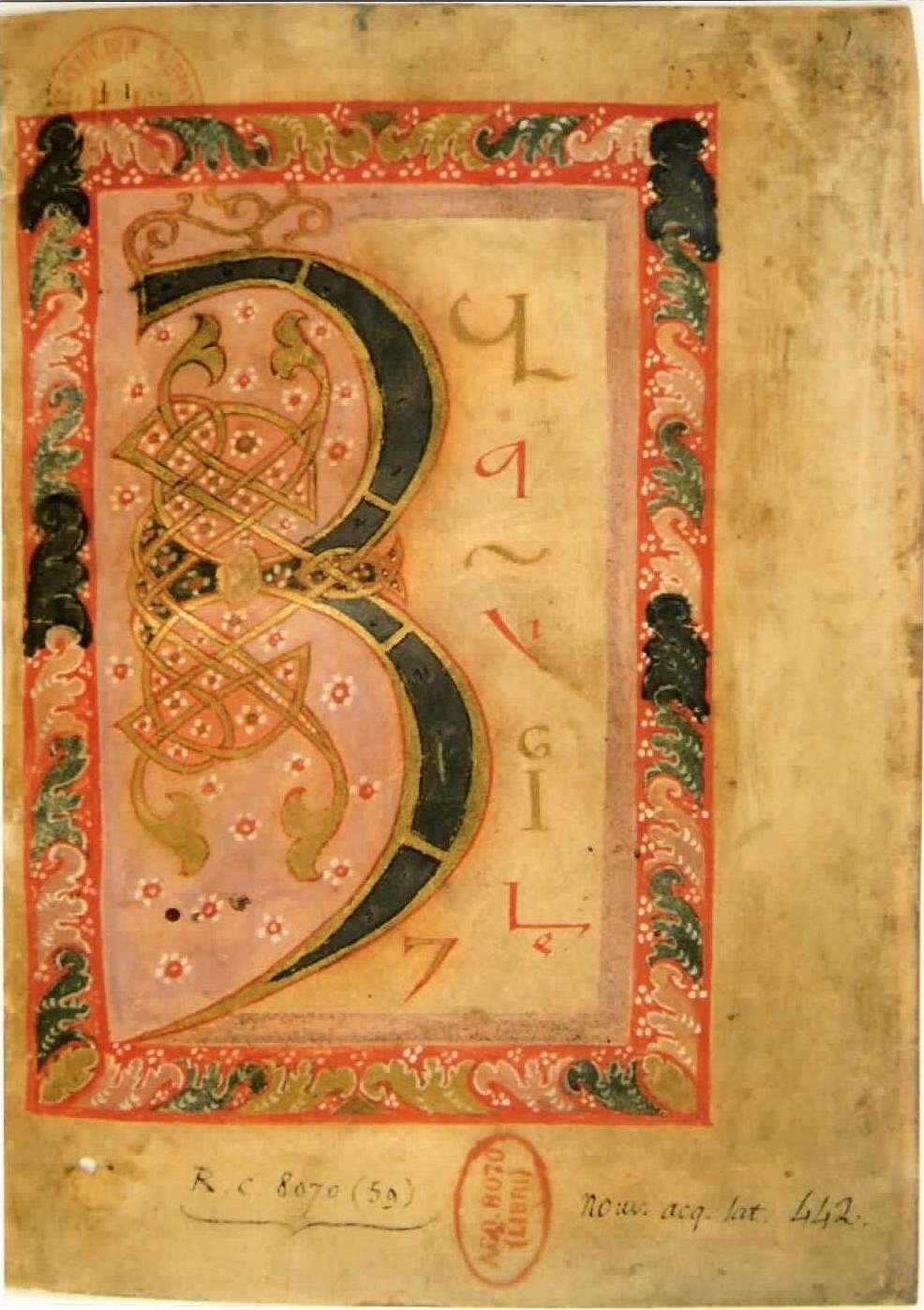
• Psaume I, 1 : « Bea-tus vir qui non abi-it in-consilio impi-orum » •
• Paris, Bibliothèque nationale de France, n. a. l. 442 | Tours [?] | IXe s. | f. 1r° | Ps. I : 1 •
• Psautier « gallican » complet avec ses 16 Cantica | écrit en sténographie latine •
• (Parmi les 8 psautiers tironiens connus, BnF, n.a.l. 442 est le seul qui soit complet •
• Divisions liturgiques : néant •
• http://archivesetmanuscrits.bnf.fr/ark:/12148/cc71166v •
•
• Sténographie latine (Notes tironiennes) :
histoire et évolution – manuscrits – paléographie.
Bassin méditerranéen | Renaissance carolingienne.
Ier siècle avant J-C – Xe siècle •
•
• Latin Stenography (Tironian Notes) :
History & Development | Manuscripts | Palaeography.
Mediterranean Basin | Carolingian Renaissance,
1st century BCE – 10th century •
•
• Lateinische Stenographie (Tironische Noten) :
Geschichte u. Entwicklung | Handschriften | Paläographie.
Mittelmeerraum | Karolingische Renaissance,
1. Jahrhundert vor Christus – 10. Jahrhundert •
•
• Tachigrafia latina (Note tironiane) :
storia ed evoluzione – manuscritti – paleografia.
Bacino mediterraneo | Rinascimento carolingio.
Primo secolo a. C. – Decimo secolo •
•
Under the direction of:
Illo Humphrey
(Université Bordeaux Montaigne – EA 4593 CLARE-LaPRIL)
• https://u-bordeaux3.academia.edu/IlloHumphrey •
&
Michael I. Allen
(University of Chicago – Department of Classics)
• https://chicago.academia.edu/MichaelAllen • https://classics.uchicago.edu/faculty/allen •
•
Under the Auspices of the City of:
• Bergerac •
• (Dordogne-Périgord Pourpre | Nouvelle Aquitaine | France) •

In collaboration with the following local non-profit cultural associations:
• L’Atelier de Reliure de Bergerac •
• Les Collectionneurs Bergeracois •
• Les Amis de l’Église de Monbos •
• Les Amis de la Chapelle de Tresséroux •
• Éden-&-Sens •
•
• Place: Villa Aquitana | Béluzie-Est | Route de Sainte-Foy-des-Vignes | 24130 Ginestet | France •
• Contact: Illo.humphrey@free.fr | Illohumphrey01@gmail.com | Skype : illo.humphrey •
• +33(0)9 52 45 02 53 | +33(0)6 51 30 69 96 •
•
• GPS : Latitude : 44°53’45.5″N | Longitude : 0°28’11.6″E •
•
• PROGRAMME | PROGRAM | PROGRAMM | PROGRAMMA •
•
• VENDREDI (Friday | Freitag | Venerdì) 3 août 2018 (matin) : (1) Accueil et Présentations | 9h – 10h : Villa Aquitana • (2) 10h 30 : Visite | Atelier de Reliure (Collectionneurs Bergeracois | 14, rue Saint-Jâmes | Bergerac) : http://collectionneurs-bergeracois.fr/n…/atelier-de-reliure/ • • VENDREDI (Friday | Freitag | Venerdì) 3 août 2018 : Pause déjeuner | 12h 30 • _____________________ • VENDREDI (Friday | Freitag | Venerdì) 3 août 2018 (après-midi) | 1ère Session | 14h 30 – 16h 30 : Villa Aquitana • • Président : Michael Idomir Allen (Professeur de lettres classiques | Université de Chicago) • (3) Illo Humphrey, (Chercheur associé | Université Bordeaux Montaigne) : La Sténographie latine : « Notarius – Exceptor – Librarius – Scriba – Puer – Amanuensis –Secretarius. Observations sur l’ancien métier de scribe-secrétaire en rapport avec la sténographie latine » •
• Courte pause •
(4) Martin Hellmann (Dietrich-Bonhoeffer-Gymnasium | Wertheim am Main | Allemagne) : « Wild Flowers in the Garden of Calligraphy. Tironian Notes in Early Middle Ages Manuscripts » • (5) 17h : Soirée | Éden-&-Sens (http://eden-et-sens.com/) | Repas | Producteurs biologiques • _______________________ • SAMEDI (Saturday | Samstag | Sabato) 4 août 2018 (matin) | 2e Session | 10h – 12h : Villa Aquitana • • Bienvenue : Mme. Denise Miguel (Conseillère municipale | Déléguée à la culture | Mairie de Bergerac) • • Président : Martin Hellmann • (6) Michael I. Allen | Brett Kirken (Université de Chicago) : « Autour des lettres de Loup de Ferrières : les notes tironiennes du manuscrit Bibliothèque nationale de France, Fonds latin 2858-I et leurs auteurs » •
• Courte pause •
(7) Illo Humphrey | Atelier : « Initiation à la sténographie latine : l’écriture des notes tironiennes » • • Courte pause • (8) Martin Hellmann | Atelier : « Reading Tironian Notes » • • SAMEDI (Saturday | Samstag | Sabato) 4 août 2018 : Pause déjeuner | 12h 15 – 14h • ________________________ • SAMEDI (Saturday | Samstag | Sabato) 4 août 2018 (après-midi) | 14h 30 : Villa Aquitana • (9) 15h : Visite | Chapelle de Tresséroux (« Prieuré des Trois Sœurs ») XIIe s. (24400 Les Lèches) | Classée Monument historique | Restauration à partir de 1998 : https://www.tresseroux.com/calendrier-des-estivales | http://www.richesheures.net/epoque-6-15/eglise/24tresseroux-general.htm •
Nota bene : Cf. Claude Pauvert, La Chapelle prieurale de Tresséroux, Mussidan (Presse de L’imprimerie mussidanaise), 21 décembre 2004, 50 pages, Préface, Prologue, Avant-Propos, Historique, Bibliographie (p. 45), 11 Illustratons : https://www.ebay.fr/itm/LES-LECHES-La-chapelle-prieurale-de-TRESSEROUX-Claude-PAUVERT-PERIGORD-/151351348209 •
(10) Mini-concert a cappella | Chant grégorien : Illo Humphrey, Baryton • _________________________
• DIMANCHE (Sunday | Sonntag | Domenico) 5 août 2018 (matin) | 9h 30 : Villa Aquitana • (11) 10h : Visite | Église Saint-Pierre de Monbos, XIIe s. (24240 Thénac) | Inscrite sur l’Inventaire supplémentaire des Monuments historiques le 16-V-1947 : http://www.petit-patrimoine.com/fiche-petit-patrimoine.php… •
Nota bene : Cf. Florence Vachia, « Les églises médiévales du canton de Sigoulès : Dordogne (Périgord) », dans Colloquia Aquitana I-2005. Études médiévales : patrimoine matériel et immatériel, éd. Illo Humphrey, Paris (Éditions Le Manuscrit), pages 153-211, voir pages 165-187 : https://u-bordeaux3.academia.edu/IlloHumphrey/Books •
(12) Mini-concert a cappella | Chant grégorien : Illo Humphrey, Baryton • • DIMANCHE (Sunday | Sonntag | Domenico) 5 août 2018 : Pause déjeuner | 12h 30 – 14h • __________________________
• DIMANCHE (Sunday | Sonntag | Domenico) 5 août 2018 (après-midi) | 3e Session | 14h 30 – 16h 30 : Villa Aquitana • • Présidente : Florence Vachia (Historienne d’art | Master 1 et Master 2 (D.E.A.) en Histoire de l’art : Université Bordeaux Montaigne | DRAC de la Nouvelle Aquitaine | Bordeaux) • (13) Illo Humphrey : « Le Psautier tironien conservé dans le codex Paris, Bibliothèque nationale de France, nouvelles acquisitions latines 442, IXe s., provenance : Saint-Martin de Tours » •
• Courte pause •
(14) Table ronde | Intervenants : Notes tironiennes : (a) Observations | (b) Questions | (c) Réponses • (15) Clôture des Colloquia Aquitana V-2018 | Collation (vers 17 h) •
• Illo.humphrey@free.fr | Illohumphrey01@gmail.com •
• http://www.colloquiaaquitana.com/?page_id=28 • https://u-bordeaux3.academia.edu/IlloHumphrey •
•
• Nota bene (1) : The Colloquia Aquitana V-2018 wish to stimulate a renewed interest in Latin stenography (commonly known as “tironien notes” since the beginning of the 17th century), and to encourage a new scientific, pedagogical, and proto-philological enthusiasm for scholarly research in this discipline, which will, hopefully, engender new studies, new symposia, and new publications on Latin stenography by a new generation of scholars and researchers, that is to say: specialists in Roman Antiquity, medievalists, palaeographers, grammarians, proto-philologists, historians, art historians, etc., both in Europe, and internationally •
• Nota bene (2) : The Colloquia Aquitana V | August 3rd | 4th | 5th | 2018 | Bergerac, France, is organized under the direction of Illo Humphrey (Université Bordeaux Montaigne | EA 4593 CLARE – Laboratory LaPRIL) and Michael Idomir Allen (University of Chicago | Classics Department), within the framework of La Bibliothèque Interdisciplinaire de Recherche Européenne (La B.I.R.E.)-Bergerac and l’Association Vox Nova-Bergerac, with the support of: the City of Bergerac | the University Bordeaux Montaigne (EA 4593 CLARE – Laboratoire LaPRIL) | the University of Chicago Department of Classics, and in local partnership with: (a) the Atelier de Reliure [Book Binding Workshop] of Bergerac (Collectionneurs Bergeracois), (b) Éden-&-Sens (Organic Botanical Park : 24130 Ginestet), (c) the Association of the Friends l’Église Saint-Pierre de Monbos: 12th century (24240 Thénac), (d) the Association of the Friends of the Chapelle de Tresséroux: 12th century (24400 Les Lèches) •
• Inscription | Entrée : Libre (une libre participation aux frais sera très appréciée) •
• Registration | Addmission : Free (a free-will contribution will be greatly appreciated) •
• Einschreibung | Eintritt : Frei (ein freiwilliger Beitrag zu den Kosten wäre sehr geschätzt) •
• Registrazione gratuita | Ingresso libero : (una partecipazione gratuita alle spese sarebbe molto apprezzata) •
• IH | ih | Explicit | 1-VII-2018 •
•
• Appel à communication | Call for Papers •
•
• Notes tironiennes •
(histoire – manuscrits – paléographie) :
• Bassin méditerranéen | Renaissance carolingienne •
• Psaume I, 1 : « Bea-tus vir qui non abi-it in-consilio impi-orum » •
• Paris, Bibliothèque nationale de France, nouvelle acquisition latine 442 | Tours ? | IXe s. | f. 1r° | Ps. I : 1 •
• Psautier « gallican » complet avec ses 16 Cantica | écrit en sténographie latine (notes tironiennes) •
• (Parmi les 8 psautiers tironiens connus, BnF, n.a.l. 442 est le seul qui soit complet •
• Divisions liturgiques : néant •
• http://archivesetmanuscrits.bnf.fr/ark:/12148/cc71166v •
•Anciens possesseurs | Anciennes cotes •
• Jean Bouhier de Savigny (*1673 – †1746) E 150 | Montpellier, Bibliothèque de la Faculté de Medecine H 449 •
• Guglielmo Brutus Icilius Timeleone Libri-Carucci dalla Sommaja (*1803 – †1869) 94 •
• Lord Bertram Ashburnham IV (*1797 – †1878) s.c. : http://www.arlima.net/mss/collections_particulieres/ashburnham/ •
• BnF, R. C. 8070(59) •
• Codicologie •
• Parchemin | 98 feuillets | 2 colonnes | 19 lignes | 12 quaterniones | 184 mm x 143 mm | Justification: 120 mm x 95 mm •
• Bibliothèque Interdisciplinaire de Recherche Européenne-Bergerac (La B.I.R.E.) •
• (http://www.colloquiaaquitana.com/?page_id=3) •
• Association Vox Nova (http://www.colloquiaaquitana.com/?page_id=6) •
• Sous le haut patronage de la Ville de Bergerac | 24100 | Dordogne-Périgord | France •
• Avec le soutien de l’Université Bordeaux Montaigne – UR PLURIELLES – Laboratoire LaPRIL •
• (https://plurielles.u-bordeaux-montaigne.fr) •
• Direction : Illo Humphrey, PhD-HDR | CNU-18 •
• Directeur-Fondateur des Colloquia Aquitana •
• https://u-bordeaux3.academia.edu/IlloHumphrey/Colloquia%20Aquitana •
•
• Mise à jour | Updated | Aktualiziert | Aggiornamento | 15-VII-2026 •
• (die mercurii• idibus iuliis• anno Domini D• bis millesimo vicesimo sexto) •
~ • ~